
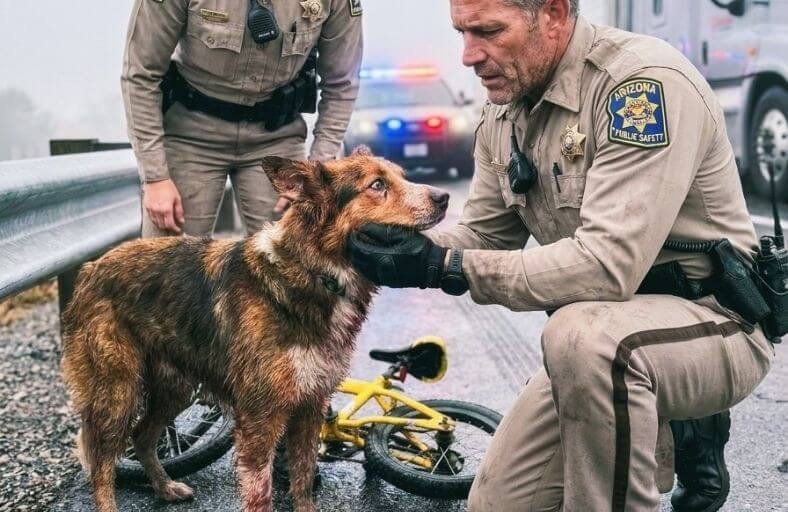
PART 1 – The Border Collie Who Ran Into Traffic on Highway 89
An eighteen-wheeler air horn blasted across Highway 89 at 6:12 on a freezing November morning, but the senior Border Collie refused to move from the northbound lane, and when I dropped to my knees beside him, I realized his bleeding body was hiding a crushed yellow bicycle from every approaching driver.
My name is Nathan Vance. I was forty-four years old then, a white American state trooper entering my sixteenth year with the Arizona Department of Public Safety when dispatch radioed us toward the northern outskirts of Flagstaff.
The first caller reported a stray dog darting wildly through morning commuter traffic.
The second caller shrieked that a semi-truck had swerved off the lane to avoid a child on the shoulder.
The third caller shouted that a broad-chested dog had hurled itself into the lane, knocked a little girl out of the truck’s blind spot, and was now taking the impact of oncoming speed.
I found them near Mile Marker 211 beneath the shadow of the San Francisco Peaks, where the highway stretches through open pine stands and wet frost turns dark pavement into ice.
A male Border Collie mix sat directly on the center yellow line, his broad chest showing a rust-colored crescent patch, his muzzle turned pure white, and his right shoulder soaked in dark blood.
His wet fur lifted with every draft from passing gravel trucks.
He should have bolted toward the timber.
He did not move an inch.
A double-trailer freight truck locked its brakes forty feet ahead of him. The mechanical scream rattled the guardrails, spraying dirty meltwater over his face, but the old dog only braced his front paws wider and pressed his back closer to the ground.
My headlights illuminated fresh scarlet trails along his left hind leg.
“Traffic control needed immediately,” I told dispatch, my voice tight against the cold. “Northbound lanes blocked at Mile 211. Shut this highway down before we lift another body off the frost.”
My partner and younger brother, Trooper Marcus Vance, a forty-one-year-old white American officer with a heavy frame and sharp eyes, angled his cruiser across both lanes to form a barricade. Blue and red strobes swept over the asphalt, reflecting off the dog’s eyes and the crushed metal frame behind him.
The dog turned his head toward us.
Then he looked past our boots toward the line of diesel rigs groaning to a stop behind our light bar.
Anyone who has worked around working dogs knows the look in their eyes when a task is unfinished. At six in the morning, with blood dripping onto icy pavement and white foam gathering around a sixty-pound dog’s jaw, the scene was horrifying.
Marcus stepped out holding a catch pole from the trunk.
“He could bite,” Marcus warned. “He’s in shock and bleeding heavy.”
The dog did not bare his teeth. He did not growl. He only sat with his front legs trembling from exhaustion, his dark brown eyes locked onto the line of cars.
I stepped past Marcus and lowered myself onto the wet road.
His left ear was notched at the tip. His right ear stood sharp and alert toward every idling engine.
One eye was swollen half-shut from an impact, and skin along his left flank had been scraped bare. His breath billowed in thick white clouds against the mountain air.
“Easy, boy,” I whispered, reaching into my pocket for my keys out of habit. “We’ve got the road locked down.”
The dog looked straight into my face for one silent second.
A coal truck engine brake groaned two hundred yards back.
The metal rumble echoed off the rock cut.
The Border Collie tried to stand.
His broken hind leg buckled under his weight, but he dragged his hips three inches to the left, repositioning his chest to completely block the gap where the child’s yellow helmet stuck out from the drainage ditch.
That exact movement made my chest tighten.
He had not tried to save himself when the lane cleared. He had moved to cover the precise angle where danger still sounded loud.
Marcus saw it too.
“He’s protecting the ditch.”
“No,” I said, my voice catching. “He’s shielding a person.”
I aimed my flashlight past his bleeding flank.
The beam passed the silver pedal, crossed a twisted chain, and rested on a bright yellow helmet lying in the tall frosted grass.
A small hand was clinging to the dog’s tail.
An eight-year-old girl lay curled in the weeds behind him. She wore a purple winter coat and gray thermal pants that blended seamlessly with the frozen dirt.
One arm was hooked around the dog’s lower leg, her small fingers buried deep in his muddy fur, but her body remained motionless.
The old dog stood like an iron wall between her small frame and three lanes of stopped steel.
I broke into a run.
He limped after me, placing his body between my boots and the child until I dropped onto the frost beside her and pressed two fingers beneath her jawline.
A pulse fluttered against my skin.
Rapid.
Frail.
Alive.
“Get the medics here right now,” I shouted to Marcus.
Marcus reached out to slip a slip-lead over the dog’s neck to pull him to safety. The Border Collie pulled his head back, stumbled twice on the slick asphalt, and sat right down on the child’s abandoned backpack.
He was bleeding from a gash across his shoulder. His left leg hung at an unnatural angle. One front paw was missing half its pad from skidding across gravel.
Still, he refused to lie down.
The ambulance arrived at 6:24. Paramedics set a neck collar on the girl, wrapped her in thermal blankets, and lifted her stretcher under the harsh floodlights. The Border Collie watched every single gloved hand that touched her coat.
When they loaded the stretcher into the back, he tried to climb the rear bumper.
His leg folded again.
This time, he did not get back up.
He lay flat on the center yellow line, his head raised toward the glass doors closing around the little girl he had shielded with his own skin.
We had cleared the highway in time.
What none of us knew was how long he had been standing in the freezing dark before our arrival, or what the State Trooper dashcam would reveal about the blizzard four years ago that connected this old dog to my own broken home.
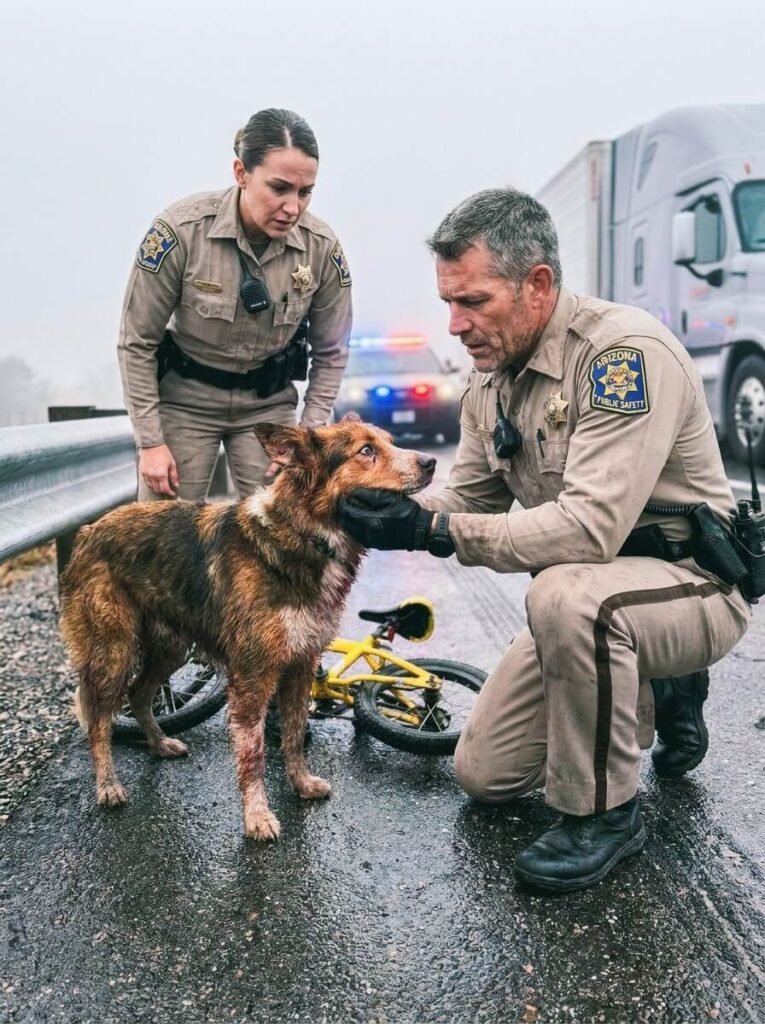
Part 2 – The Sound of Freight Brakes at Mile Marker 211
Four years before I found Copper on Highway 89, my life had ended on a stretch of Route 66 six miles east of Williams.
My wife, Sarah, had been thirty-eight then, a school librarian with quiet eyes and a habit of leaving handwritten notes in my patrol jacket pocket.
On a Tuesday night in December, a sudden mountain blizzard dropped eight inches of black ice onto the asphalt within an hour. A jackknifed tanker swept three vehicles off the shoulder into an eighty-foot ravine.
Sarah’s car was the last one down.
I was on duty that night. I heard the call come over the radio, but by the time my cruiser reached the mile marker, the storm had swallowed the embankment. Search crews could not locate the wreckage in the dark.
For two hours, we stood in the freezing gale while my wife bled out in the snow below.
When rescue K9 units finally arrived from the county, a young handler released a Border Collie mix into the drift. That dog fought through waist-deep powder, ignored the roar of rescue saws, and found Sarah’s car jammed beneath an overturned pine.
Because of that dog, I was able to climb down into the canyon and hold my wife’s hand for her final ten minutes on this earth.
After Sarah died, I locked our house. I kept her coffee mug on the counter, her boots by the back door, and a small silver metal whistle she had given me for my patrol keys on my keyring.
I worked twelve-hour shifts, avoided quiet rooms, and told myself I was doing fine because my uniform stayed pressed and my patrol reports were filed on time.
The truth was simpler: I was an empty suit walking through a career.
When I knelt beside the bleeding dog on Highway 89 four years later, I had no idea that grief was about to sit up and demand an answer.
“Keep him still, Nate!” Marcus called out, rushing over with an emergency blanket from the trunk. “If he moves on that gash, he’ll bleed out before the transport arrives.”
I pulled my gloves off to get a better grip.
The cold air bit into my knuckles instantly. I reached beneath the dog’s chest to support his weight.
The dog did not flinch.
Instead, as my right hand moved near his muzzle, the silver metal whistle attached to my patrol keys jingled against my belt buckle.
The Border Collie’s ears locked forward.
His open eye widened.
He lifted his blood-stained nose, pressed it directly against my cold knuckles, and inhaled deeply. His tail, heavy with frozen mud and road slush, gave two slow, deliberate thumps against the asphalt.
Tap.
Tap.
It was not the cautious tail-wag of an abandoned dog being handled by a stranger.
It was the steady greeting of a dog who recognized a sound he had carried through years of dark weather.
“Marcus,” I said, my fingers freezing against his fur. “Look at his neck.”
Marcus leaned down under the strobes.
Beneath the thick collar of mud and dried blood, the dog was wearing an old, faded nylon collar. The lead ring was gone, snapped off by immense force, but a tarnished brass rivet remained stamped into the fabric.
There was no name tag.
No phone number.
Only a single stamped code: K9-408.
“That’s an official tracking designation,” Marcus whispered, his eyes widening. “He’s not a pet, Nate. He’s a retired working dog.”
The realization hit the cold air like exhaust fumes.
Retired K9s in Arizona do not roam the high country alone at six in the morning. They live with former handlers, stay inside fenced yards, and sleep on thick orthopedic cushions paid for by county pensions.
This dog was thin. His ribs showed under his dense winter coat like fence pickets. His paws were worn raw, and his coat carried the smell of pine sap, wet earth, and long miles walked in the dark.
“He traveled to get here,” I said, lifting his heavy head onto my lap. “He wasn’t lost. He was walking a route.”
The veterinary transport vehicle from Flagstaff Animal Emergency arrived seven minutes later. Dr. Aris Thorne, a fifty-two-year-old Greek-American veterinarian with silvering hair, wire-rimmed glasses, and hands that moved with clinical precision, stepped out onto the highway.
He took one look at the dog’s posture, the blood on the yellow bicycle, and the stopped semi-trucks.
“How long has he been on this leg?” Dr. Aris asked, dropping his medical case to the asphalt.
“At least twenty minutes before we got here,” I answered. “He took the impact from the truck’s side mirror to keep the child clear.”
Dr. Aris carefully ran his gloved fingers down the dog’s spine, moving past his shoulders to the left hind leg. The dog let out a sharp, shallow hitch in his breath but did not bare his teeth.
“Compound fracture of the tibia,” Dr. Aris diagnosed calmly. “Severe laceration on the right shoulder. Shock setting in. But his chest is clear and his pupil response is stable.”
He looked up at me, taking in my blood-soaked sleeves and the way I was holding the dog’s chest.
“You want to come in the rig, Trooper?”
“I’m driving the cruiser behind you,” I said, standing up on stiff knees. “He’s not dying in the back of a truck alone.”
Dr. Aris nodded once, sliding a stretcher beneath the dog’s frame.
As we lifted him, the Border Collie’s head turned toward my belt again. His nose reached for the silver whistle on my keys one last time before the transport doors closed.
I stood on the highway while Marcus directed the first line of freight trucks past the scene.
The little girl’s yellow bicycle lay bent in the ditch, its front reflector reflecting the blue strobes of my cruiser.
I picked up the bike, placed it in the back of my patrol car, and turned my siren on toward Flagstaff.
Part 3 – What the Scanner Read Beneath the Scar
The emergency clinic smelled of rubbing alcohol, iodine, copper blood, and wet fur.
Dr. Aris worked under six overhead surgical lights while I stood in the corner of the treatment room, my tan patrol uniform stained dark with mud and blood across the chest.
Marcus waited in the lobby, updating dispatch and checking on the little girl, Chloe Miller, who had been taken to Flagstaff Medical Center with a mild concussion and a fractured wrist.
Chloe’s father, a local carpenter, had already called the station weeping. He said Chloe had snuck out at dawn to ride her new bike before school, slipping onto the highway shoulder when a sudden gust of wind blew her off balance.
She remembered only a loud horn, a flash of red fur, and a heavy body knocking her into the grass before the world went black.
“Hold his head steady, Nate,” Dr. Aris requested, preparing a local anesthetic. “I need to clean this shoulder wound before we take him to x-ray.”
I placed both hands gently around the dog’s muzzle.
His fur was soft beneath the crust of mud. The rust-colored crescent patch on his chest was bright white around the edges, showing his age.
Every time my fingers brushed his ears, his body relaxed slightly, as if my touch offered a familiar anchor against the pain.
“He’s roughly nine years old,” Dr. Aris observed, using a scalpel to trim away matted fur around the shoulder gash. “Look at these scars on his pads. This dog has worked rough terrain for years. Rocks, ice, heavy timber.”
“He’s got a K9 rivet on his collar,” I told him. “Code K9-408.”
Dr. Aris paused, his gloved hand hovering over the wound.
“K9-408?” He turned toward a digital scanner on the metal counter. “Let me run a microchip reader over his neck. State working dogs carry encrypted chips under the left shoulder blade.”
He picked up the white plastic wand and passed it over the dog’s neck.
Nothing.
He passed it lower, near the ribcage.
A sharp electronic beep echoed off the tiled walls.
A string of ten digits flashed across the screen: 847-009-408.
Dr. Aris entered the code into the National Working Dog Registry database. The screen loading wheel spun for three long seconds while the old dog breathed heavily against my chest.
Then a profile loaded onto the monitor.
Registered Name: K9 Tracker
Copper Breed: Border Collie / Australian Shepherd Mix
Assignment: Coconino County Search and Rescue (Retired)
Handler: Sheriff David Ross (Retired)
Status: Retired on Medical Pension (Four Years Prior)
Notable Service Record: 142 Successful Searches. Lead K9 in the 2022 Route 66 Ravine Recovery.
The breath left my lungs all at once.
The room seemed to shrink until the only sound was the steady hum of the heart monitor.
“Nate?” Dr. Aris looked at me over his glasses. “You alright?”
I couldn’t answer.
My hand reached down to touch the silver metal whistle hanging from my patrol keys.
Four years ago.
The night the tanker went off the road on Route 66. The night the search crews stood frozen in the blizzard while my wife lay dying in the dark.
It was not a random search team that had found Sarah’s car.
It had been an old Sheriff named David Ross, and a young, broad-chested Border Collie mix with a rust-colored crescent on his chest.
Copper was the dog who had scrambled down eighty feet of frozen granite, located Sarah beneath the pine branches, and barked until I could hear his voice over the mountain wind.
He had sat beside her car in the snow while I held her hand. He had licked her frozen fingers while I said my final goodbyes.
And when they hauled us both up the canyon wall that night, his handler, Sheriff Ross, had blown a silver metal whistle to call Copper back to the transport rig.
The whistle on my keys was not just Sarah’s.
It was the exact same model of training whistle Sheriff Ross had used for ten years to command K9-408 in the high country.
Copper had not just run into traffic to save a random child on Highway 89.
He had heard my patrol car idle at the intersection two miles back. He had recognized the metallic chime of the whistle against my belt.
And when he saw a child in danger on the asphalt, the old K9 had executed the final command he was born to perform.
“He remembered,” I whispered, my voice thick with emotion.
Dr. Aris looked from the monitor to the dog’s quiet eyes.
“Remembered what, Nate?”
“He found my wife four years ago,” I said, tears finally breaking past my composure. “He’s the reason I got to say goodbye.”
Copper shifted his head on the table, reached out his dark nose, and nudged my hand once more.
Part 4 – The Retired Sheriff With the Blue Folder
By eight in the morning, the news of the Highway 89 rescue had reached the regional news outlets, but inside the private recovery room at Flagstaff Animal Emergency, the world was entirely quiet.
Copper’s left leg was wrapped in a blue fiberglass cast. His shoulder had been stitched, his wounds dressed, and an IV drip ran steadily into his front leg.
He lay on a thick memory-foam bed in the corner, his muzzle resting on my patrol jacket, which I had laid out for him on the floor.
The door opened slowly.
A sixty-year-old white American man stepped into the room. He walked with a heavy limp, using an oak cane, wearing a faded wool jacket, a gray Stetson hat, and carrying a thick blue paper folder under his arm.
His hair was silver, his face lined by decades of high-altitude wind, and his blue eyes were rimmed with red.
Sheriff David Ross.
He stopped at the threshold, his cane resting against the doorframe, his gaze locked onto the Border Collie lying on the floor.
Copper’s tail gave a single, heavy thump against the blanket.
“You stubborn old fool,” David Ross rasped, his voice cracking as he lowered himself onto one knee with great difficulty. “You slipped the gate latch while I was hauling firewood, didn’t you?”
Copper reached out and licked the old Sheriff’s calloused thumb.
David buried his face in Copper’s neck fur for a long, silent minute, his broad shoulders shaking.
I stood up from my chair by the window.
“Sheriff Ross,” I said softly.
David wiped his eyes with the back of his sleeve, standing up slowly with the help of his cane. He looked at my uniform, my name tag, and then at the silver whistle hanging from my keys on the side table.
His eyes widened slightly.
“Trooper Vance,” David said, his voice steadying. “I recognized your name on the police dispatch log. I didn’t believe it until I saw your cruiser outside.”
“He saved an eight-year-old girl today, David,” I told him. “Threw himself between her bike and a semi-truck at Mile 211.”
David let out a long, heavy breath, shaking his head as he looked down at the dog.
“That’s Copper,” David said, opening the blue folder he carried. “He doesn’t know how to turn it off. When the vest came off four years ago, I thought he’d settle down on my porch in Parks. But a working dog doesn’t retire in his head, Trooper. He just waits for the call.”
He pulled a sheet of official county paperwork from the folder and handed it to me.
It was a medical discharge report dated December 22, four years prior—just two days after the blizzard on Route 66.
“Look at the date,” David said.
I looked.
“That was his last official search,” David explained quietly. “The night we pulled your wife out of the canyon. Copper tore his shoulder ligaments scrambling up the frozen rock to lead you down. The department retired him on full medical coverage the following week.”
I stared at the paper, the black ink blurring before my eyes.
“He got hurt finding Sarah?” I asked.
“He never complained,” David replied, touching Copper’s notched ear gently. “He spent three weeks limping around my house, staring out the front window toward the highway. Every time a state patrol siren went off in the distance, he’d stand at the door and whine.”
David turned to face me directly, his eyes clear and intense.
“He didn’t escape my yard this morning to run wild, Nate. Chloe Miller rides her bike past my fence in Parks every morning at 5:45 on her way to her uncle’s farm.
Copper has been walking the tree line along her route for three months, watching her from the pines.”
“He was escorting her,” I realized aloud.
“He saw the truck coming around the blind curve before the driver did,” David said. “He did what he was trained to do for nine years. He took the hit so the civilian wouldn’t.”
The silence in the room was absolute.
Copper let out a long, contented sigh, his chin settling deeper onto my patrol jacket.
David looked at me, then down at his own crippled knee, and finally at the dog’s blue leg cast.
“I’m seventy years old, Nate,” David said softly. “My joints are shot, my house is steep, and I can’t give him the active care he needs with this cast. He needs someone who can take him to the flat trails, someone who understands what he carries in his heart.”
David pulled a set of brass dog tags from his pocket and set them on the table beside my patrol keys.
“He picked you four years ago in that canyon,” David said. “And he picked you again on Highway 89 this morning. It’s time he went home with his handler.”
Part 5 – The Rules of an Old K9’s Heart
Bringing Copper home to my house outside Flagstaff was not like adopting a pet.
It was like welcoming an old soldier into a quiet home that had been frozen in time for four years.
The first week was defined by small, precise routines. Copper could not climb the front porch steps with his leg cast, so Marcus and I built a wide wooden ramp over the weekend.
We covered it with heavy rubber matting so his front paws wouldn’t slip on the mountain frost.
The first night Copper entered my living room, he did not sniff the furniture or look for food.
He walked slowly, his cast clicking against the hardwood floor, straight to the corner near the fireplace where Sarah’s armchair sat.
He stopped.
He pressed his white muzzle against the fabric of her favorite fleece blanket, which still lay draped over the back.
Then he turned around three times, settled his broad body onto the rug beside the chair, and laid his head directly on my boots.
I sat down on the floor beside him in the dark.
For four years, that room had felt like a tomb. It was a space where I returned every evening only to eat standing up at the counter, turn off the lights early, and wait for the alarm to wake me for another shift.
With Copper lying beside me, his breathing heavy and steady, the room felt different.
It felt like a place where survival was no longer a punishment.
“You’re home, boy,” I told him, running my fingers through his thick fur.
His tail tapped the rug twice.
Dr. Aris visited every Tuesday evening to check the shoulder stitches and evaluate the leg cast. He brought a box of soft chicken treats and sat on the floor with us, taking off his medical jacket and drinking coffee while Copper rested his head in his lap.
“He’s healing remarkably well for a nine-year-old,” Dr. Aris noted during the third week. “His heart is strong, his blood work is clean, and the bone alignment looks solid. But he needs a purpose, Nate. Working breeds don’t do well with empty hours.”
“He has one,” I said.
Every morning at 7:00, when my shift started, I brought Copper out to the driveway.
He couldn’t ride in the cruiser yet, but he would stand at the top of the ramp, his ears sharp, watching my patrol car idle in the cold air. I would kneel down, show him the silver metal whistle on my keys, and give him his daily instruction.
“Watch the house, Copper. Hold the line.”
He would let out one soft, deep bark, bark once more toward the tree line, and then slowly retreat inside to lie by Sarah’s chair until Marcus brought him his lunch at noon.
The community did not forget what happened at Mile 211.
Chloe Miller’s family visited during the second week. Chloe walked up the ramp carrying a drawing she had made in school: a large black-and-rust dog wearing a gold cape, standing in front of a yellow bicycle under a bright yellow sun.
She knelt beside Copper on the rug, her small arms wrapping around his broad neck.
“Thank you for being fast,” she whispered into his fur.
Copper closed his eyes, leaning his heavy head against her shoulder with the absolute gentleness that only old working dogs possess around children.
Chloe’s father stood by the door, tears filling his eyes as he shook my hand.
“We didn’t know how to thank you, Trooper,” he said. “Or how to thank him.”
“You don’t have to,” I told him. “He was doing his job. We’re just keeping him company while he finishes it.”
That night, for the first time in four years, I washed Sarah’s coffee mug from the counter, set it carefully inside the glass cabinet, and made a full dinner for myself at the kitchen table.
Copper sat right beside my chair, his blue cast resting comfortably on the floor, watching every bite with quiet, dignified interest.
The house was no longer silent.
It was holding its breath, waiting for the spring thaw.
Part 6 – The Snow on Route 66
By late March, the heavy winter snows began to melt off the lower slopes of the San Francisco Peaks, leaving dark earth and bright green shoots along the highway shoulders.
Dr. Aris removed Copper’s blue cast on a bright Tuesday afternoon.
The leg was thinner than the right, the muscle slightly atrophyed from six weeks of immobilization, but the bone had fused clean and strong.
Copper stood on the stainless steel table, shook his whole body until his ears flopped, and took three firm, steady steps across the clinic floor without a limp.
“He’s cleared for light duty,” Dr. Aris announced with a wide smile, handing me a bottle of joint supplements. “No forty-foot leaps into drainage ditches, but daily walks on flat ground are mandatory.”
“Understood, Doctor,” I replied.
That Sunday, I loaded Copper into the specially padded back seat of my personal pickup truck.
We drove west out of Flagstaff, past the timber yards, past the high country meadows, down the winding two-lane stretch toward Route 66 near Williams.
The sky was pale blue, the air crisp and clean, smelling of melting snow and ponderosa pine.
I parked the truck on the wide dirt shoulder near the canyon overlook at Mile Marker 184, the exact spot where the jackknifed tanker had gone off the road four years ago.
The old guardrail had been replaced with shiny galvanized steel. The young pine trees along the rim had grown six feet taller, hiding the sharp granite drop-down into the canyon floor.
I opened the truck door.
Copper stepped out carefully, his nose instantly lifting into the mountain breeze.
He walked to the edge of the overlook, his tail held level, his white-muzzled face turned toward the deep timber below.
I walked beside him, hands in my jacket pockets, my fingers resting on the silver metal whistle on my keyring.
Four years ago, this place was a nightmare of whiteout conditions, screaming sirens, red flares burning against black ice, and the suffocating realization that I was losing the person I loved most in the world.
Standing there in the spring sunlight beside the dog who had gone into that darkness for me, the memory didn’t hurt in the same way.
The pain hadn’t disappeared, but it had found a frame to rest in.
Copper looked up at me.
His brown eyes were clear, bright, and completely peaceful.
He didn’t see a tragedy when he looked at the canyon. He saw a mission completed, a promise kept, and a line held until the very end.
I knelt beside him in the dry grass, wrapped my arm around his neck, and pressed my forehead against his shoulder.
“Thank you, Copper,” I whispered into the mountain wind. “Thank you for finding her. And thank you for coming back for me.”
Copper gave one short, soft whine, turned his head, and licked my cheek with broad, warm affection.
We stayed on that rim for an hour, watching the red-tailed hawks circle over the pines, two old survivors who had finally walked out of the blizzard together.
Part 7 – Facing the Patrol Cruiser
Four years after the morning at Mile Marker 211, a new ritual exists at the Arizona Department of Public Safety substation in Flagstaff.
Every morning at 6:30, a black-and-gold Highway Patrol cruiser pulls into the rear parking lot near the fleet maintenance bay.
The driver’s door opens, and Sergeant Nathan Vance steps out, wearing his crisp uniform, his silver whistle gleaming on his key ring, his face weathered but calm.
From the passenger side, a thirteen-year-old Border Collie mix steps down using a custom padded folding ramp. His muzzle is entirely white now, his step is slightly slower, and a rust-colored crescent patch on his chest shines like a badge in the high-country morning sun.
He wears a red canvas vest embroidered with two words in bold gold thread: HONORARY K9.
Copper does not chase suspects. He does not search for contraband.
His job is different.
He sits on his orthopedic bed in the main dispatch room, his head resting near the supervisor’s console. When young troopers return from hard calls on the highway—from bad crashes, winter rollovers, or long nights in the cold—they don’t go to the breakroom first.
They sit down on the floor beside Copper.
They bury their hands in his thick fur.
And the old dog leans his broad body against their knees, offering the silent, unbreakable comfort of a creature who has faced the worst weather the mountains can offer and never backed down.
Chloe Miller is seventeen now. She stops by the station every Friday afternoon after school, bringing a bag of dried liver treats and showing Copper her latest report cards. She’s studying to be a veterinary technician at Northern Arizona University.
She still keeps her yellow bicycle helmet on a shelf in her room.
Sheriff David Ross passed away peacefully two winters ago at the age of seventy-two. At his memorial service in Parks, twenty State Patrol cruisers lined the rural driveway, their lights flashing silently against the snow.
Copper stood beside me at the front of the gathering, his head held high, his ears alert, as the bugle played Taps across the timber.
He didn’t whine.
He knew his handler was at peace.
Sometimes, new officers ask me why I bring a thirteen-year-old retired K9 to a police station every single day.
I always give them the same answer.
People say dogs don’t understand the past. They say animals live only in the current minute, forgetting what came before. But anyone who has ever seen an old working dog stand against three lanes of freight traffic to shield a child knows better.
A true working dog never forgets a life it was trained to protect, even when the vest comes off and the body grows old.
Copper saved Sarah’s memory in that canyon four years ago.
He saved Chloe Miller on Highway 89.
And every single day when I look down at him sleeping beside my desk, I remember that no matter how dark the storm gets, no matter how cold the road becomes, there is always a way back home if you have someone willing to hold the line with you.
If this story touched your heart, follow this page for more unforgettable dog stories about rescue, loyalty, second chances, and the quiet heroes who prove that true devotion never retires.