
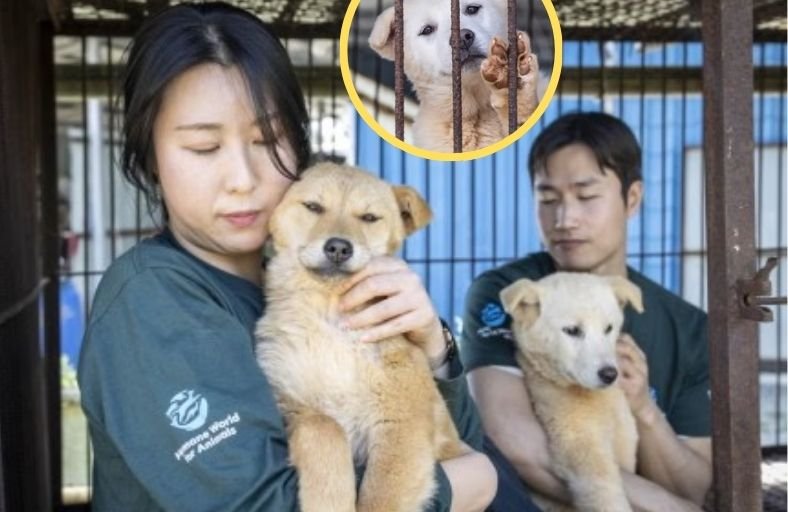
South Korea is closer than ever to becoming the first country in the world to fully end its dog meat industry, and the numbers show it’s happening faster than anyone expected.
The country’s nationwide ban on breeding, slaughtering, and selling dogs for meat was passed in January 2024, giving farmers and restaurant owners a three year window to close their businesses or transition to other work.
When the ban takes full effect in February 2027, South Korea will officially close the chapter on being the only nation known to intensively farm dogs specifically for human consumption.
According to the country’s Ministry of Agriculture, the phaseout is already well ahead of schedule.
As of December 2025, 1,204 of the 1,537 registered dog meat farms had already shut down, a closure rate of 78 percent.
Officials point to growing public support, financial incentives for early closures, and encouragement from local governments as key reasons behind the accelerated pace.
Once the ban is fully enforced, anyone caught breeding, slaughtering, or selling dogs for meat will face up to three years in prison and fines of roughly 30 million won.
Behind the statistics are stories like DeeJay’s. Musician Annie Ko will never forget the night she brought her rescued Labrador home in 2015, watching him immediately curl up beside her as if he already knew he was finally safe.
For the first three months of his life, DeeJay had known nothing but a cramped cage on a dog meat farm in Wonju, alongside six siblings, before he was rescued.
He remains the only puppy from that litter still living in South Korea today.
Ko had never owned a pet before meeting DeeJay, but seeing him trembling as the runt of the litter was enough to change that.
At the time, she was interpreting for the nonprofit Humane World for Animals, an organization that has since helped rescue roughly 2,800 dogs from similar farms, sending many overseas for adoption in the US, UK, and Canada.
A recent report from Humane World for Animals also found that 86 percent of South Koreans now reject dog meat entirely, a striking shift reflecting a decade of advocacy, changing cultural values, and growing political will.
By February 2027, dogs like DeeJay won’t need rescuing at all, because farms like the one he came from simply won’t exist anymore.
Do you think other countries facing similar practices could follow South Korea’s example?
Source:
humaneworld – “South Korea ends the dog meat industry: A model for change”
straitstimes – “South Korea’s dog meat restaurants face their final dog days”