
Part 1
The thermometer on my patrol car read 108 degrees when I smashed the window of that sedan.
The dog inside never barked.
He just looked at me with eyes that could barely see anymore.
People like to think of cops as tough, unemotional, only good for writing tickets and slapping on cuffs.
I used to think that about myself too, until the day I knelt down in a scorching parking lot, held a stranger’s dog in my arms, and cried like he was family.
My name is Daniel Whitfield.
I was forty-one that year, a white American patrol officer in Fort Smith, Arkansas, six foot two, broad-shouldered, with short military-cut hair already going gray, and a long scar on my left forearm that I had never told anyone the full story behind.
Old partners called me “Whit.”
I used to be a K9 trainer with the department, until two years earlier, when I asked to transfer to regular patrol and never set foot in the K9 kennels again.
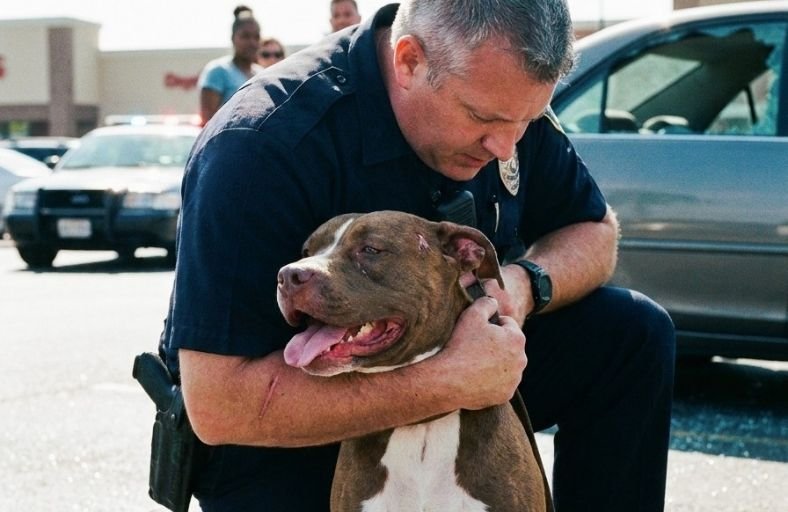
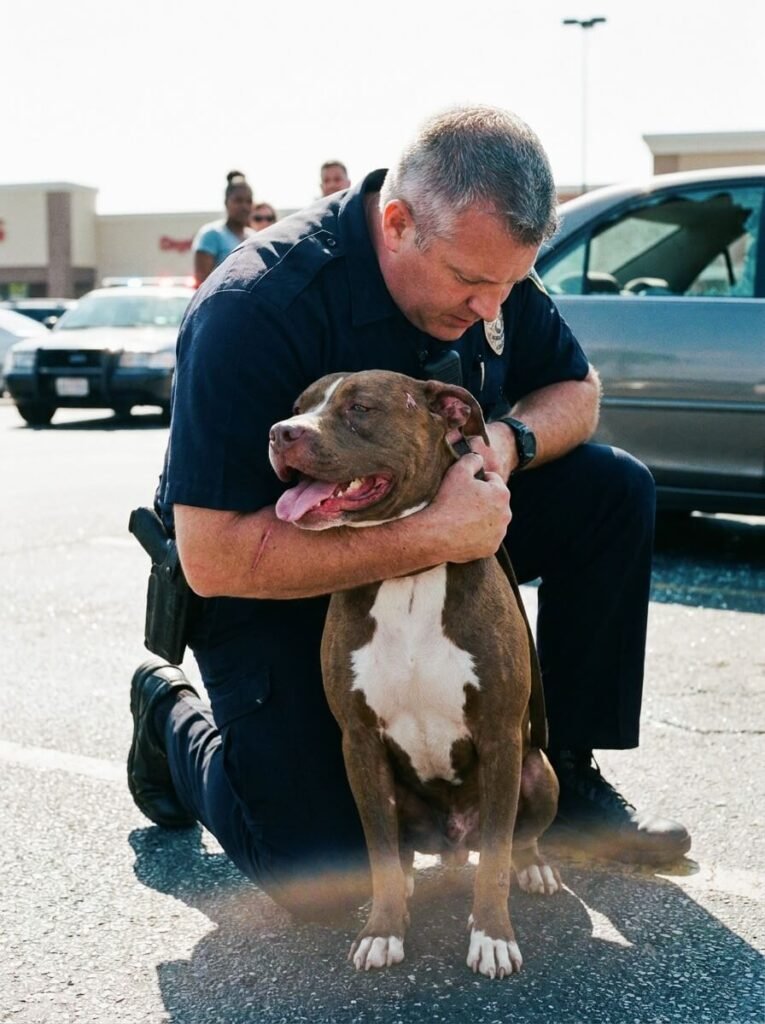
The dog I found that day was a Pit Bull mix, about six years old, brown and white, with a striking white V-shaped patch on his chest and an old scar on his right ear, the kind left by a chain pulled too tight for too long.
Neighbors nearby had taken to calling him “Tank.”
By the time I got the door open, his tongue had gone purple, lolling to one side, his whole body shaking in uncontrollable waves.
He no longer had the strength left to be afraid of me.
It started with a 911 call at 1:40 in the afternoon.
Loretta Simmons, fifty-four, a Black cashier at Redbud Market, was on her lunch break when she heard a weak scratching against a car window in the far corner of the lot, the one spot with no shade at all.
She was still shaking when I got there.
“I knocked on the glass. He just looked at me. He couldn’t even bark anymore, officer.”
The car was locked, windows sealed shut, not even a crack for air.
Inside a closed car under direct sun, temperatures can climb past 140 degrees in just a few dozen minutes, even when it’s “only” 108 outside.
Store security footage we pulled later showed the car had been sitting there for at least forty minutes.
I didn’t wait for a call back on the radio.
I pulled the window punch from my belt, broke the rear glass, unlocked the door from inside, and lifted the dog out of that rolling oven.
He was heavier than I expected, but limp as a wet sack of sand in my arms.
I laid him down in the only patch of shade near my cruiser, poured cool water, not ice water, I still remember that clearly, since sudden ice water can trigger thermal shock, over his belly and legs while calling for emergency vet response on the radio.
When my hand reached his neck to check his pulse, I felt a worn leather collar, and a small metal tag, one corner scorched as if it had once brushed against fire.
I didn’t get a good look at it then.
I only remember that something about this dog, the way he strained to lift his head and look at me even on the edge of collapse, tightened something in my chest I couldn’t explain, something that had nothing to do with the emergency in front of me.
The car’s owner, a man in his early thirties, came back to the lot more than fifteen minutes after I’d already called for backup, two bags of fast food in hand, his face going pale at the sight of the shattered window and the vet emergency van pulling in with its siren wailing.
He said he had “just bought the dog off a classified ad two weeks ago” and had “only run in for five minutes to grab lunch.”
The footage showed the real number was forty-two minutes.
I didn’t say much to him at the time.
I was too busy watching the dog’s eyes fade, watching him fight to hold onto consciousness with whatever strength he had left, and too busy sitting with a thought I wasn’t ready to say out loud yet: some strange sense that I had met this dog before, in another life, a life before everything fell apart.
The scorched tag on his collar, if I had read it carefully right then, could have given me the answer much sooner.
But I didn’t read it.
I just lifted him up, laid him across the back seat of my cruiser with the AC already blasting, and drove straight for the nearest emergency vet clinic, where Dr. Priya Anand was already waiting at the door.
Part 2 – The Whistle in My Pocket
Two years before that day in the parking lot, I was a different man.
I spent nine years as a K9 trainer with the Fort Smith Police Department, and my closest partner wasn’t a working dog at all.
He was flesh and blood: Marcus Bellweather.
Marcus Bellweather was thirty-seven when he died, a white American, tall, with a smile that could ease the tension out of even the tightest briefing room.
He’d served as a Marine before joining the force.
He and I rode as patrol partners for six years before I moved into K9 training full time.
He had one habit that stuck with everyone who knew him.
Whenever things got tense, he’d whistle the first four notes of an old folk song his grandmother used to sing, and joke that “dogs listen to music better than they listen to orders.”
At home, Marcus kept a Pit Bull mix named Duke.
Duke wasn’t a working dog, just a family pet, but Marcus trained him with a few basic K9-style commands for fun, including a posture called “at ease,” sitting up straight, tail sweeping gently, ears alert and waiting for the next cue.
He taught it with a small metal whistle, not with his voice.
That whistle ended up living in my shirt pocket for the next two years.
The night that changed everything happened during a late shift in October.
We got a call about an armed robbery in progress at a convenience store.
Marcus and I were the closest unit.
By the time we arrived, the suspect had already opened fire before we could give a single order.
Marcus shoved me down behind a parked delivery truck exactly half a second before the bullet that would have hit me hit him instead.
He died at the hospital forty minutes later.
I never told this part to anyone, not even the department psychologist, but I’ve held onto one thing all this time.
The training whistle Marcus always carried on his hip during shift, the item his fellow officers handed back to me at the funeral, wrapped in an old handkerchief.
I kept it in my chest pocket from that day on, and never once blew it.
After Marcus died, his wife, Sarah Bellweather, thirty-nine, an elementary school teacher, stayed on alone in their small house with Duke.
I stopped by a few times during that first month, but then, like a lot of other things in my life back then, I started avoiding it, not because I stopped caring, but because every time I saw Duke run to the door with his ears perked exactly the way Marcus had taught him, I couldn’t breathe.
I requested a transfer out of K9 three months later.
I told my supervisor I “needed a change of environment.”
The truth was I couldn’t stand watching another working dog step into the role Marcus and I once shared, even indirectly.
What I never knew was that, over those same two years, Sarah had been quietly struggling with her own grief, to the point where she no longer had the strength to care for a large, energetic dog who reminded her of her husband in a hundred small habits every single day.
She sent Duke to live with a distant cousin.
That cousin, a few months later, moved out of state for a new job and left Duke with a friend.
That friend posted him on a local classifieds page.
Not one person in that chain of well-meaning but overwhelmed hands thought to update the microchip still registered under his old information, “Marcus D. Bellweather,” at the address where Sarah once lived with her husband.
The scorched metal tag I touched on Duke’s collar that day in the parking lot was, in fact, the surviving fragment of an old name tag, half its remaining digits formatted exactly like the internal registration numbers used by our K9 unit.
Only someone who had worked in that field, like me, would recognize the format instantly.
At the time, though, I brushed the flicker of recognition aside, telling myself I was just imagining things.
I knew none of this yet as I carried Duke into the emergency clinic that day.
I only knew one thing: my hands shook when they touched his fur, and in my chest pocket, Marcus’s whistle felt heavier than it ever had before.
Part 3 – Duke Would Not Lie Down
The emergency vet room was blindingly white when I carried Duke in.
Dr. Priya Anand, thirty-seven, an Indian American with her dark hair pulled back tight and hands well practiced in life-or-death moments, immediately ordered two technicians to prep an IV and a rectal thermometer.
“One hundred seven point two,” she read aloud. “We need to bring that down now, but slowly. No thermal shock.”
I stood back against the wall, feeling out of place in my uniform still dusted from the parking lot, and watched the medical team move with a speed and calm that pulled me right back to the exact feeling of standing beside the ambulance the night Marcus was shot.
That same feeling of helplessness, of being the one who can only watch.
Thirty minutes later, Duke’s temperature began to stabilize.
He was still flat on the table, breathing hard, but there was light coming back into his eyes.
Dr. Anand turned to me, her voice softer now.
“You got him here in time, officer. Ten more minutes and it would have been a different outcome.”
I nodded, unable to say much.
I just stood there, watching a stranger’s dog breathe, unable to understand why my own eyes were suddenly burning, a reaction that didn’t fit the image I’d spent years trying to hold onto as a hardened cop.
Then something happened that I wasn’t ready for.
Duke, still weak, forced his head up, eyes locked on me, and started struggling to get up off the exam table, despite both technicians trying to keep him still for monitoring.
“He won’t settle down,” one technician said, clearly worried. “Could he be panicking, doctor?”
I don’t know what made me do what I did next.
Maybe it was old instinct from years as a K9 trainer, instinct I thought I’d buried along with Marcus.
I reached into my chest pocket, pulled out the small metal whistle I’d carried untouched for two years, brought it to my lips, and blew one short, quiet note, the exact sound Marcus used to signal “at ease.”
The room went silent.
Duke stopped struggling instantly.
He sat straight up on the table, tail sweeping once, ears rising, and held that exact posture, the same “at ease” position Marcus had taught to exactly one dog in his entire life.
I stood frozen, the whistle still at my lips, my hand shaking.
“What did you just do?” Dr. Anand asked, half amazed, half curious.
“I don’t know,” I said, my voice hoarse. “That’s a K9 training cue. Not many people would know how to use it that way.”
Dr. Anand looked at me, then at Duke, and something in her expression shifted from curiosity into something more careful, closer to professional instinct.
She stepped closer, gently lifting the worn leather collar to look more closely at the scorched metal tag I had missed back in the parking lot.
“Officer,” she said slowly, “do you want to see this?”
I stepped forward, and for the first time, I saw clearly what was left on the tag: half of a first initial, and a string of numbers that anyone who had ever worked in the Fort Smith K9 unit would recognize on sight.
It wasn’t a standard city dog license number.
It was our department’s internal registration format.
I felt the floor tilt under me.
“We need to scan his chip,” I said, my voice sounding foreign to my own ears. “Right now.”
Dr. Anand didn’t ask any more questions.
She signaled a technician to bring the scanner, and while we waited, I stood there, whistle still gripped in my hand, eyes fixed on the dog who had just sat into the exact posture that only one person on earth had ever taught to only one dog on earth.
If you want to know what that chip revealed, and why the name on it brought me to my knees on that clinic floor, drop “DUKE” in the comments and stay with me for the next part.
Part 4 – The Tag Dr. Anand Would Not Throw Away
The scanner let out a short beep, and a registration number appeared on the small screen, along with an owner’s name pulled from the national database.
Marcus D. Bellweather.
The address attached was the small house on Larkspur Street, the same house I used to visit more times than I could count while Marcus was alive, the same house I had stopped visiting after the funeral because I couldn’t bear it anymore.
I don’t remember when exactly I ended up sitting on the clinic floor.
I only remember Dr. Anand kneeling down beside me, one hand on my shoulder, her voice gentle, the way you’d speak to a patient going into shock.
“Officer Whitfield? Are you okay?”
“That’s Marcus’s dog,” I said, barely above a whisper. “That’s Duke.”
I told her everything, in broken pieces, about Marcus, about the night of the shooting, about the whistle in my pocket, about avoiding the house on Larkspur Street for two straight years.
Dr. Anand listened without interrupting, just nodding, and when I finished, she said something I will never forget.
“Maybe that tag didn’t scorch by accident, officer. Maybe it was just waiting for the right person to read it.”
We reached out to the department’s records division to confirm the details and dug deeper into the chip’s registration history.
Over several calls and one long afternoon of tracking down leads, the story came together.
After Marcus died, Sarah, exhausted by grief and financial strain, had sent Duke to live with her aunt in Rogers, over sixty miles away.
That aunt, a few months later, had to move in with her daughter in another state for health reasons, and asked a friend in the neighborhood to watch Duke temporarily.
That friend, unable to keep a large dog long term, had posted him on a local classifieds group three months before I found him.
The man who left Duke in that hot car was the one who had answered that ad, with no idea of the dog’s real history, and no thought to check or update the microchip.
No one in that entire chain of well-meaning, overwhelmed people was a bad person.
They were just people trying to get through their own days, and somewhere along the way, one important thread quietly slipped out of everyone’s hands, almost ending in a scorching parking lot in the middle of July.
The only thing that didn’t feel accidental, I thought, was the fact that I, Marcus’s old partner, the man who had carried his whistle in his pocket for two straight years, was the one who took that 911 call, on my own shift, on the exact patrol route that passed by Redbud Market.
I’m not someone who believes in fate easily.
But sitting on that clinic floor, the cold metal whistle still in my hand, I couldn’t find a more convincing explanation.
What scared me most in that moment wasn’t the coincidence.
It was the question I wasn’t ready to answer for myself yet: did I have the courage to call Sarah Bellweather, after two years of silence, and tell her that her husband’s dog, the dog she had been forced to let go of because the pain was unbearable, had nearly died in a hot car less than twenty minutes from her home?
Part 5 – What Sarah Bellweather Never Told Me
I called Sarah that evening, sitting in my cruiser parked outside the vet clinic, my hands shaking so badly it took three tries just to dial the right number.
She picked up after the second ring, her voice full of surprise at seeing my name on her screen after so much silence.
“Dan?” she said. “Is everything okay?”
I didn’t know how to lead into it gently, so I just said it straight. “I’m at the vet clinic. With Duke.”
There was a long silence on the other end, long enough that I thought the call had dropped.
“Duke,” she repeated, her voice cracking. “Is… is he okay?”
I told her the whole story, from the parking lot to the microchip, and through the entire call, I could hear her crying, not the sound of pure grief, but something closer to a person finally setting down a weight they had carried far too long.
“I’m sorry I let him go,” she said, once she’d caught her breath. “I just didn’t have it in me, Dan. Every time I watched him sit down the exact way Marcus taught him, it was like seeing my husband standing right there. I couldn’t take it. I thought I was protecting myself, but it turns out I gave away the last piece of him I had left.”
I understood that feeling better than anyone.
It was the exact reason I’d left the K9 unit two years earlier, not because I’d stopped loving the work, but because I couldn’t stand living in a world that still carried Marcus’s shape in every corner of it.
Sarah came to the clinic the next day.
The moment she walked in, Duke, still trailing an IV line from his front leg, tried to push himself up out of his kennel, tail whipping wildly, letting out a sound somewhere between a whine and a howl.
Dr. Anand said later she’d rarely heard a dog make a sound quite like that, unless he was recognizing someone.
Sarah dropped to her knees in front of the kennel, both hands cupping Duke’s head, sobbing into his fur, and I stepped back, letting the two of them, a person and a dog who each carried a piece of Marcus, be reunited without me standing in the way.
It was Dr. Anand who said the words I believe both Sarah and I needed to hear right then, standing beside us with Duke’s chart still in her hand.
“We don’t just save them once, you know. If we’re lucky, they save us back, slowly, one day at a time, until we finally realize we actually survived.”
Sarah looked at me, then at Duke, then asked me something I wasn’t prepared for at all. “Do you think… do you think you could take him, Dan? I don’t have it in me anymore. But I know Marcus would have wanted that. He always said you were the one person he trusted to keep Duke, if anything ever happened to him.”
I don’t remember exactly how I got the word “yes” out, since my throat had all but closed up.
But I remember exactly how it felt when Duke, for the first time since I’d carried him out of that scorching car, rested his head in my open palm and let out a long, slow breath, as if he had just realized something too.
Part 6 – The Night of the Fireworks
Three weeks later, I brought Duke home to my apartment, a place that had held nothing but a sofa, a TV I rarely turned on, and a photo of Marcus lying face down in a desk drawer for two years, because I couldn’t bear to look at it every day.
That first night, Duke refused to sleep in the dog bed I’d hastily bought at the pet store.
He lay right outside my bedroom door instead, eyes open, as if standing guard over something.
I let him be.
Maybe he needed time too, time to understand that this time, he wouldn’t be handed off again.
We slowly built a new rhythm together.
Every morning, I ran with Duke around the neighborhood before my shift.
Every Saturday afternoon, we visited Sarah, who was starting to smile more when she talked about Marcus, instead of only crying.
I took the photo out of the drawer and set it on the bookshelf, right next to the training whistle, which I now kept in a small wooden box instead of carrying it on me at all times.
Our story spread through Fort Smith too.
Loretta Simmons, the woman who made that 911 call, became a regular visitor, bringing homemade cookies for Duke every time she passed by.
The department invited me to speak at a summer pet safety event, and for the first time in years, I stood in front of a crowd and talked about Marcus without it being a memorial.
But not everything settled smoothly right away.
On the night of the Fourth of July, when fireworks lit up the whole town, Duke completely fell apart.
He bolted under the kitchen table, shaking, breathing fast, and wouldn’t respond to any command I tried.
Dr. Anand later explained that many dogs who’ve been through trauma, being abandoned, locked away, passed from hand to hand, often react more intensely to sudden loud noise, because they no longer have a fixed sense of safety to anchor to.
I sat down on the kitchen floor next to him.
I didn’t force him out, didn’t try to hug him before he was ready.
I just sat there, took Marcus’s whistle out of its wooden box, and blew the soft “at ease” note one more time.
It took almost twenty minutes, with fireworks still going off outside, before Duke crawled out from under the table, rested his head on my leg, and slowly, his breathing began to match mine.
That night, I understood something.
Duke wasn’t perfect, and neither was I.
We both carried scars that wouldn’t just disappear because we’d found each other.
But for the first time in two years, I didn’t feel like I was facing those hard nights alone anymore.
Part 7 – The Empty Chair at the Kennel Club
Two years have passed since the night I broke that car window in the Redbud Market parking lot.
Duke, now eight years old, still carries that same white V-shaped mark on his chest, though the fur around his muzzle has started going gray.
He doesn’t run as fast as he used to, and our morning runs are slower now, with more stops along the way.
But he still drops into that same “at ease” posture the moment he hears that familiar whistle, though these days I only need it for distant thunder or fireworks.
I went back to the K9 unit six months after saving Duke, this time as the head of a new department program, training volunteers to foster retired K9 dogs and rescue dogs carrying their own trauma.
The empty chair in the training room, where Marcus used to sit every Monday morning with his coffee and that same four-note whistle, is a chair I no longer avoid looking at.
I placed a small plaque on it with his name, and I leave that seat empty on purpose, as a reminder that some people, even after they’re gone, keep teaching us how to love properly.
Sarah remarried last year, to a kind man who works as a firefighter, someone who understands and respects the place Marcus still holds in her heart.
She still visits Duke every month, and every time she arrives, he still runs to greet her with that same half-whine, half-howl sound from the day they were reunited at the clinic.
Loretta Simmons has since retired from her cashier job, but still keeps up the habit of bringing homemade cookies whenever Duke and I stop by her old store.
Dr. Priya Anand, the first person to understand what that scorched tag really meant, now serves as a regular consulting vet for the foster program I run.
I don’t know how much longer Duke will be with me.
Dr. Anand told me, gently but honestly, that at his age, every year with him is a gift, not something to take for granted.
I try not to dwell on that too much on ordinary days, and simply enjoy every morning he’s still there outside my bedroom door, standing guard over something only he understands.
There are still nights I sit on the kitchen floor with Duke when a storm rolls in, Marcus’s whistle in my hand, thinking back to what Dr. Anand said that day at the clinic.
We don’t just save them once.
If we’re lucky, they save us back, slowly, one day at a time, until we finally realize we actually survived.
I believe Marcus, wherever he is, is smiling somewhere, watching his empty chair still standing there, and watching his dog teach another cop how to breathe normally again, one breath at a time, after every storm life throws at him.
If this story touched your heart, follow this page for more unforgettable dog stories about rescue, loyalty, and the most unexpected reunions you’ll ever read.