
Part 1
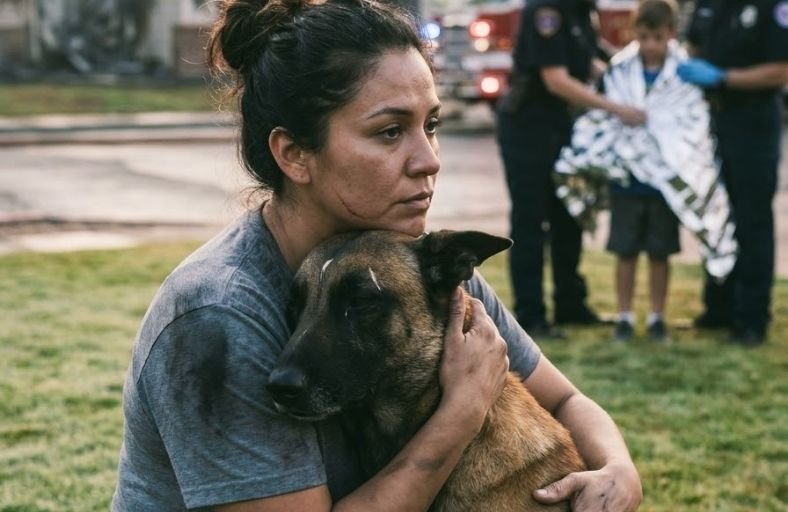
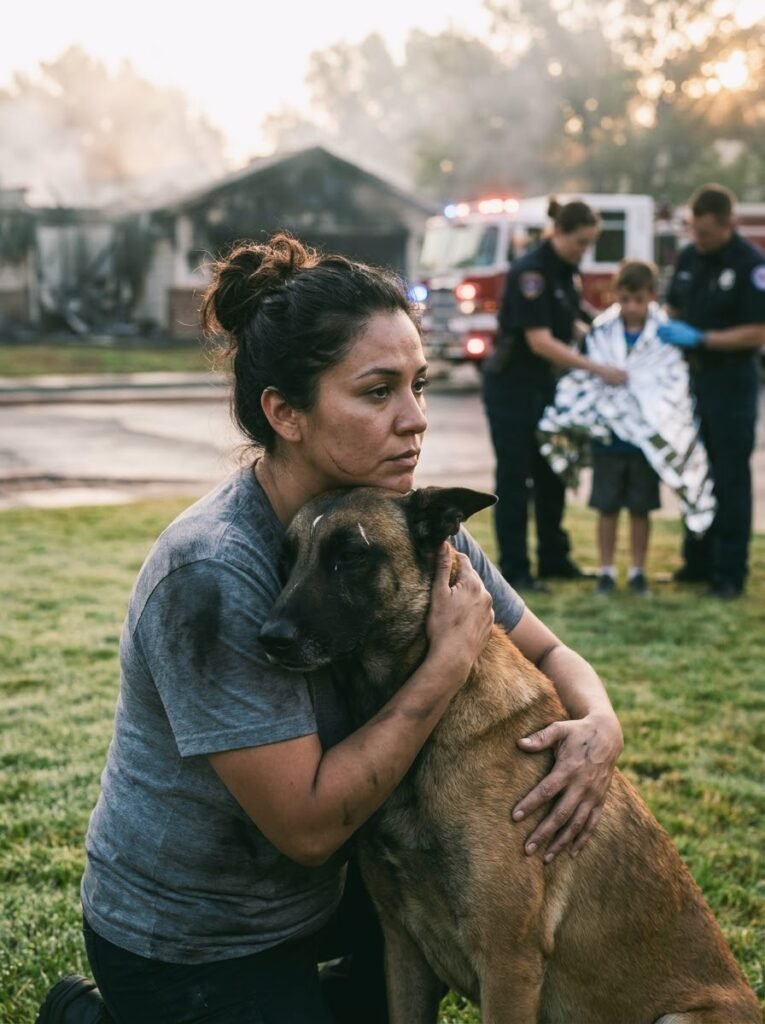
The dog who was too old and too broken down to work a single shift anymore was the reason two children walked out of a burning house alive.
If you had passed Detective Sergeant Naomi Reyes on the street, you would not have guessed she was afraid of anything.
She carried a badge and a sidearm for a living.
She had talked armed men into putting down their weapons.
She had knelt over car accidents that would have sent most people running the other way.
But there was one thing Naomi Reyes had never told most of her coworkers, not in eleven years on the force.
She was afraid of house fires, and she had been since she was twenty seven years old.
Naomi was thirty eight now, five foot six, with dark hair she kept twisted into a tight bun even on her days off, as if she never fully believed she was off the clock.
A thin scar ran along her jaw from a car accident years earlier, the kind of detail nobody noticed until they knew to look.
Under her shirt, resting against her collarbone, she wore a small silver whistle on a chain.
It had belonged to her old training sergeant.
She had not taken it off since the day he died.
Colleagues who worked violent crimes with her described her as unshakeable, the calmest voice in the room during a hostage call, the last one to raise her voice in a briefing.
What most of them did not know was that Naomi had spent eleven years quietly steering her own life away from anything that smelled like smoke.
She kept a fire extinguisher in every room of her house.
She checked the stove twice before bed.
She had a habit, one Marcus teased her about gently, of counting exits the moment she walked into any building.
Nobody at the department connected any of it to a case file from over a decade ago, a case that was never officially hers, a case involving a four year old girl named Ava Whitcombe who did not make it out of a house fire in time.
Naomi had been a rookie then.
She had not been the one who failed that day.
She had simply been close enough to feel it happen.
She had carried it anyway.
Ranger did not know any of this history when he came to live with the Reyes family eighteen months earlier.
He was a nine year old Belgian Malinois, a black mask over a fawn coat, with a thin white scar above his left eye and one ear that had never quite finished standing up, giving him a permanently curious, slightly crooked expression.
He had spent seven years as a working police dog, trained in narcotics detection and general patrol work, before hip dysplasia forced an early retirement.
By the time he arrived at the Reyes house, he moved a little stiffly in the mornings, slept most of the afternoon on the cool tile by the back door, and showed no outward sign that he had ever worn a badge of his own.
He liked belly rubs from five year old Eli.
He tolerated the enthusiastic hugs of three year old Sofia, who was not yet gentle with anything.
He slept, most nights, at the foot of the stairs, halfway between the children’s bedrooms and the front door, a habit nobody in the family had trained into him and nobody thought twice about.
It was late October in Prescott, Arizona, the kind of dry, brittle season when the whole town smelled faintly of dust and pine needles baking in the sun.
The Reyes house sat on Willow Creek Road, a quiet cul de sac of single story homes with gravel yards and desert landscaping, the kind of street where everyone knew whose dog barked at the mail carrier and whose porch light burned out first.
Nobody on Willow Creek Road knew that the wiring behind the laundry room wall in the Reyes house had been slowly fraying for months, worn thin by a rodent nest nobody had found, tucked into insulation nobody had checked.
Just after eleven o’clock on a Tuesday night, that wiring finally sparked.
By the time the smoke alarm in the hallway began to scream, flames were already climbing the drywall behind the dryer, and thick black smoke was pouring into the hallway that led straight to the children’s rooms.
Marcus was the first one on his feet, already coughing, already shouting for Naomi.
Naomi was two steps behind him when she realized, with a cold drop in her stomach that felt exactly like the worst night of her career all over again, that she could not see either one of her children through the smoke filling the hallway.
What Ranger did in the next four minutes is the reason this story is still being shared months later.
Part 2 – The Night I Could Not Reach Ava
To understand what Ranger did on Willow Creek Road, you have to go back eleven years, to a case Naomi Reyes has never once discussed at a department barbecue.
She was twenty seven then, six months out of the academy, paired that year with a training sergeant named Walt Dunbar.
Walt was fifty nine at the time, a broad shouldered man with a gray crew cut and a voice like gravel in a coffee can.
He had run the department’s K9 unit for two decades.
He did not talk about his personal life. He did not talk about his own dogs’ retirements or deaths. He answered questions about his training methods and nothing else.
What Walt Dunbar was known for, across three counties, was his ability to train dogs to find people buried under conditions that should have made it impossible. Collapsed buildings. Flooded basements. Smoke so thick that handlers themselves had to be led out by hand.
On a March night that year, Walt and Naomi responded to a house fire on the far side of town, a call that came in as a possible entrapment.
A neighbor reported that a four year old girl named Ava Whitcombe was still inside.
Walt’s K9 partner at the time, an aging German Shepherd named Duke, was not trained specifically for smoke work. He was a narcotics dog first, a generalist second.
Naomi remembers Walt going in anyway, Duke straining at the end of the lead, the two of them disappearing into a hallway that firefighters themselves were still hesitant to enter.
She remembers standing at the edge of the yard, radio pressed to her ear, counting seconds the way she still counts exits today.
They found Ava four minutes later.
Four minutes too late.
Naomi was not the one who carried the girl out. She has never claimed to be. But she was close enough to see Walt’s face when he came back through the front door, and she has never forgotten it.
Walt Dunbar did not speak to anyone for the rest of that shift.
He filed his report. He drove home. As far as Naomi knew, he never mentioned the Whitcombe fire again, not once, not in eleven years, not even the week before he died.
What Naomi did not know, and would not learn until much later, was what Walt did with his next K9 partner.
The following spring, the department assigned him a young Belgian Malinois with a black mask, a fawn coat, and one ear that refused to stand fully upright.
Walt named him Ranger.
Departmental training logs from that period, the kind of paperwork nobody reads unless they go looking for it, show something unusual. Where most K9 handlers logged general patrol and detection drills, Walt’s sessions with Ranger, several times a month for nearly two years, were logged under a category he invented himself.
He called it “structure smoke, child scent, low visibility.”
No supervisor ever questioned it. Walt had run the unit for twenty years and nobody argued with his methods.
Naomi did not connect any of this to Ava Whitcombe at the time. She had transferred to patrol, then detectives, and crossed paths with Walt only occasionally after that, usually a nod in the hallway, sometimes a gruff word of advice on a case.
What she did notice, years later, long after Walt retired and Ranger came into her own life, was a strange habit the old dog had.
One evening the following winter, walking Ranger past a garage two streets over that had burned out the year before, the dog stopped dead in the middle of the sidewalk.
He would not move.
He stood with his nose lifted, ears forward, body rigid, staring at the blackened frame of the garage like he was waiting for a command nobody had given.
Marcus laughed it out. He guessed at raccoons, guessed at some leftover scent from the fire, and eventually had to physically turn Ranger around by the collar to get him walking again.
Naomi did not laugh.
She stood there a moment longer than she needed to, watching her old, stiff hipped, retired dog stare at a burned building like it meant something to him.
She did not know why. Not yet.
But she filed it away, the same quiet way she filed away everything she could not explain about that year, and she went home and checked the fire extinguisher in the hallway, the way she always did, and said nothing.
Part 3 – The Last Ordinary Sunday on Willow Creek Road
The Sunday before the fire was, by every measure, an ordinary one.
Marcus grilled chicken in the backyard while Eli chased Ranger in slow, careful circles around the gravel yard, careful because Ranger’s hips did not move the way they used to, and Eli, at five, had already learned to be gentle with him without being told twice.
Sofia sat on the porch step feeding Ranger small pieces of bread when she thought nobody was watching, a habit the whole family pretended not to notice.
Naomi spent most of the afternoon in the garage, sorting through boxes for a donation run to the church two streets over, the kind of task she took on every few months whether the garage needed it or not.
It was on that Sunday that she moved, for the second time in two years, a plain cardboard box sitting on the highest shelf, sealed with packing tape gone brittle and yellow, marked on one side in black marker with two initials.
W.D.
Marcus had asked about it once, a year earlier, when they first moved boxes into that garage.
Naomi had told him it belonged to Walt, that it had come to her along with Ranger after Walt passed, part of an instruction Walt left with his lawyer that specific personal items go to her and no one else.
She had not opened it.
Marcus had not pushed. He knew, in the careful way a good husband knows, which subjects in his wife’s life required patience rather than questions.
That Sunday, standing on a step stool with the box in her hands, Naomi felt the same pull she always felt, a small, persistent curiosity she did not examine too closely, followed by the same quiet decision to set it back down.
“Not today,” she said out loud, to no one, and slid the box back onto the shelf.
She did not know it would be the last ordinary Sunday of the year.
That evening, after the kids were bathed and the dishes were done, Naomi sat on the back step with a cup of coffee gone cold, watching Ranger stretch out slowly on the warm concrete, his bad hip clicking faintly as he settled.
“You’re getting old, buddy,” she told him, scratching behind the ear that never fully stood, the way she did most nights.
Ranger thumped his tail twice against the ground and closed his eyes.
Inside the house, the smoke detector in the hallway had a battery that was six months past its recommended replacement date, a fact Naomi would learn later, from a fire investigator, in a tone that was gentle but precise.
The wiring behind the laundry room wall, meanwhile, had been getting warmer for weeks, a slow, invisible countdown nobody in the house could have known to watch for.
Naomi finished her coffee. She locked the back door, the way she always did, checked it twice, the way she always did, and went to bed beside Marcus without knowing that in two nights, everything she had spent eleven years quietly protecting her family from was about to arrive at her own front door.
She fell asleep to the sound of Ranger settling onto the tile at the base of the stairs, exactly where he slept every single night, halfway between the children’s rooms and the front door, a position nobody had ever trained into him, and nobody had ever thought to question.
Part 4 – The Box Marked W.D.
The fire captain who worked the scene on Willow Creek Road told Naomi, two days later, standing in her driveway with a clipboard she never looked at, that Ranger’s actions that night matched almost exactly what department trainers call an advanced smoke search pattern.
Low body position to stay under the worst of the heat.
A direct line to the children’s rooms instead of a search pattern.
Physical contact with each child, nudging, pulling at pajama sleeves, positioning himself between them and the thickest smoke until firefighters reached them.
“That’s not something a narcotics dog does on instinct,” the captain told her. “That’s trained behavior. Somebody built that into him.”
Naomi did not sleep well for the next several nights, not because of the smoke damage crews were still clearing from her hallway, but because of that single sentence turning over in her mind.
Somebody built that into him.
She thought about the garage two streets over, the way Ranger had frozen in front of it, refusing to move.
She thought about the box on the shelf, sealed for two years, marked only with two initials.
Four days after the fire, while the family was staying with Marcus’s sister across town, Frank Whitaker, the Reyes’s next door neighbor, a retired firefighter of thirty one years who had been the one to pull Naomi through the window that night, showed up at the temporary house with a second, smaller box under his arm.
Frank had known Walt Dunbar for decades, the way most longtime first responders in a town the size of Prescott eventually cross paths.
He explained, a little awkwardly, that he had been helping clear out Walt’s old storage unit for the estate, a task that had been sitting unfinished for two years because nobody quite wanted to do it, and had found something he thought Naomi should have.
It was Walt’s personal training log, a battered spiral notebook Frank said Walt had kept separate from his official department paperwork, the kind of thing a man keeps for himself and nobody else.
Naomi sat at her sister in law’s kitchen table that night, after the kids were asleep, and opened it.
Most of it was what she expected. Dates, drill descriptions, notes on Ranger’s early stubbornness, notes on his surprising focus once he understood a task.
But scattered through the pages, in Walt’s blunt handwriting, were short entries that stopped her cold.
“Structure smoke drill, child mannequin, low crawl approach. For Ava. Every session.”
She found the same phrase, or some version of it, eleven more times across two years of entries.
She sat with the notebook for a long time before she understood what she was looking at.
Walt Dunbar had spent the last two years of his working life quietly, deliberately, without telling a single supervisor why, training Ranger to do the one thing Duke had not been able to do in time on a March night eleven years earlier.
He had never said Ava’s name to Naomi, not once, not in eleven years.
He had carried it the same way she had, silently, and instead of talking about it, he had built something out of it, one drill at a time, for two years, in a dog he would eventually leave to the one other person on earth who had stood in that yard with him.
Naomi went home the next morning and finally opened the box marked W.D.
Inside, on top of Walt’s folded uniform jacket, was a single sheet of paper in his handwriting, dated the week before he died.
It read, simply: “Ranger goes to Naomi Reyes and her family. He is ready for whatever they need. He always has been.”
She sat on the garage floor for a long time after that, the letter in one hand, her other hand resting on Ranger’s head as he leaned his weight patiently into her side, the way he had every difficult evening for eighteen months, waiting, the way it turned out he had always been trained to.
Part 5 – What Dr. Anand Said About Love That Waits
Ranger spent two nights at the veterinary hospital after the fire, treated for smoke inhalation and a minor burn on one paw pad he had gotten crossing too close to the laundry room doorway.
Dr. Priya Anand, the clinic’s veterinary behaviorist, was the one who ran his follow up exam the week after he came home.
She was forty five, soft spoken, with the kind of patient, unhurried manner that made even anxious dogs settle in her exam room within minutes.
She had also, it turned out, spent six years early in her career working alongside search and rescue teams, evaluating exactly the kind of specialized training Walt Dunbar had built into Ranger without ever putting it on paper.
Naomi brought the training log with her to that appointment. She had not shown it to anyone outside the family yet. She was not entirely sure why she brought it to Dr. Anand, except that she needed someone who understood dogs to tell her she was not imagining what she had read.
Dr. Anand read through the entries slowly, twice, while Ranger dozed against Naomi’s leg on the exam room floor, his breathing still faintly raspy from the smoke.
“This is real,” she finally said, closing the notebook gently. “This is deliberate, repeated, purpose built training. Whoever did this knew exactly what he was doing, and he did it for a very long time.”
Naomi asked the question she had been carrying for a week. Could training like that simply disappear, the way muscles weaken with age, the way memory fades.
Ranger had not worked a real search in nine years. He had spent eighteen months as a house pet, sleeping on tile, begging for bread crusts from a three year old.
Dr. Anand considered the question carefully before she answered.
“Dogs don’t forget the way we think they might,” she said. “Especially not something trained this deeply, this repeatedly, tied this closely to scent and instinct rather than performance for a reward.
It goes somewhere deeper than obedience. It becomes part of how he reads a room, how he reads danger. It waits.”
She paused, looking down at Ranger, who had opened one eye at the sound of his own name, tail thumping once against the tile before he settled back to sleep.
“The training we give with love,” she said, “does not end when we let go of the leash. It waits in the muscle and the memory until the day it is needed most.”
Naomi did not say anything for a long moment.
She thought about Walt, standing silent in a yard eleven years ago, saying nothing about the four minutes that had haunted them both.
She thought about two years of drills logged under a category he invented, “structure smoke, child scent, low visibility,” each one a private apology he never spoke out loud.
She thought about a single sheet of paper in a box she had been afraid to open. He is ready for whatever they need. He always has been.
Naomi had spent eleven years believing that what happened to Ava Whitcombe was something she carried alone, a private failure lodged somewhere behind her ribs that nobody else could see or understand.
Sitting on that exam room floor, one hand resting on Ranger’s chest as it rose and fell, she understood for the first time that Walt had never stopped carrying it either.
He had simply chosen to answer it instead of just enduring it, one quiet drill at a time, in a dog he must have known, somehow, would eventually end up exactly where he was needed.
Naomi drove home that afternoon with the notebook on the passenger seat and Ranger stretched across the back, and for the first time in eleven years, she did not check the fire extinguisher in the hallway before she went to bed.
She checked it the next morning instead, out of habit, and found, a little to her own surprise, that her hands were steady.
Part 6 – The Smoke Detector Test
Recovery, Naomi would tell people later, did not arrive all at once, and it did not arrive without setbacks.
The Reyes family moved back into their house two months after the fire, once the wiring throughout the property had been fully replaced and the laundry room rebuilt.
Marcus installed new smoke detectors in every room, the interconnected kind that all sound together, and a fire escape ladder folded neatly under each of the children’s windows.
Every Sunday evening after that, without anyone deciding it as a formal rule, the family started running through it together.
Marcus called it their fire drill.
Eli called it their Ranger drill, because Ranger, without any retraining or command, positioned himself at the base of the stairs every single time, exactly where he always slept, exactly where he had been the night it mattered.
The test came on a windy night in January, three months after the fire, when a neighbor two doors down accidentally set off their own smoke alarm making dinner, the sound sharp and sudden through the thin desert air.
Sofia, who had turned four that winter, woke up screaming.
Eli froze at his bedroom door, unable to make himself step into the hallway.
Naomi felt her own pulse spike so hard it took her a full three seconds to remember the sound was not coming from inside her own walls.
Ranger was faster than any of them.
He was at Eli’s door within seconds, nudging his hip gently against the boy’s leg, the same low, steady posture the fire captain had described from the night of the real fire, walking him calmly down the hallway toward his parents.
It was not a perfect recovery. Sofia cried for twenty minutes. Naomi’s hands did not fully stop shaking until she had checked every window in the house twice.
But it was, Marcus pointed out quietly afterward, a house where everyone made it to the front door together within ninety seconds, calm, accounted for, unhurt.
“That’s not nothing,” he told her, and Naomi, sitting on the front step with Ranger’s head heavy in her lap, found she agreed.
The neighborhood noticed the change too, in smaller ways.
Frank Whitaker started stopping by most evenings, ostensibly to check on the new wiring job, mostly to sit on the porch step and toss a tennis ball for a dog who could no longer chase it very far but still tried, every time, out of something that looked a great deal like joy.
The local fire department invited Ranger, a little unofficially, to a community safety day that spring, where he sat patiently in the shade of a fire truck while children took turns scratching behind his crooked ear and firefighters told his story to anyone who would listen.
Naomi found, standing at the edge of that crowd, that she could tell people about the fire now without her voice catching, most of the time.
She still checked exits in every building she walked into. She suspected she always would.
But she had stopped believing that habit was a wound. She had started to understand it, slowly, as something closer to a promise she had made to a four year old girl eleven years ago without ever saying it out loud, a promise Walt Dunbar had quietly helped her keep.
Part 7 – Nine Years Later, in the Same Kind of Smoke
Ranger lived another two and a half years after the fire on Willow Creek Road, long enough to watch Eli lose his first tooth, long enough to watch Sofia learn to read, long enough to grow gray around his muzzle and slow down even further on his morning walks with Naomi, who never once stopped taking them.
He died quietly in his sleep on the same square of tile at the base of the stairs where he had slept every single night for four years, in the spot Naomi eventually admitted was less about comfort and more about a job he had never officially been asked to keep doing.
She buried Walt Dunbar’s old training log in the same shoebox as Biscuit, the smoke stained rabbit from a fire eleven years before Ranger ever came into her life, two objects from two tragedies that had somehow, quietly, saved each other’s ending.
Naomi still works detectives for the Prescott Police Department. She still wears Walt’s silver whistle under her shirt.
She still counts exits in every room she walks into, though these days she does it less like a woman flinching and more like a mother making sure everyone she loves has a way out, just in case.
The wooden ramp Marcus built for Ranger’s last stiff months still leans against the side of the garage. Nobody in the family has been able to move it yet, and nobody has tried very hard.
What Naomi tells people now, when they ask about the dog whose photograph still hangs in the Prescott fire station, whose story local news outlets still bring up every October around fire prevention week, is something close to what Dr. Anand told her that afternoon in the exam room, three months after the worst night of her adult life.
The training we give with love does not end when we let go of the leash.
It waits in the muscle and the memory until the day it is needed most.
Walt Dunbar spent two years building that promise into a dog, quietly, without ever explaining why, because he was carrying a weight he did not know how to put down any other way.
He handed that promise to the one person on earth who understood exactly what it cost him.
And on an ordinary Tuesday night in October, in a hallway thick with smoke, a nine year old dog with bad hips and a crooked ear walked into the one kind of danger he had spent two secret years training for, and brought two children home.
If this story touched your heart, follow this page for more unforgettable dog stories about retired K9 heroes, second chances, and the families they never stop protecting.