
PART 1
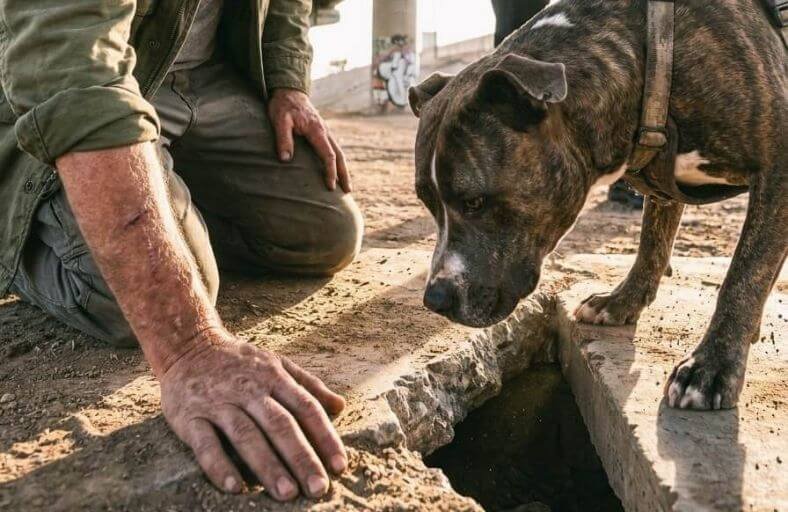
At 4:12 p.m. in the middle of a 104-degree Phoenix heatwave, my dog stopped beside a pile of fallen concrete under the Interstate 10 overpass, pressed his nose against a dark three-inch gap, and refused to move even when the hot asphalt began burning his paws.
I had spent four years living out of a rusty 2004 Ford Econoline van parked near the industrial tracks off Grand Avenue.
The city was hot, loud, and unforgiving to men who looked like they had left their best years in a foreign desert.
Most people walked past us fast.
I did not blame them.
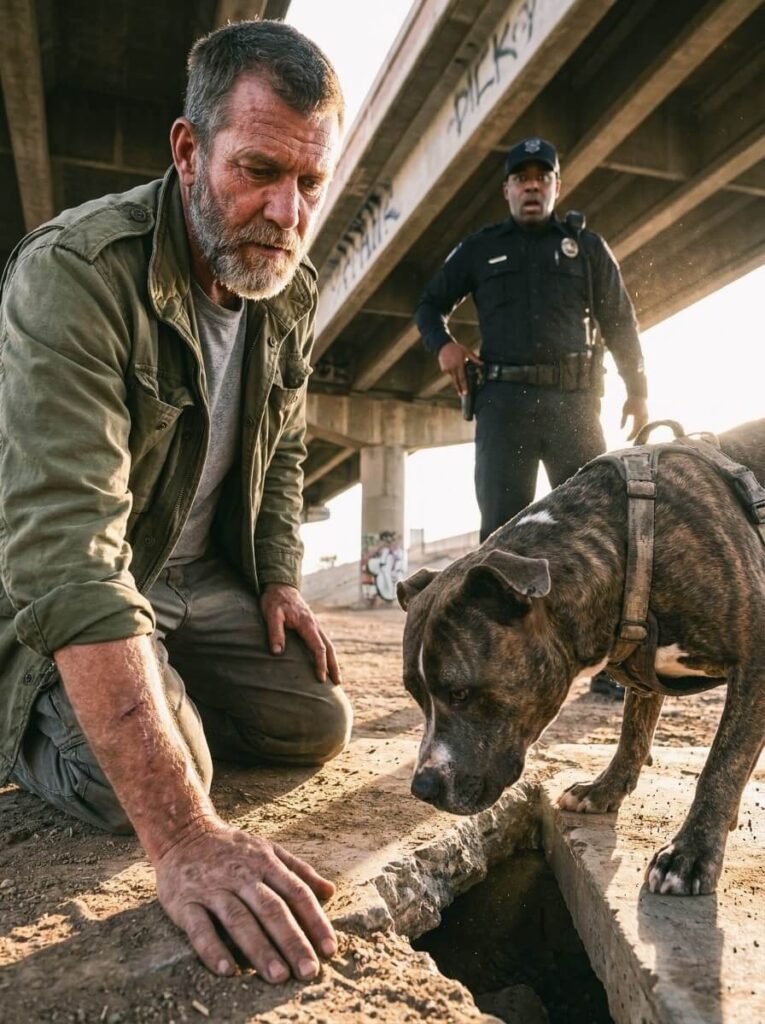
My name is Thomas “Doc” Callahan, and I was fifty-two then, a White American combat veteran with a graying beard, a scarred right forearm, bad knees, and a faded field jacket I wore even when the sun turned the streets into an oven.
I had served eight years as an Army medic. After the noise in my head got too loud for regular jobs, I learned to keep my world small. One van. One stove. One dog.
That dog was Sarge.
He was a five-year-old Pit Bull and German Shepherd mix, sixty-five pounds of muscle, brindle coat, notched right ear, white chest patch, and eyes that looked like he had spent his own time in hard places.
I pulled him from a county shelter two years earlier, ten minutes before his name was scheduled to hit the final log.
People thought he was dangerous because he was quiet.
He was not dangerous.
He was just waiting to see if the world was going to hit him again.
On July 9, the heat off the pavement was thick enough to taste. Sarge and I were walking toward a public tap near the rail yard to fill our water jugs. That was when Sarge froze beside the bridge support.
His notched ear flipped forward.
His tail went straight.
He did not bark.
He pushed his nose into a dark gap where two cracked concrete slabs had collapsed against a dirt embankment during a construction mishap three weeks earlier.
“Hey, boy,” I said, tugging his leash. “Come on. The ground’s too hot.”
He leaned harder against the concrete.
Then I heard it.
It was not a dog bark. It was a high, thin, whistling sound, like a toy squeaker losing air under a heavy boot.
Something was trapped inside that concrete pocket.
Something small, exhausted, and running out of time in the dark.
I dropped my water jug, got down on both knees despite the burning dirt, and shined my small flashlight into the gap.
Two tiny golden eyes reflected back from the shadows.
A puppy was wedged six feet deep inside a cave of rubble, pinned beneath a rusted rebar grid, unable to turn around, with no water and no way out.
Sarge looked at me, then at the hole, then pressed his chest against the dirt as if he was ready to dig through concrete himself.
Part 2 – The Call From Under the Bridge
The heat under the overpass smelled of dry dust, old exhaust, burned rubber, and baked concrete.
I had been living on the Grand Avenue corridor long enough to know how fast desert heat turns small spaces into tombs. Inside a closed car, twenty minutes can take a life.
Inside a tight concrete pocket surrounded by dark asphalt at four in the afternoon, twenty minutes was already a long time to be breathing.
I pressed my ear against the cracked slab.
The sound came again.
A tiny, raspy whimper, shorter than the one before.
“Sarge, back up,” I whispered.
He did not leave. He took one step back, sat on the hot dirt, and kept his nose pointed at the opening like a sentry on watch.
I reached into the gap with my left arm, reaching as far as my shoulder would go. The concrete was jagged, rough as coarse sandpaper, scraping through my sleeve.
My fingers touched air, then hot dust, then a tangle of twisted metal mesh. Six feet down, the space narrowed into a funnel where construction crews had dumped broken footings three weeks back.
My fingers missed the puppy by at least two feet.
“Doc! What are you doing down there?”
A voice barked out from behind the bridge pillar.
It was Officer Marcus Vance.
He was a forty-one-year-old Black American patrol officer, six-foot-two, broad-shouldered, with a shaved head and a uniform that stayed crisp despite the heat. Vance had written me two sleeping-in-vehicle citations over the past six months.
He was not a cruel man, but he was a man who believed rules kept a city from falling apart, and a homeless van on a public curb was a broken rule.
He walked over, hand resting near his belt, boots crunching on the gravel.
“Callahan, you can’t be loafing under this bridge,” Vance said, his voice deep and measured. “The city’s clearing this section today for the road crew.”
I didn’t stand up. I stayed on my knees in the dirt.
“Officer, there’s a live pup down in this footings gap,” I said, pointing my flashlight into the dark. “She’s pinned under the rebar. She won’t last until the road crew brings a backhoe.”
Vance stopped. His face hardened, the professional look a cop wears when he thinks someone is making an excuse to stay where they shouldn’t be.
“Callahan, don’t play games.”
“Look for yourself,” I said.
Vance hesitated, then stepped closer, his heavy duty boots stopping beside Sarge. Sarge didn’t growl.
He just shifted his weight, eyes locked on the officer’s face, making a small, low sound in his chest that wasn’t anger. It was urgency.
Vance lowered himself slowly, his uniform pants tightening against his knees. He shined his heavy duty flashlight into the gap.
The beam cut through the red dust.
Down in the corner, caught between two heavy concrete chunks, a tiny golden fur body moved once. A paw reached through the rebar grid, weak and shaking.
Vance stood up fast, his boots sliding on the loose dirt. His posture went rigid.
“How long has she been in there?” Vance asked.
“Long enough to be dry,” I said. “I can’t reach her with my arm.”
Vance looked at the heavy slabs. They weighed at least four hundred pounds each. Moving them without a jack would collapse the dirt wall beneath them and crush whatever was sitting in the hole.
I reached back into the dust with a piece of bent wire I found near the rail fence, trying to hook the wire around the rebar grid.
My hand scraped against a sharp metal edge, and something small clicked against the concrete floor.
It was a piece of metal that had fallen off the pup’s neck when she moved.
I dragged the wire back out.
Hooked on the end was a tarnished pink collar tag shaped like a faded heart.
I handed it up to Vance without looking.
“Found this in the dirt edge,” I said.
Vance took the tag into his large palm. He looked down at it under the harsh desert sun, and for three full seconds, the officer forgot to take his next breath.
Part 3 – The Last Morning on Grand Avenue
The afternoon sun hit the western side of the overpass, turning the concrete into a wall of radiator heat.
Vance stood motionless in the dust, staring at the small metal heart in his hand. His fingers closed around it so tightly his knuckles turned gray.
“Officer?” I asked, wiping sweat and road grit from my eyes.
He didn’t answer right away. He tucked the tag into his breast pocket, his face going pale beneath his dark skin.
“We need a hydraulic jack,” Vance said, his voice dropping an octave, losing its sharp police edge. “The fire department is tied up three miles south on a brush fire by the river bed. It’ll take them forty minutes.”
“She doesn’t have forty minutes,” I said. “Look at her breathing.”
Through the gap, the puppy’s chest was moving in short, dry hitches. In 104-degree heat, a small dog loses moisture faster than a wet cloth on a hot engine block.
I looked at Sarge.
“Sarge,” I said quietly. “Show me.”
My dog knew three commands that weren’t in standard obedience books. When we lived in the van, he learned to dig, to hold, and to pull. He stepped toward the narrow dirt seam running beneath the lower slab where the soil was soft from an old utility trench.
Sarge began to dig.
His front paws hit the dirt like pistons. Red dust flew backward between his hind legs, coating my boots and Vance’s trousers.
He didn’t stop, didn’t whine, didn’t look up. He dug a channel eight inches wide directly under the main weight-bearing slab.
“Stop him!” Vance shouted, reaching forward. “He’ll undermine the rock!”
Sarge stopped instantly when Vance’s hand came near his head. He turned his broad head, notched ear standing straight up, and let out a single, sharp bark that echoed off the bridge girders.
He didn’t snap. He didn’t bare his teeth. He just placed his heavy brindle paw directly over Vance’s boot, pressing down with steady weight, refusing to let the officer step closer to the hole.
“He won’t let you near the dirt unless you talk to him,” I said, crouching beside them. “He thinks you’re gonna pull him off.”
Vance looked down at the sixty-five-pound Pit mix holding his foot to the earth.
“Get your dog off me, Callahan.”
“Tell him it’s okay,” I said softly. “He doesn’t know your rank, Officer. He just knows who’s loud.”
Vance swallowed hard. He looked from Sarge’s amber eyes down to the dark gap where the small golden body lay silent.
The big officer leaned down until his face was six inches from Sarge’s nose.
“Easy, big boy,” Vance whispered, his voice trembling slightly. “Easy, Buster.”
Sarge’s notched ear twitched.
His tail gave two slow, heavy thumps against the hot gravel.
I froze.
“What did you call him?” I asked.
Vance didn’t look at me. He kept his eyes on the dirt channel Sarge had opened.
“Nothing,” Vance muttered, pulling a collapsible steel crowbar from his patrol car trunk. “Just an old name. Let’s get this jack under the edge before the ground settles.”
We worked together in the dirt for fifteen minutes, a homeless veteran, a police officer, and a shelter dog whose paws were bleeding from the gravel.
Vance jammed the steel bar beneath the upper slab while I wedged a spare wooden railroad tie under the pivot. Sarge kept digging the side channel until his shoulders were buried three feet into the earth.
At 4:48 p.m., the concrete slab groaned.
A shower of dry dust poured down inside the pocket.
I reached deep into the gap Sarge had cleared, my scarred arm sliding through the cool dirt, until my fingers touched soft, hot fur.
The puppy didn’t move.
I closed my fingers gently around her small chest, lifted her clear of the rebar grid, and pulled her out into the blinding Phoenix light.
Part 4 – What the Microchip Remembered
She was smaller than a loaf of bread.
A pale golden retriever mix, no more than eight weeks old, covered in gray concrete dust, her eyes gummed shut with dirt, her tiny ribs sticking out like wire wrapping.
She lay in my calloused palms without making a sound, her body limp as a wet rag.
Sarge immediately leaned in, his big tongue making three long, careful sweeps across the puppy’s face, clearing the red dust from her nose and mouth.
The puppy sneezed weakly.
A tiny, wet sound.
“She’s breathing,” I said, wrapping her in the tail of my faded field jacket. “We need water and a vet right now.”
Vance didn’t speak. He opened the back door of his air-conditioned patrol car, something he had never done for me or Sarge before.
“Get in,” Vance said. “Both of you.”
Ten minutes later, we pulled into the rear bay of the Sonoran Emergency Animal Clinic on Thomas Road.
Dr. Maya Lin, a thirty-four-year-old Asian American veterinarian in blue scrubs with a silver watch, met us in the intake room. She took the puppy from my jacket, laid her on the stainless steel exam table, and began working with quick, practiced hands.
“Severe dehydration,” Dr. Lin said, slipping a microscopic IV needle into the pup’s front leg. “Heat exhaustion. But her lungs are clear. Another half hour under that bridge and her organs would have shut down.”
Sarge sat on the cold floor tiles beside the exam table, resting his chin directly on Vance’s polished duty boot.
Vance didn’t move his foot. He stood by the wall, hands resting on his utility belt, staring at the little dog with an unreadable expression.
“Does she have a tag?” Dr. Lin asked, searching the pup’s neck. “No collar.”
“I have the tag,” Vance said quietly from the corner.
He pulled the tarnished pink metal heart from his pocket and set it on the stainless table.
Dr. Lin picked up a handheld microchip scanner and passed it over the puppy’s shoulder blades.
The scanner emitted a loud, high-pitched beep.
A string of twelve numbers flashed on the blue digital screen.
Dr. Lin typed the number into her desktop computer, waited for the registry database to load, and then stopped typing. She looked at the screen, then looked up at Officer Vance.
“This chip was registered three years ago,” Dr. Lin said, her voice dropping into a quiet hush. “The owner name listed is Maya Vance.”
The room went completely silent.
The only sound was the steady hum of the clinic’s air conditioner and Sarge’s slow breathing on the floor.
Vance closed his eyes. His broad chest heaved once under his dark uniform shirt, and his hands trembled against his belt.
“Maya was my daughter,” Vance said, his voice raw and tight. “She died of leukemia two years ago when she was six.”
I looked from Vance to the tiny golden puppy on the table.
“Before she passed,” Vance continued, looking at the ceiling to keep his eyes from overflowing, “her mother and I let her name a shelter puppy we fostered. A golden mix named Chloe. Chloe got adopted by a family in Scottsdale two years ago. This must be one of Chloe’s litters.”
He looked down at the pink metal heart on the table.
“Maya drew that heart on the back of the tag with her own fingernail polish before the puppy went home,” Vance whispered. “I’d know that crooked pink edge anywhere.”
Part 5 – The Quiet Rules of Ruins
We sat in the clinic waiting room for two hours while Chloe received fluids and oxygen.
Sarge lay between my boots and Vance’s chair. The big cop had taken off his duty cap and set it on his knees, his face lined with a exhaustion that had nothing to do with the heat outside.
“I tried to tow your van three weeks ago, Callahan,” Vance said softly, staring at the tile floor.
“You were doing your job, Officer,” I replied, adjusting the silver St. Christopher medal around my neck.
“My daughter loved dogs,” Vance said, his voice rough. “After we lost her, I couldn’t look at them for a long time. Every time I saw a dog in a car or on a street, it reminded me of the home we had before the hospital rooms took over. I guess I got hard about things. Rules were easier to deal with than memory.”
I looked at my own hands, scarred, calloused, grease-stained under the fingernails.
“I lost my medic squad in Kandahar in 2011,” I said, the words coming out slow because I hadn’t spoken them out loud in five years. “Four guys. Good guys. I came home and thought if I stayed away from people, nobody else would get hurt on my watch. I bought the Econoline and stopped looking at calendars.”
Sarge lifted his head and pressed his broad snout against Vance’s knee.
Vance reached down, his large, calloused hand cupping Sarge’s notched ear, gently stroking the fur behind it.
“We do not heal by escaping our ruins, Doc,” Dr. Maya Lin said, walking out from the treatment area with a warm smile. “We heal by reaching back into them for whoever is still trapped.”
She carried the golden puppy wrapped in a fresh white towel.
Chloe’s eyes were open now—bright, clear, dark brown eyes that looked around the room with cautious curiosity. She saw Sarge first, made a soft squeaking sound, and wriggled her tail inside the towel.
Dr. Lin set Chloe down on the clinic floor.
The tiny golden pup didn’t wobble toward me. She didn’t wobble toward the vet.
She walked straight to Officer Marcus Vance, fell over his boot, and began licking his leather laces.
Vance dropped to both knees on the clinic floor, his heavy uniform jacket bunching around his shoulders, and pulled the small dog into his chest.
The big officer didn’t try to hide his tears anymore.
He buried his face in the puppy’s golden fur, his shoulders shaking silently, while Sarge sat beside him, resting his heavy head against Vance’s arm like a bridge holding up a wall.
Part 6 – The Night of the Summer Storm
Three days later, the desert heatwave broke with a sudden, massive monsoonal thunderstorm.
Rain pounded against the metal roof of my Ford Econoline parked in its new spot behind the city water yard. The wind whipped through the mesquite trees, and thunder rolled across the valley like heavy artillery.
In the old days, thunder would have had me gripping the steering wheel in the dark, counting tiles or mailboxes, waiting for the sky to clear.
That night was different.
My van door opened, and Officer Vance stepped inside, out of the pouring rain, carrying a box of hot coffee and a bag of dry dog food.
He wasn’t in uniform. He wore a plain gray hoodie and jeans, looking less like an officer and more like a man who had finally come home from a long shift.
Tucked inside his jacket was Chloe.
Her coat was clean and golden, her eyes bright, her tail wagging like a small yellow clock pendulum.
“She doesn’t like the thunder much,” Vance said, sitting down on the edge of my wooden bed frame while the rain drummed on the roof.
Sarge welcomed them with a low, happy huff, immediately making room on his fleece blanket for the puppy. Chloe curled between Sarge’s big brindle paws, feeling safe under the shelter of his broad chest.
“City council approved the new shelter access permit today,” Vance said, handing me a paper cup of coffee. “They’re letting us use the empty city lot on 4th Street for the veteran-pet foster program. We’re calling it Maya’s Yard.”
I looked at him through the steam rising from my cup.
“You’re running it?” I asked.
“Not alone,” Vance smiled, looking at my scarred hands. “I need a medic who knows how to handle broken dogs and hard men.”
Out on the street, the rain kept falling, washing away the red dust, the old heat, and the hard edges of Grand Avenue.
Inside the small van, two old men who had spent years hiding inside their own ruins sat listening to the storm, while two rescue dogs slept quietly between their boots.
Part 7 – Three Warm Beds Under One Roof
A year has passed since the afternoon Sarge stopped at the concrete gap under Interstate 10.
If you walk past the corner of 4th Street and Jackson on any Tuesday morning, you won’t see a rusty Econoline van parked illegally on the curb.
You’ll see a bright red brick building with a fenced yard, clean water stations, and a wooden sign above the porch that reads:
MAYA’S PLACE: VETERAN & ANIMAL RECOVERY CENTER
I don’t live in the Econoline anymore.
I have a room on the second floor of the center, with a real bed, a desk where I keep my medic manuals, and a window that looks out over the yard where ten rescue dogs play every afternoon.
Officer Marcus Vance retired from patrol six months ago to run the center’s outreach operations full-time.
He still walks like a cop, still keeps his boots polished, but his voice doesn’t hold the sharp edge it used to when he checked vans on Grand Avenue.
Every morning at 7:00 AM, three dogs wait by the front porch gate.
Sarge sits on the right, his notched ear straight, his brindle coat shiny, watching the sidewalk with the calm posture of a dog who knows his work is valued.
Chloe sits on the left, a full-grown golden mix now, her tail sweeping the porch boards whenever visitors arrive.
And between them sits an old, gray-muzzled terrier mix named General, whom Vance pulled from a drainage ditch three months back.
People in Phoenix still talk about the afternoon a homeless veteran and a police officer pulled a dying puppy from under a collapsed bridge during a 104-degree heatwave. They call it a miracle story.
I don’t use that word.
I just think about what happens when people stop walking past the places that look broken.
The world is full of collapsed concrete, old ruins, closed doors, and official rules that make it easy to keep driving past someone else’s trouble.
But if you stop your bike, your truck, or your feet, get down on your knees in the dust, and listen close enough to hear what’s whimpering in the dark, you might just find that the life you save is the one that brings you home.
Sarge still checks every bridge gap we walk past on our morning rounds.
He doesn’t do it out of fear.
He does it because he knows that sometimes the best things in life are waiting under the heavy places, just waiting for somebody with enough patience to dig them out.
If this story touched your heart, follow this page for more unforgettable dog stories about rescue, loyalty, second chances, and the people who prove that nobody is ever too far lost to be found.