
Part 1: The Red Canvas at Threshold
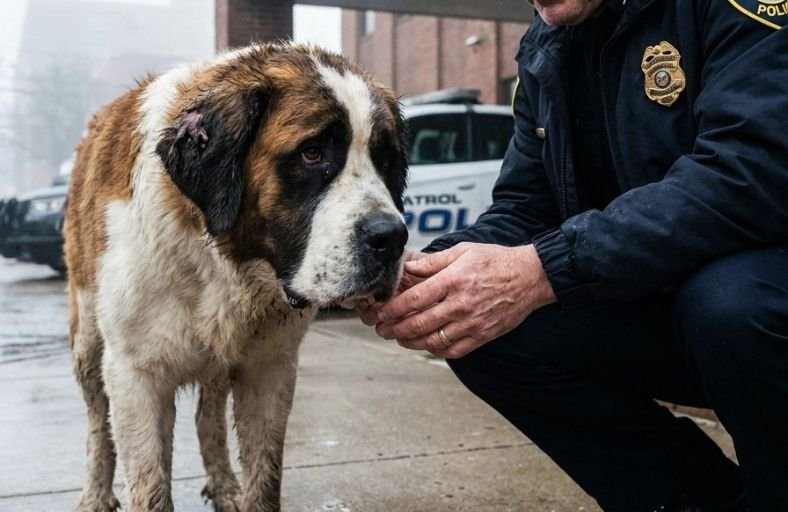
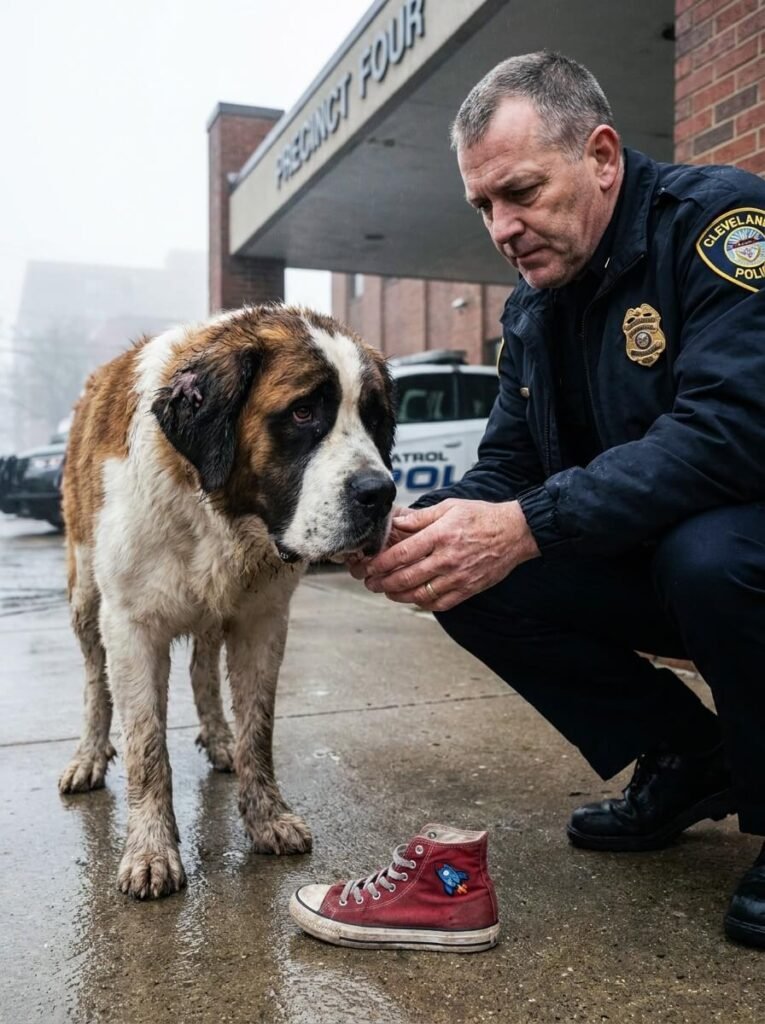
A giant Saint Bernard placed one red child’s sneaker outside our police station every morning, refused the food we offered, and stared through the glass doors as if sixty trained officers were failing a test only he understood.
Most people who walked past Precinct Four in downtown Cleveland that November looked right through the rain, but that dog made every veteran officer stop in his tracks.
When a hundred-and-forty-pound animal stands in absolute silence beneath a pouring rainstorm, people do not see a stray; they see a riddle that refuses to go away.
They see matted white fur turning gray with street grime, mud caked up to his hocks, ribs showing like fence pickets through a coat that should have made him look twice his size, and eyes so heavy with purpose that even the toughest shift lieutenant lowers his voice.
My name is Thomas “Tom” Miller, and I was fifty-two years old then, a white American police sergeant with thirty years on the force, short graying hair, broad shoulders bent slightly by years of walking pavement, and hands rough enough to hold a fading memory without dropping it.
I had served Precinct Four through riots, blizzards, homicides, and lost children, but my own home had stayed quiet for five years,ever since my eight-year-old son, Leo, was struck by a skidding truck on a icy Tuesday afternoon, taking my marriage and my sleep along with him.
That Monday morning, the rain was hitting the concrete awning like broken glass.
At exactly 7:12 a.m., the dog appeared from the alley behind West 25th Street.
He carried a small red canvas sneaker in his jaws.
A child’s shoe.
He crossed the slick sidewalk with long, agonizingly slow strides, lowered his massive head, and placed the shoe precisely against the stainless-steel threshold of our front sliding doors. Then he backed away three steps, sat on the freezing pavement, and looked through the glass right into my eyes.
“What does big guy want?” Officer Jared Cole asked, leaning over the front desk with a half-eaten sausage biscuit in his hand.
I had no answer.
The dog did not scratch the glass. He did not bark. He did not wag his tail when Jared stepped outside and held out half of his breakfast. The Saint Bernard smelled the warm meat once, turned his dark snout away with tragic dignity, and fixed his brown eyes back on my badge.
His eyes were deep brown, with pale, clean tracks through the dirt beneath them where rain,or something else,had washed his fur.
I knelt on the wet threshold, pushing the biscuit closer. “Go ahead, buddy. Eat something. You’re skin and bones.”
He would not touch it.
For thirty-eight minutes, the giant dog sat outside Precinct Four while patrol officers stepped around the small red shoe. Officer Maya Lin rubbed his wide forehead. Another officer brought out a paper bowl filled with warm water. A rookie joked that our new evidence courier needed a badge and a jacket.
The dog ignored every single one of us.
At 7:50, as the shift change horn blew inside, he stood up on stiff legs, picked up the red sneaker by the heel, and walked west into the morning fog.
He returned Tuesday at 7:09.
Same shoe.
Same spot.
Same absolute refusal to eat.
By Wednesday, I began to study the shoe. It was a cheap red canvas sneaker, size 2, with a faded blue embroidered rocket stitched near the ankle. Someone had carefully repaired the torn toe with green thread.
The rubber sole had separated near the heel, and three black marker letters showed beneath the tongue, though mud and teeth marks made them nearly impossible to decipher in the dim streetlights.
The dog stayed forty-one minutes that morning before taking the shoe and vanishing toward the old industrial district.
By Friday, dispatch had started calling him Big Red, though nobody knew whether the call sign belonged to the dog or the sneaker.
Animal Control came out with a catch pole and a slip lead, but the Saint Bernard rose before the warden even cleared the cruiser door. He didn’t growl or run. He simply stepped into morning traffic, passed beneath a stopped delivery truck, and vanished between two abandoned brick warehouses.
He came back Saturday. And Sunday. And the next week.
His front pads were split and bleeding. A fresh, shallow cut crossed the bridge of his nose. He breathed with a raspy, rattling sound, yet he placed the red sneaker on the exact same stainless-steel strip every single day.
“What are you trying to tell us, big man?” I asked on the fifteenth morning, kneeling so close I could feel the cold heat radiating from his wet coat.
His good ear lifted once. That was all.
For three full weeks, the ritual never broke. The Saint Bernard arrived before the morning briefing, delivered the child’s shoe, refused every slice of ham, every bowl of broth, and every gentle hand, staring through the glass at every uniform that entered the building.
On the twenty-first morning, snow began mixing with the icy rain. The dog’s white chest was gray with slush, and his hind legs trembled violently when he sat down.
I couldn’t watch him freeze anymore. While Jared kept him distracted outside, I picked up the red sneaker and carried it inside under the bright fluorescent lights of the briefing room.
Outside the glass doors, the Saint Bernard rose instantly.
He pressed his wet muzzle against the glass and released one low, vibrating sound,not a growl, not a bark, but a mournful, desperate cry. His heavy claws scraped the glass doors as I turned the wet tongue of the shoe over beneath the light.
The black marker letters became clear under the magnifying lamp:
O.M.C.
A green repair thread crossed the toe. A blue rocket leaned sideways near the ankle.
My breath caught in my throat. My pocket watch seemed to tick louder in my vest.
I had seen those exact details three months ago.
Ninety days earlier, a nine-year-old boy named Owen Michael Carter had vanished while walking home from the Jefferson Branch Library just six blocks away.
His mother had handed us six photographs, including a close-up of the red sneakers he had been wearing that afternoon,the shoes she had mended herself with green sewing thread.
I pulled open the cold-case missing-person folder on my desk.
The photograph on page seventeen showed the same blue rocket. The same green thread. The same initials: O.M.C.
Outside the glass, the giant Saint Bernard lifted his heavy head and stared straight at me through the window, as if he had spent twenty-one freezing mornings waiting for my face to change in exactly that way.
Then he turned west toward the old abandoned library district again.
This time, we didn’t bring Animal Control. This time, we followed.
Part 2 – The Call From West 25th
Three weeks before the Saint Bernard showed up at our doors, the file on Owen Michael Carter had gone cold on my desk.
In a city like Cleveland, when a nine-year-old boy vanishes between a public library and his front porch on an October afternoon, the first forty-eight hours are a whirlwind of sirens, search grids, scent dogs, and news cameras. But when the rain washes away the scent trails and the search dogs lose the track near the railroad tracks, the cameras pack up, the volunteers go home, and the file gets closed into a steel drawer.
I remember the night Owen vanished. It was an October Tuesday, raw and wet.
His mother, Sarah Carter, a thirty-two-year-old white American woman with tired hazel eyes, wearing a faded navy diner uniform, had sat in Precinct Four’s interview room for six hours without touching her coffee.
She kept holding a single red canvas shoe,the matching left one,that she had found near the sidewalk curb two blocks from her house.
“He doesn’t run away, Sergeant,” she had told me, her voice trembling like a dried leaf. “He carries his library books in his backpack. He promised me he’d be home by five.”
We searched every vacant lot, every abandoned factory along the Cuyahoga River, every storm drain in the Fourth Precinct. We brought in state police hounds.
They tracked Owen’s scent from the library steps to the corner of West 25th and Lorain Avenue, and then… nothing. It was as if the boy had simply evaporated into the gray Ohio sky.
Then came the dog.
On the second morning the Saint Bernard appeared at Precinct Four, Officer Jared Cole, twenty-nine, a white American patrol officer with a fresh haircut and an eager smile, had tried to follow him down the western alleyway after the dog reclaimed the shoe.
Jared came back twenty minutes later, his uniform trousers soaked to the knees in muddy water.
“He’s fast for a big guy, Sarge,” Jared said, leaning against the briefing room door. “Lost him near the old industrial rail line behind the abandoned brick warehouses. But I found something strange near the rusted chain-link fence.”
Jared laid two items on my desk.
The first was a heavy piece of rusted iron chain, snapped violently at one link as if an immense force had yanked it free from a wall or a post.
The second was a small scrap of bright yellow rain-jacket fabric, caught in the jagged teeth of the fence. It was stained with fresh green industrial paint.
“There’s no green paint on those rail cars, Sarge,” Jared muttered, rubbing his chin. “That paint is fresh. Like someone’s been working inside those boarded-up city buildings.”
I looked out the window. The Saint Bernard was gone for the day, but the impression of his heavy body remained in the wet mud near the door threshold.
My pocket watch clicked open in my hand. 7:45 a.m.
Five years ago, when my son Leo died, I remembered sitting on the hospital curb while doctors spoke in soft, hushed tones behind closed doors. I remembered the feeling of absolute helplessness,the feeling that the universe was moving forward while I was trapped in a room with no doors.
Looking at that scrap of yellow fabric and the rusted chain, a cold shiver ran down my spine.
The dog wasn’t just wandering the streets. He was coming from somewhere specific. He was tied to something,or someone,who couldn’t leave.
I picked up my patrol car keys.
“Maya,” I called out to Officer Maya Lin, thirty-four, a sharp-eyed Asian American detective who handled our precinct’s evidence logs. “Pull the city utility maps for the Jefferson Library sector from 1950. Every steam tunnel, every maintenance sub-basement, every abandoned coal chute within six blocks of West 25th.”
Maya looked up from her computer monitor, her brow furrowed. “Tom, that sector has over three miles of forgotten underground utility corridors. Most of them were sealed off during the urban renewal project in eighty-two.”
“Then unseal the maps,” I said, looking out at the cold Cleveland rain. “Because that big dog isn’t walking around for his health. He’s running a clock.”
Part 3 – The Last Morning at Precinct Four
On the twenty-first morning,the morning I finally matched the initials under the sneaker’s tongue,the temperature in Cleveland dropped to twenty-six degrees Fahrenheit.
The rain had turned into a thick, blinding sleet that coated the police cruisers in a crust of gray ice.
When the Saint Bernard arrived at 7:12 a.m., he could barely walk.
His hind legs dragged slightly through the freezing slush, leaving two dark red streaks on the snow. His ribs were so prominent beneath his coat that you could count every single one from behind the glass doors.
The cut on his nose had infected, and his breath came in ragged, wheezing gasps that formed thick white clouds in the freezing air.
Yet, with agonizing precision, he stepped onto the threshold, opened his jaw, and dropped the red sneaker onto the metal plate.
He didn’t back away three steps this time.
He collapsed right onto his side against the cold glass, his massive body shivering uncontrollably against the door.
“Sarge!” Jared yelled, rushing out with a wool police blanket.
We ran outside into the freezing sleet. Jared wrapped the thick blue blanket over the dog’s shivering body, while I knelt in the slush, placing my hand gently on the side of the dog’s neck. His pulse was slow, heavy, and erratic,like an engine running out of fuel on a desolate highway.
The dog didn’t fight us. He lifted his heavy head, his dark brown eyes clouding over with exhaustion, and pressed his cold, wet nose directly into the palm of my hand.
For the first time in three weeks, he let out a soft, trembling sigh and allowed a human hand to touch him without pulling away.
“We need an emergency vet van right now!” Jared shouted into his shoulder radio.
“No time,” I said, my fingers pressing against the dog’s ribcage. “He’s hypothermic. He’s been out in this storm all night.”
I turned the red sneaker over under the yellow streetlamp outside the door.
The sole was crusted with wet gray dust,not ordinary street mud, but a fine, whiteish-gray lime mortar dust that smelled faintly of old coal soot and damp masonry. It was the specific dust of mid-century brick foundations being broken apart.
“Maya!” I yelled toward the open doors. “Where is lime mortar used in Sector Four?”
Maya ran out onto the snow-covered steps holding a blue printout map. Her eyes were wide behind her rain-spattered glasses.
“The old Jefferson Branch Library,” Maya said, her voice shaking against the wind. “The city closed it three years ago for demolition, but the contractor went bankrupt. The sub-basement connects to the old 1950s municipal heating plant. It’s been abandoned and boarded up with plywood since last spring!”
I looked down at the Saint Bernard.
The dog heard the word Library.
His tail gave one heavy, wet thud against the ice.
He tried to stand up, his front legs trembling violently under his massive weight, his dark eyes fixed on the western horizon toward Lorain Avenue. He took two staggering steps, turned back to look at my badge, and let out a sharp, demanding bark that echoed down the empty, snow-covered street.
It wasn’t a cry for help. It was a command.
Chief Vance stepped onto the precinct porch, his heavy black overcoat buttoned to his chin, his dark face grim as he looked at the blood trails on the snow, the red shoe in my hand, and the giant dog waiting in the storm.
“Take two patrol units, Sergeant Miller,” Vance barked, his voice cutting through the wind. “Bring heavy breaching tools, bolt cutters, and the paramedic unit. If Owen Carter is in that building, we don’t stop for locks.”
“Yes, sir,” I said.
Jared loaded the Saint Bernard into the back of my SUV, wrapping him in three more heated blankets. The dog didn’t resist. He sat up, his nose pressed against the front windshield, staring straight ahead through the flashing red and blue lights as our sirens cut through the freezing Cleveland morning.
Twenty-one days of silence were over. The red shoe had given us a direction.
Part 4 – What the Microchip Remembered
The old Jefferson Branch Library looked like a fortress of rotted wood and rusting iron under the gray November sky.
Its red-brick facade was covered in dead ivy, its high arched windows boarded over with thick plywood sheets painted with faded green municipal sealant,the exact same green paint Jared had found on the yellow fabric three weeks earlier.
As soon as my patrol SUV skidded to a halt on the snow-covered curb, the Saint Bernard threw his body against the rear door.
When I opened it, he didn’t wait for a leash. He leaped out into the snow, his legs suddenly fueled by a desperate, final surge of adrenaline, and sprinted toward the rusted iron cellar door at the back of the building.
The iron doors were secured with a massive steel chain and a heavy padlock.
Fresh tire tracks cut through the slush near the loading dock,tracks from a heavy commercial van.
“Sergeant! Look here!” Jared yelled, pointing his flashlight at the padlock.
The chain was new, but one of the links had been cut halfway through with a hacksaw, then abandoned. Scratches covered the iron latch,scratches made not by tools, but by animal claws.
The Saint Bernard stood before the iron doors, barking wildly, his heavy paws slamming against the rusted metal.
“Get the hydraulic spreader!” I ordered Jared.
Within two minutes, the heavy metal jaws of our rescue tool groaned against the lock. With a loud, metallic SNAP, the chain gave way, and the heavy cellar doors flew open, revealing a steep, pitch-black concrete staircase leading deep beneath the earth.
A wave of freezing, damp air rushed up from the dark,air smelling of rot, lime mortar, old paper, and something else.
A faint, trembling human whimper.
“Owen!” I screamed, unholstering my flashlight and gun as I charged down the stairs.
The Saint Bernard was already ahead of us, his heavy footfalls echoing like thunder through the dark concrete corridors.
We followed the sound of his barking through three winding sub-basement corridors, past rusted steam pipes and crumbling brick arches, until we reached a heavy iron security door at the far end of the old boiler room.
The door was locked from the outside with a heavy wooden crossbar.
Standing beside the door, his face pale in the beam of our flashlights, was a sixty-one-year-old white American man named Arthur Vance (no relation to the Chief),a former night caretaker for the library system who had been fired two years prior for squatting in city buildings.
In his hand, he held a heavy iron wrench.
“Don’t come any closer!” Arthur screamed, his voice unhinged and echoing off the dripping concrete walls. “This is my place! Nobody’s supposed to be down here!”
Before I could even raise my service weapon, a hundred and forty pounds of brown and white fur launched through the darkness.
The Saint Bernard didn’t bite to kill; he slammed his massive shoulders straight into Arthur’s chest, knocking the man backward onto the concrete floor and pinning his arms beneath two heavy paws with a roar that shook the dust from the ceiling.
Jared rushed in, slapping heavy steel cuffs onto Arthur’s wrists before the caretaker could even regain his breath.
I didn’t care about Arthur. I threw the wooden crossbar off the iron door and kicked it wide open.
Inside the small, windowless concrete storage room, lit only by a single battery-powered lantern, sat a nine-year-old boy.
He was wrapped in a filthy yellow rain jacket, missing his left shoe, his small face pale and thin, his legs tied loosely to a rusty cot with a thick blue nylon rope. On the small wooden crate beside him sat a single empty water jug and three stale crusts of bread.
“Owen?” I whispered, dropping my flashlight and falling to my knees on the cold concrete floor.
The boy lifted his small, dark eyes toward the light. He was shivering, weak, but alive.
He didn’t look at me first. He looked past my shoulder at the giant dog standing in the doorway, blood dripping from his split paws onto the concrete floor.
“Barnaby…” the boy sobbed, his small voice cracking in the dark room. “You brought them… You promised you’d bring them…”
The giant Saint Bernard walked slowly into the room, lowered his massive head into the boy’s lap, and let out a long, quiet whine that sounded like three months of fear finally leaving a living body.
Part 5 – The Quiet Rules of Grief
We carried Owen Carter out of the library basement in a heated wool blanket at 8:42 a.m.
The ambulance was waiting on West 25th Street, its flashing red lights painting the falling snow in brilliant shades of crimson.
When the paramedics placed Owen onto the gurney, the boy refused to let go of the Saint Bernard’s collar.
He held onto the dog’s matted white coat with both hands, his small knuckles white against the fur.
“He stays with me,” Owen whispered to the paramedic, his voice firm despite his hypothermia. “Barnaby saved me.”
Dr. Maya Lin brought Sarah Carter to the scene in a patrol car. When the mother ran across the snowy street and threw her arms around her son, the giant dog stepped back slightly, sitting on the cold curb, watching the reunion with silent, solemn eyes.
At the hospital, while doctors treated Owen for malnutrition and dehydration, we learned the full story from the city records and Arthur’s confession.
Barnaby had not been a stray.
Three years ago, when the city closed the Jefferson Library, the old caretaker Arthur had secretly stayed behind, living in the sub-basement corridors.
He had adopted Barnaby as a puppy from an illegal breeder in southern Ohio to keep him company in the dark. But as Arthur’s mental state deteriorated, he became paranoid, hoarding stolen city property and locking himself away from the world.
Three months ago, nine-year-old Owen Carter had taken a shortcut through the library’s rear courtyard after picking up books from the new branch. Arthur, fearing the boy would report him to the city, had grabbed Owen and dragged him down into the sub-basement storage room.
Barnaby had refused to let Arthur harm the child.
For ninety days, the giant dog had stayed in the cellar room with Owen, sleeping beside the cold cot to keep the boy warm through the freezing nights. Arthur, terrified of the dog’s size, had allowed Barnaby to move freely through a broken coal chute that led to the alleyway outside.
Every time Arthur brought down scraps of food, Barnaby would share them with the boy.
And then, twenty-one days ago, Owen had managed to slip off his right red canvas sneaker while Arthur was sleeping. He had scratched his initials O.M.C. beneath the tongue with an old nail, wrapped the shoe in Barnaby’s mouth, and whispered into the dog’s torn ear:
“Take it to the men in blue, Barnaby. Find the badges.”
Barnaby hadn’t known what a police station was. But he had walked the streets until he saw the blue uniforms coming in and out of Precinct Four.
And for twenty-one freezing mornings, despite starving, despite his split paws, despite the icy winds of Lake Erie, the giant dog had stood outside our glass doors, dropping that small red shoe onto our threshold, refusing every meal because he knew that if he ate, if he rested, if he gave up, the boy in the dark room would die alone.
I sat in the hospital waiting room at 2:00 p.m. holding my pocket watch in my hand.
Dr. Sarah Vance, a forty-five-year-old veterinary surgeon who had treated Barnaby’s paws and dehydration in the hospital’s animal bay, walked out wearing green scrubs.
“How is he?” I asked, standing up so fast my knee popped.
“He’s severely malnourished, Sergeant,” she said, looking at me with soft, tired eyes. “He lost over forty pounds.
His feet are badly scarred, and he has a mild lung infection from the damp basement. But his heart is strong.”
She paused, looking toward Owen’s room down the hall.
“A dog doesn’t do what he did out of instinct, Sergeant,” she whispered. “That dog made a decision. He decided that boy’s life was worth more than his own comfort.”
I looked at my reflection in the dark hospital window.
For five years, since my son Leo died, I had lived in my own dark basement. I had locked my doors, pushed away my friends, and walked through my shifts like a ghost who had forgotten how to feel the cold.
I had told myself that grief was a permanent sentence,that once you lose a child, you don’t get to belong to the world anymore.
Watching that giant, battered dog sleep on the floor beside Owen’s hospital bed, I felt something inside my chest break open.
Healing doesn’t mean forgetting the child you lost.
It means honoring them by making sure no other child stays in the dark.
Part 6 – The Night of the First Snow
The city of Cleveland wanted to give Barnaby a medal.
Two weeks after the rescue, the Mayor’s office organized a press ceremony at City Hall. They invited news cameras, local reporters, city council members, and half the police force. They bought a brass collar tag shaped like a police shield that read: BARNABY – PRECINCT FOUR HERO.
Barnaby didn’t care about the medal.
He sat on the polished marble floor of City Hall beside nine-year-old Owen Carter, wearing a blue police bandana Jared had bought him. His paws were bandaged with soft white gauze, his coat was clean and brushed, and he had already gained twelve pounds back thanks to a steady diet of steak and rice.
Whenever the flashbulbs went off, Barnaby would simply lean his heavy head against Owen’s shoulder, letting out a soft sigh that made the reporters laugh.
When it was my turn to speak at the podium, I didn’t read the prepared police statement Chief Vance had handed me.
I looked at Owen, sitting in his new wheelchair with his mother’s hand on his shoulder. I looked at Barnaby, whose dark brown eyes were watching me with the same steady, solemn gaze he had offered through the glass doors of Precinct Four.
“People ask us how a dog could repeat the same journey for twenty-one days without stopping,” I said into the microphone, my voice echoing through the high marble arches. “They ask if it was training, or luck, or chance. But those of us who wear a badge know the truth.”
I touched the old pocket watch inside my vest pocket.
“A dog does not measure time in days or miles; he measures it in the promises he refuses to break. Barnaby made a promise to a boy in a dark room. And until we were smart enough to understand his message, he refused to let the winter stop him.”
The crowd stood up and cheered, but Barnaby just wagged his heavy tail three times against the floor, picked up a rubber squeaky toy Owen dropped, and laid it quietly at my boots.
The criminal trial of Arthur Vance moved quickly through the Cuyahoga County Court. The former caretaker was sentenced to twenty-five years without parole for kidnapping, endangerment, and felony animal abuse. He would never see the inside of a city building again.
Sarah Carter tried to go back to work at the diner, but her story had touched people across three states.
A local veterans’ foundation set up a trust fund for Owen’s education, while a city housing nonprofit helped Sarah secure a clean, safe three-bedroom house near the park in Lakewood,a house with a large, fenced backyard and no dark basements.
And Barnaby?
The police department officially adopted Barnaby as the mascot and therapy dog of Precinct Four. But everyone knew where his real bed was.
Every afternoon at 3:00 p.m., when the bell rang at Lakewood Elementary School, my patrol car would pull up to the front gate.
Barnaby would sit in the front passenger seat, wearing his official blue harness, his white-and-brown head leaning out the window.
And when Owen walked down the front steps wearing his new blue backpack, Barnaby would let out a single, thunderous bark that made every kid on the playground turn around and smile.
Part 7 – Facing the Room at Jefferson
Five years have passed since the morning Barnaby dropped the red shoe at Precinct Four.
I retired from the Cleveland Police Department last spring after thirty-five years of service. My retirement plaque hangs in the precinct hallway right next to a framed photograph of a giant Saint Bernard dropping a faded red canvas shoe onto a stainless-steel door threshold.
The old Jefferson Branch Library building is gone now.
The city demolished the rotted brick structure three years ago. But instead of selling the land to a commercial developer, the city turned the lot into a public neighborhood park.
They named it Owen & Barnaby Park.
In the center of the green lawn, where the old sub-basement boiler room used to be, stands a bronze sculpture of a giant Saint Bernard sitting proudly beside a small boy wearing a red sneaker. On the base of the statue, carved into the granite, are the words:
“A dog does not measure time in days or miles; he measures it in the promises he refuses to break.”
Every Tuesday morning, I walk to the park with my new companion.
Her name is Clementine, a two-year-old Saint Bernard mix I pulled from the city shelter last winter. She has the same dark, tragic brown eyes Barnaby had, and she insists on carrying an old tennis ball everywhere she goes.
Owen is fourteen now,a tall, quiet high school freshman who plays cello in the school orchestra and volunteers every weekend at the Dane County Humane Society. His mother, Sarah, manages the local community center, helping families in crisis find safe housing before desperation turns into tragedy.
Barnaby lived to be eleven years old.
He passed away peacefully three years ago, asleep on the fleece blanket in Owen’s sunroom, with Owen’s hand on his head and his brass police shield resting on his collar.
We buried him under the large oak tree at the edge of the park that bears his name, looking out over the playground where children run and laugh every afternoon.
Sometimes, when the Lake Erie wind blows cold across Cleveland and the first winter sleet begins to fall on West 25th Street, I stand outside Precinct Four and look down at the stainless-steel threshold near the sliding doors.
The metal is worn smooth there from years of boots, snow scrapers, and tires.
But if you look closely under the streetlamp, you can still see the tiny scratches made by the claws of a giant dog who refused to leave a boy behind in the dark.
I open my father’s silver pocket watch. It clicks open smoothly in the cold air.
7:12 a.m.
I don’t look at the watch to check the time anymore. I open it to remind myself that every dark room has a door, every lost child deserves a searcher, and sometimes the greatest courage in the world arrives on four split paws, carrying a red canvas shoe through the freezing snow.
If this story touched your heart, follow this page for more unforgettable dog stories about rescue, loyalty, second chances, and the animals who teach us how to keep our promises.