
PART 1
The dog would not stop scraping his paw against the floor, three quick scratches, then silence, then three more, and nobody understood yet that he was counting.
Sergeant First Class Priya Nair had spent seventeen years believing she had seen every way a body could brace against danger.
She was wrong about that, and she would be wrong about several other things before this morning was over.
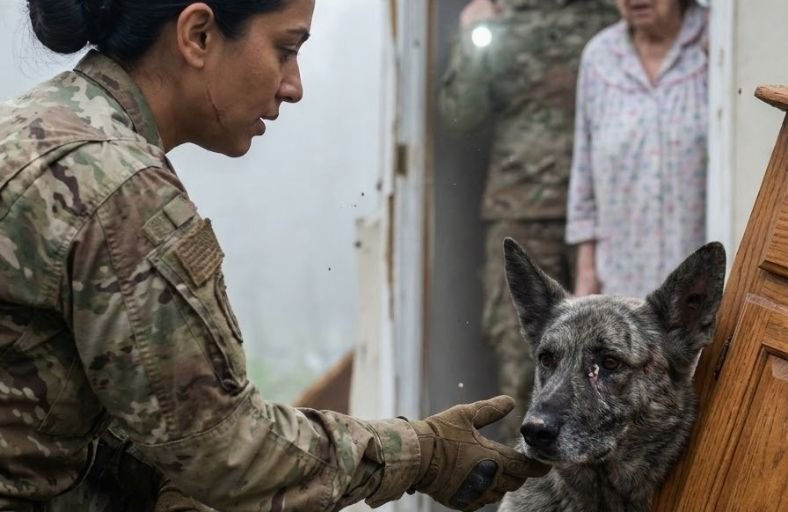
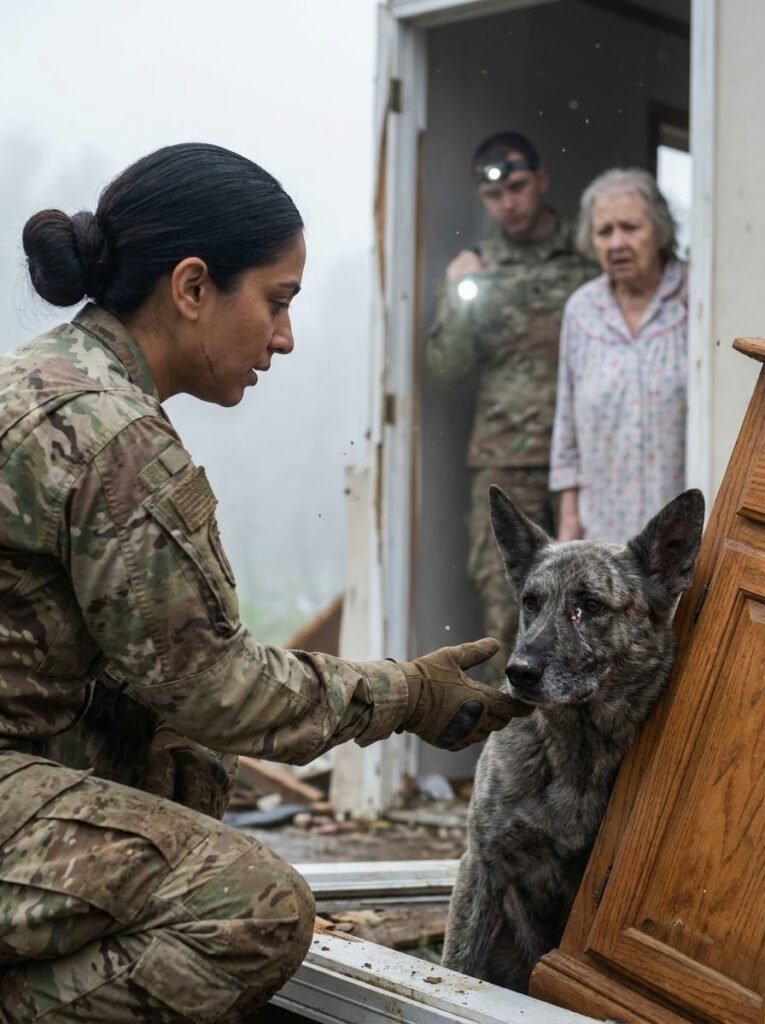
“Sergeant, this one might bite.” Specialist Marcus Webb kept his flashlight low, sweeping across shattered glass and cans of green beans that had rolled halfway across the kitchen floor.
Priya did not answer right away. She had learned, over three deployments and two years of disaster response duty with the Kentucky National Guard, that the moment you decided an animal was dangerous, you stopped watching what it was actually doing.
And this dog was not lunging. He was not barking at them the way a frightened, cornered animal barks.
He was standing his ground low and rigid beside a massive fallen oak hutch, lips curled just enough to warn them back, eyes darting constantly to the space beneath the cabinet.
She was thirty six years old, five foot six, with a thin white scar along her jaw from a training accident a decade earlier that she never explained to anyone who asked. She carried a unit challenge coin in her left breast pocket, and her thumb found it now without her deciding to move it there.
The tornado had come through Briarcreek, Kentucky just after eleven the night before, an EF3 that tore a quarter mile path through the Willow Row mobile home community.
Priya’s squad had been running search sweeps since four in the morning, moving from one flattened home to the next, calling out, listening for anything human in the wreckage.
This particular single wide had lost half its roof and one whole wall had folded inward. A heavy antique oak hutch, the kind meant to hold good china and family photographs, had toppled forward across what used to be a hallway.
The dog stood almost directly beneath it.
“He’s guarding something,” Marcus said. “Food, probably. Half the pantry’s dumped out right there.”
It was a reasonable guess. Cereal boxes, a split bag of flour, canned peaches, all scattered across the linoleum in a mess that did look, at first glance, exactly like the kind of chaos a hungry, panicked dog might defend.
Priya crouched anyway, slow, palms open.
She was not from Briarcreek originally.
She had grown up two hours north in Louisville, the daughter of a pharmacist and a high school math teacher, and she had joined the Guard at nineteen partly to pay for nursing school and partly, if she was honest with herself, because she had never once in her life wanted to be the person who stood back and watched someone else run toward trouble.
That instinct had cost her something two years earlier, during flash flooding near Pikeville, and she still had not fully forgiven herself for what it cost. She did not think about that now. She could not afford to.
“Marcus, get me the catch pole just in case,” she said, “but don’t bring it close yet.”
The dog was a mix, German Shepherd through the shape of his skull and the set of his ears, something leaner and faster in his build, probably Belgian Malinois.
He was around five years old, brindle gray, with a notched left ear that looked like an old injury long healed and a thin pale scar above his right eye.
His ribs showed faintly through his coat, not from starvation but from the kind of hard, sustained tension that burns through an animal fast.
He had been standing like this, Priya would later learn, for nearly an hour.
Marcus tossed a strip of beef jerky from an MRE toward him, an offering, an attempt to calm him down.
The dog did not even glance at it.
He turned his head, met Priya’s eyes directly, and scraped his front paw against the floor three times.
Scratch, scratch, scratch. Pause. Then again.
“That’s not guarding behavior,” Priya said quietly, almost to herself.
She had spent enough hours around military working dogs during her deployments to know the difference between an animal protecting territory and an animal trying, with everything he had left, to say something.
She eased closer, and the growl deepened, but his body did something strange as she moved, not forward, not lunging, but backward, pressing his shoulder harder against the base of the hutch as if bracing it from tipping further.
That was when she noticed the frame of the cabinet was not resting flat on the floor. It was tilted, wedged at an angle against a section of collapsed drywall, held there by something she could not yet see.
“Marcus,” she said, “get on the radio. Tell them we might have a live one.”
Behind them, in the doorway, an elderly woman in a faded pink housecoat clutched the frame and stared in at the scene with her hand pressed over her mouth.
Dolores Yates lived two lots down and had been the first neighbor to reach the wreckage after the storm passed.
“That’s Frank’s dog,” Dolores said, her voice shaking. “That’s Scout. Oh Lord, is Frank in there? Frank never leaves without Scout, he never would have left him behind.”
Priya felt something cold settle low in her stomach.
She looked back at the dog, at the way his paw kept striking the floor in that same deliberate rhythm, three taps, a pause, three taps again, and at the way his eyes never once left her face, as if he was waiting for her to finally understand.
Part 2 – The Night Margaret Taught Him to Tap
Two years before the tornado, on a Tuesday evening that felt like every other Tuesday evening on Willow Row, Frank Doyle sat across the kitchen table from his wife and watched her search for a word that would not come.
Frank was eighty one, six foot one even with the stoop age had given his shoulders, a retired long haul trucker who had spent thirty four years hauling freight between Louisville and the Gulf Coast before his knees gave out.
His left hand had gone slightly weak two years earlier after a minor stroke, enough that he dropped things sometimes, a coffee mug, a wooden spoon, without meaning to.
His wife Margaret had been married to him for fifty three years, and for the last four of them, a piece of her had been slipping away a little more each season.
That Tuesday, Margaret set down her fork and looked at Frank with an expression he had come to recognize and dread, the look of someone standing at the edge of a word she could not reach.
“The, the thing,” she said. “The, I need the, help me, Frank.”
He had learned, slowly and clumsily, that panicking only made it worse for her. So instead he had started something small, almost by accident, weeks earlier.
When she got stuck like this, he would tap the table three times, and she would tap back once if she was simply frustrated, or three times if she truly needed him to come to her, to sit beside her, to hold her hand until the fog cleared enough for language to return.
It became their private code. Three taps for help. One tap for I am still here, just give me a moment.
Scout was two years old then, newly adopted from a police canine training program that had washed him out for a reason nobody at the shelter could fully explain.
The trainers there had called him too soft, too attentive to human distress, unsuited for the aggression work the program required.
Frank had read that line on the shelter card and felt something click into place.
“Soft ain’t a flaw, son,” he told the young volunteer who handed him the leash. “Soft is exactly what we need around here now.”
Margaret took to the dog immediately, in the strange, uncomplicated way she still took to a handful of things even as so much else grew difficult.
She started including Scout in the tapping game without anyone teaching her to, tapping the floor near his paws the way she tapped the table for Frank, and Scout, ever watchful, ever eager to understand what these two people wanted from him, began tapping back.
Frank leaned into it. He turned it into something like training, three taps meaning find help, one tap meaning I hear you, stay close.
He never imagined he was teaching the dog a rescue signal. He only knew that it gave Margaret something to hold onto on the days when almost everything else slipped through her hands.
Margaret passed away eighteen months later, quietly, in her sleep, on a January night with snow falling outside their window.
Frank kept Scout’s tapping game alive anyway. He was not sure why, at first. Habit, maybe. Or the simple, aching need to keep one more piece of her present in the house.
Every evening after dinner, out of a ritual that had outlived its original reason, Frank would tap the kitchen table three times, and Scout would trot over and tap the floor back at him, once for hello, three times if Frank had been sitting too long and needed to get up and move.
None of the neighbors on Willow Row understood the game, though most of them had seen it. Dolores Yates, who lived two lots down and had known Frank and Margaret for nineteen years, used to laugh gently about it over the fence.
“That dog’s smarter than half the men I dated before I met my husband,” she told Frank once.
Frank never explained the real reason behind it. Some things, he had decided, belonged only to him and Margaret, and now, strangely, to the dog who had somehow learned her language before she was gone.
What Frank did not know, could not have known, sitting at that kitchen table two years earlier teaching a rescue dog a comfort game for his ailing wife, was that he was building the only tool that would one day save his life.
Part 3 – The Last Quiet Morning on Willow Row
The morning before the tornado hit, Willow Row looked exactly like it always did, unremarkable in the particular way small, settled places are unremarkable, right up until the moment everything changes.
Frank Doyle woke at five thirty the way he had woken every day for sixty years, trucker’s habit, he called it, even though his last long haul had been over a decade ago.
He made coffee, let Scout out into the small fenced yard behind the mobile home, and sat on the porch step watching the dog investigate the same three trees he investigated every single morning.
His daughter Carol Doyle Simms called around nine.
Carol was fifty two, a nurse practitioner who lived forty minutes away in Elizabethtown, and she called her father most mornings out of a habit that had started as worry after his stroke and had settled, over time, into something closer to comfort for them both.
“You watching the weather, Dad?” she asked. “They’re saying there could be storms tonight.”
“I got eyes, Carol Anne,” Frank said, using the middle name he only used when he wanted to sound more exasperated than he actually was. “I’ll bring the porch chairs in.”
“I need to borrow the truck this afternoon,” Carol added. “Mine’s in the shop till Thursday. I’ll drop it back tomorrow.”
This detail, small and forgettable in the moment, would matter enormously by the following morning.
Frank handed his truck keys over to Carol just after noon, and by the time the tornado sirens sounded that night, his driveway sat empty, exactly the way it would look if a man had already evacuated and driven himself somewhere safe.
Nobody on Willow Row knew that yet. Nobody had any reason to think about it.
The afternoon passed the way spring afternoons in Kentucky pass, warm and a little too still, the kind of stillness longtime residents learn to distrust.
By six o’clock the sky had gone the color of a bruise, greenish gray, heavy in a way that made the birds go quiet all at once.
Frank brought the porch chairs in, just as he’d promised Carol, and turned on the local news out of Louisville.
The meteorologist’s voice carried the particular tightness of someone who had seen the radar and did not love what it showed him.
At 10:47 p.m., the tornado sirens across Hardin County began to wail.
Frank moved as fast as his knees allowed, herding Scout toward the hallway closet, the safest interior space in the small home, the way emergency broadcasts had told him to for years.
He grabbed a flashlight, an old wool blanket, and, out of a habit he could not have explained to anyone, Margaret’s wooden recipe box, the one thing from the kitchen he always thought to save first.
He never made it fully into the closet.
The wall gave way first, the sound of it later described by survivors up and down Willow Row as something between a train and a scream.
The old oak hutch in the hallway, the one that had held Margaret’s good china for forty two years, tore loose from its bolted anchor and came down across the narrow space where Frank had been standing.
He remembered very little of the impact itself. He remembered the pressure across his chest and legs, sudden and enormous, and then a strange muffled quiet, as if the whole world had been wrapped in cotton.
And he remembered Scout, immediately, impossibly close, pressed against his side in the narrow gap the fallen cabinet had left, refusing to be anywhere else.
For the first twenty minutes, Frank stayed conscious enough to speak, to tell Scout to go, to find someone, the same command they had practiced a hundred times in the tapping game. Three taps for help.
Scout did try.
Neighbors would later piece together his path from paw prints in the mud and torn insulation, out through the collapsed wall, across the debris field toward Dolores Yates’s porch light, then back again when no one answered fast enough, then out once more toward a group of voices near the community center before turning back a second time.
Each time, he returned to Frank’s side within minutes, as if some instinct told him that leaving too long risked losing the only person he had left.
By the time rescue teams reached Willow Row just before dawn, Frank had drifted in and out of consciousness for hours, and Scout had planted himself against the base of the fallen hutch, bracing his own body weight against it every time a gust of wind or a shifting piece of debris threatened to drop it the final few inches onto the man beneath.
Neighbors who saw him standing there in the gray early light assumed, understandably, that he was simply guarding the wreckage out of fear.
They had no way of knowing he had been holding a promise instead.
Part 4 – The Notebook Carol Found in the Truck
Priya had been on the ground at Willow Row for six hours by the time Carol Doyle Simms arrived, and the discovery that finally broke the mystery open came from the last place anyone was looking.
By mid morning, her team had confirmed what Scout’s tapping had been trying to tell them from the start.
Beneath the tilted hutch, wedged in the narrow crawlspace between a collapsed interior wall and the cabinet’s heavy oak frame, Frank Doyle lay pinned, conscious in flickers, his breathing shallow but steady.
“Sir, can you hear me? We’re going to get you out.” Priya kept her voice low and even, the tone she used with every survivor, calm enough to borrow.
Frank’s eyes opened partway. His lips moved, cracked and dry.
“Scout,” he whispered. “Good boy. Good boy, Scout.”
It was Marcus who first raised the idea of pulling the hutch free quickly, a fast extraction to get weight off Frank’s chest before his breathing worsened further.
Scout would not allow it.
Every time a guardsman reached toward the cabinet’s edge, the dog inserted himself between them and the frame, low growl rising, until Priya finally understood what her instincts had been circling around for the last hour.
“He’s not stopping us from helping,” she said. “He’s stopping us from doing it wrong.”
The structural engineer attached to their unit confirmed it moments later.
The hutch’s frame had partially fractured in the fall, and the only thing preventing its full weight from crushing down onto Frank was the fragile, temporary bracing of collapsed drywall, exactly the kind of load that could shift catastrophically the second someone yanked the cabinet free without support.
They needed cribbing blocks first, wooden supports wedged carefully beneath the frame to stabilize it before any weight was lifted.
Scout, somehow, seemed to understand this before the humans finished saying it out loud.
He only stepped back, finally, once the first cribbing block slid into place beneath the hutch’s corner, as though some deep animal calculation in him had recognized the danger had passed.
That was when Carol Doyle Simms arrived, having driven forty minutes with her hands shaking on the wheel after a neighbor’s frantic phone call.
She ran toward the wreckage calling her father’s name, and it was Dolores Yates, meeting her at the edge of the debris field, who said the words that had been quietly troubling every rescuer on scene since sunrise.
“Carol, honey, your daddy’s truck wasn’t in the driveway. We all figured he’d gotten out before the storm hit.”
Carol went pale.
“That’s because I had it,” she said. “I borrowed it yesterday afternoon, mine’s in the shop. Oh God, everyone thought he’d already left, didn’t they.”
The missing truck, an innocent, ordinary detail from an ordinary afternoon, had nearly cost searchers a full day, until Scout’s refusal to abandon the wreckage forced them to look closer regardless.
While paramedics worked to stabilize Frank enough for careful extraction, Carol climbed into the borrowed truck to retrieve her father’s insulin kit from the glove compartment, something she knew he kept there out of habit from his trucking years.
Tucked beside the insulin case, she found a small, water stained spiral notebook she did not recognize.
Inside, in her mother Margaret’s increasingly shaky handwriting from her final year, were pages of notes about the tapping game, written the way Margaret had written everything toward the end, as reminders to herself for things she feared she would forget.
Three taps means help.
One tap means I am still here.
Teach Scout. Don’t forget, even when I do.
Carol sat frozen in the driver’s seat for a long moment, the notebook trembling in her hands, before she carried it back toward the wreckage and pressed it into Priya’s hands.
“My mother taught that dog this signal,” Carol said, her voice breaking. “Years ago. Because of her Alzheimer’s. My dad kept doing it with him after she passed, I thought it was just, I don’t know, a sweet habit. I never understood it might actually mean something like this.”
Priya looked down at the water stained pages, then across the wreckage at Scout, still pressed close against Frank’s side, still watching every movement around him with fierce, exhausted attention.
Something in her chest tightened in a way that had nothing to do with the rescue in front of her, and everything to do with a flood two years earlier, and a soldier named Danny, and all the ways she had learned, since then, that love sometimes speaks in signals long after the person who first taught them is gone.
Part 5 – What Dr. Reyes Said About Grief
The extraction took eleven more minutes once the cribbing blocks were fully set, eleven minutes that felt, to everyone standing in the wreckage of Willow Row, considerably longer than that.
Priya knelt at Frank’s shoulder the entire time, one hand braced against the stabilized frame, the other resting lightly on Scout’s back to keep him calm as two guardsmen worked the hutch free in slow, careful stages.
The dog trembled under her palm, exhausted past the point most animals could sustain, but he did not move from Frank’s side, not once, not even when the final section of cabinet lifted clear.
“There you go, Frank. There you go.” Paramedic voices layered over each other as they finally reached him fully, checking his vitals, sliding a collar carefully around his neck as a precaution.
Frank’s eyes found Scout immediately.
“Good boy,” he rasped, his weak left hand rising just enough to brush the dog’s paw. “Good boy, Scout. Three taps. You did it.”
Carol rode with her father in the ambulance to the hospital in Elizabethtown, the water stained notebook clutched against her chest the entire drive.
Scout, filthy, trembling, and refusing to leave a ten foot radius of anyone connected to Frank, went home with Dolores Yates for the afternoon, wrapped in a towel on her porch while animal control cleared him medically fit.
Priya did not see Scout again for three days, not until she stopped by the hospital on her own time, still not entirely sure why she felt compelled to, and found Dr. Anita Reyes already there.
Dr. Reyes was forty five, a local veterinarian who also volunteered as a grief counselor for the county’s disaster response program, a combination of credentials that made her one of the few people in Hardin County equipped to sit with both Frank and his dog at once.
She had brought Scout to visit Frank’s hospital room that afternoon, an unofficial arrangement the nursing staff quietly allowed once they understood the story.
“He’s not just a comfort animal to him,” Dr. Reyes said to Priya in the hallway afterward, watching through the door as Frank’s good hand rested on Scout’s head. “He’s the last living piece of a language Frank built with his wife. Some people process grief in photographs, or in letters, or in a garden they keep planting even after the person’s gone.”
“Frank processed it in taps on a kitchen floor,” Priya said quietly.
“Exactly.” Dr. Reyes nodded. “Grief does not go away, Sergeant. It just learns a new language. And sometimes it takes a dog’s paw against a wooden floor to remind us that someone is still listening.”
Priya stood with that sentence for a long moment, longer than the conversation itself seemed to call for.
She thought of Danny, the young private she had pulled from the current near Pikeville two years earlier, too late, no matter how hard she had fought the water that day.
She thought of the challenge coin still in her breast pocket, worn smooth now from two years of her thumb finding it in moments exactly like this one.
She had never found a language for that grief. She had simply carried it, silent and unspoken, the way she imagined Frank had once carried his before Scout learned to answer him back.
“Can I go in?” she asked.
Dr. Reyes stepped aside.
Frank looked smaller in the hospital bed than he had in the wreckage, but his eyes were clearer now, sharp with the particular gratitude of a man who understood exactly how close he had come.
“You’re the one who wouldn’t let Marcus use the catch pole,” he said, a faint smile pulling at his mouth.
“I had a feeling,” Priya said.
“Scout don’t guard food,” Frank said. “Never has. That dog was guarding a promise. Same one he’s been keeping since my Margaret taught it to him, near four years back now.”
Scout lifted his head from the blanket at the sound of his name, ears swiveling toward Priya, tail giving one slow, tired sweep against the mattress.
Priya reached out and let him sniff her hand, the same gesture she had offered him in the wreckage three days earlier, except this time there was nothing left to guard, nothing left to fear, only a quiet, mutual recognition passing between them.
“Thank you,” Frank said, “for listening when everybody else just heard growling.”
Priya did not trust her voice fully in that moment, so she only nodded, and rested her hand gently on Scout’s head beside Frank’s, two people who had each, in their own separate ways, learned that love does not vanish when it loses its words. It simply waits for someone patient enough to hear it differently.
Part 6 – The Night of the Storm Sirens
Frank came home from the hospital eleven days later to a Willow Row that barely resembled the place he had lived in for two decades.
FEMA trailers dotted the lots where mobile homes had once stood. Volunteer crews from three counties worked in rotating shifts clearing debris.
Dolores Yates’s house, spared by six feet and pure chance, became an informal gathering point where neighbors traded news, casseroles, and slow, careful updates on who was recovering and where.
Carol had insisted her father stay with her in Elizabethtown while repairs were arranged, and Frank had agreed, on one condition.
“Scout comes with me,” he said, in a tone that made clear it was not actually a negotiation.
The two of them settled into Carol’s guest room together, and within a week, the tapping game had resumed exactly where the tornado had interrupted it, three taps on the nightstand each evening, one tap back from Scout, curled at the foot of the bed, ears flicking toward the sound even in half sleep.
Priya visited twice during that first month, official welfare checks that stretched, each time, well past their official purpose.
On her second visit, in late April, a genuine spring storm rolled through Hardin County, no tornado this time, only heavy wind and hard rain, but enough to trigger the county’s siren system as a precaution.
Frank froze the moment the first note sounded through Carol’s open kitchen window.
His hand went white knuckled around his coffee mug. His breathing shortened, quick and shallow, the particular panic of a body remembering something the mind had not fully processed yet.
Scout was against his leg within seconds, pressing his full weight there, exactly as he had against the fallen hutch weeks earlier, an anchor instead of a wall this time.
“Frank.” Priya crouched in front of him, keeping her voice level, the same tone she had used in the wreckage. “You’re safe. You’re in Carol’s kitchen. The sirens are just a precaution.”
It took almost four full minutes for his breathing to steady.
“Sorry,” Frank said afterward, embarrassed in the particular way strong, self reliant men often are about fear they cannot fully control. “Eighty one years old and a siren still about knocks me flat.”
“Don’t apologize,” Priya said. “I still hear rushing water sometimes when I’m nowhere near a river.”
She had not meant to say that last part out loud. She had certainly not meant to say it to a man she had known for barely a month.
But Frank only nodded, the way people who have survived something enormous often recognize the same thing surfacing in someone else, without needing the full story explained.
“Healing ain’t a straight road,” he said. “Margaret used to say pain don’t disappear, it just learns to sit quieter, if you’re patient with it.”
Scout, still pressed against Frank’s leg, let out a low breath and settled, satisfied that the danger, whatever shape it had taken this time, had passed.
By early June, the community had established a new small ritual of its own. Every Sunday evening, a handful of Willow Row families gathered on Dolores Yates’s porch for what she had started calling storm supper, a standing invitation for anyone still displaced or simply needing company as the neighborhood slowly rebuilt.
Frank and Scout came every week without fail, Frank in his folding chair with the bad knee stretched out, Scout curled at his feet, tail thumping lazily whenever a new voice arrived.
Priya joined when her schedule allowed, off duty, out of uniform, no longer there as a sergeant but simply as someone the neighborhood had folded, almost without noticing, into its slow process of putting itself back together.
The nightmares about Pikeville did not disappear. Neither did the hollow, guilty ache Frank still carried in the quiet hours before sunrise when Margaret’s side of the bed had been empty too long.
But something had shifted, small and steady, in both of them, the same way it had shifted in Scout the moment the cribbing blocks finally held the hutch’s weight and he understood, at last, that he could rest.
Part 7 – The Day Scout Walked Back to Willow Row
A full year after the tornado, on a bright Saturday morning in late spring, Frank Doyle stood in front of a newly built single wide on the same lot where his old home had stood, and watched Scout, now six years old, trot the fence line the way he had trotted it every morning for years before the storm.
The new home was smaller than the old one, easier for Frank’s knees to manage, but Carol had insisted on one detail before construction finished.
In the front hallway, mounted low on the wall where anyone could reach it, hung a small wooden plaque, hand carved by a veteran in Dolores Yates’s church group.
Three taps for help. One tap for I hear you.
Frank touched it every morning on his way to make coffee, the same unhurried habit he had carried since long before the tornado, since long before Margaret slipped away, a ritual that had outlived two homes now and showed no sign of stopping.
Scout had slowed down only slightly with age, a little gray creeping into the brindle around his muzzle, but the notch in his left ear and the thin scar above his right eye remained exactly as they had been, small, permanent proof of everything he had carried.
Priya still visited most Sundays, no longer in uniform, welcomed now the way any regular neighbor might be welcomed, carrying whatever dish Dolores had assigned her for that week’s storm supper, a tradition that had, somehow, outlasted the disaster that started it.
She had gone back to Pikeville that spring, for the first time in three years, and stood at the edge of the river where she had lost Danny, and said his name out loud, and let herself cry in a way she had never fully allowed herself before.
She had told Frank about it afterward, sitting on his new porch steps while Scout dozed between them in a patch of afternoon sun.
“Took me two years and an eighty one year old man and his dog to teach me that,” she said. “Grief doesn’t need permission to stay. It just needs somebody willing to still listen to it.”
“Sounds about right,” Frank said. “Margaret used to say the same thing, different words. Said love don’t end when somebody goes quiet. It just needs a new way to talk.”
Scout lifted his head at the sound of Frank’s voice, thumped his tail twice against the porch boards, and settled back down between the two of them, content, the way an animal settles only when every person he loves is finally, fully safe.
Willow Row had rebuilt itself slowly over that year, not perfectly, not without scars of its own, new homes standing beside empty lots still waiting for owners who had chosen not to return, storm sirens tested every first Saturday of the month, a sound the whole community had learned to live alongside rather than fear completely.
But on quiet evenings, if you walked past Frank Doyle’s front porch, you could still hear it, three soft taps against a wooden railing, followed a moment later by one gentle answering thump of a dog’s paw against the boards, a language two people built out of love and forgetting, kept alive now by the one who never forgot at all.
If this story touched your heart, follow this page for more unforgettable dog stories about loyalty, rescue, and the quiet ways our pets carry us through the hardest days.