
Part 1
The dog had stopped eating two days before anyone thought to check his intake papers.
Priya Anand noticed it first, at 11 PM on a Tuesday, halfway through a shift she was not supposed to be working alone.
She was twenty seven, Indian American, small framed with a long braid she kept tucked under her scrub cap, and she had a habit of talking to the animals like they could talk back.
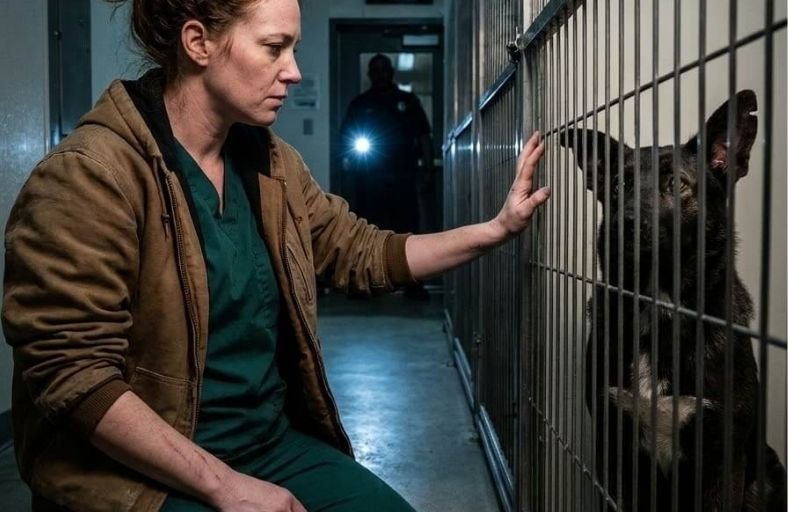
She crouched by Diesel’s kennel with a bowl of food he had not touched since Sunday.
“You’re not aggressive,” she said quietly. “I don’t know what they wrote about you, but you’re not that.”
He was a German Shepherd mix, roughly six years old, with a crescent of white fur on his chest and a small notch cut into his left ear from some old fence he had once caught himself on.
He did not growl. He did not bare his teeth.
He pressed himself into the back corner of the kennel and shook, the way a dog shakes when the fear has been living in him for a long time.
Priya pulled up his file on the shelter tablet.
Surrendered four days earlier. Owner listed as Grant Whitfield. Reason for surrender: fear based aggression, biting risk, not safe around children.
Scheduled for euthanasia Thursday at 6 PM, unless claimed or adopted before then.
She frowned at the screen. The behavior assessment notes did not match the dog in front of her.
There was no bite history flagged. No prior complaints. Just one man’s signature and a rushed intake three days after a divorce had been finalized in the Buncombe County courthouse.
Priya had learned, in two years at the shelter, that the paperwork did not always tell the truth. Sometimes it told the story of whoever filled it out fastest.
She scrolled to the emergency contact field.
It was empty. But under a previous adopter tab, buried in an older record the system had not fully overwritten, there was a name.
Dana Whitfield.
A phone number, six months out of date but still close enough to guess.
Priya sat with that for a long moment, chewing the inside of her cheek.
Then she typed a text she was almost certainly not allowed to send.
Is this your dog? Diesel, German Shepherd mix, surrendered by a Grant Whitfield. He’s scheduled for Thursday. I don’t think the paperwork is right.
She hit send before she could talk herself out of it.
Forty one miles away, at Mission Hospital, a phone buzzed in the pocket of a woman restocking IV bags in Bay 6.
She was thirty four, with auburn hair pinned back so tightly it gave her a permanent look of alertness, and a thin pink scar along her left forearm from a kitchen fire nobody at work had ever asked about.
Nine years of marriage had trained her to keep most things folded small and out of sight, including the fact that some nights, on her drive home, she still gripped the wheel like she was bracing for an argument that was no longer waiting for her at the door.
She had been divorced for six months. She still checked her rearview mirror out of habit that had nothing to do with traffic.
She read the text twice standing in the supply closet, her stomach dropping somewhere below the tile floor.
Diesel had gone with Grant in the settlement.
She had not fought for him, not really, not the way she should have. Grant had wanted him listed under his name for insurance reasons during the divorce, and she had been too exhausted, too raw, to argue about a dog when she was still arguing about everything else.
She had told herself Diesel was fine. Grant loved him too, in his own controlling way.
She had told herself a lot of things in the last year that turned out not to be true.
She typed back with shaking thumbs.
Yes. That’s my dog. What do you mean the paperwork isn’t right?
Priya’s reply came fast.
He’s terrified, not aggressive. And the surrender happened four days ago. No notice to you at all. If you want him back you need to come in before Thursday at 6.
Dana looked at the clock. It was 11:14 PM on a Tuesday.
Two days and nineteen hours.
She thought of the sound Diesel made when thunderstorms rolled through the mountains, the way he would press his whole body against her legs in the hallway until it passed.
She thought of Grant’s face the day he told her, halfway through the divorce, that the dog “understood loyalty better than she ever had.”
She had let that comment sit in her chest like a stone for weeks.
Now it felt like something closer to a threat that had already been carried out.
Her supervisor found her five minutes later, still standing in the supply closet with her phone in her hand.
“Whit, you good?”
Dana looked up. “I need to leave a little early tomorrow. Family emergency.”
It was not technically a lie.
She drove home before dawn with the window cracked despite the cold, the way she used to when Diesel rode shotgun with his head out, ears back, entirely unbothered by the wind.
In the trunk of her car, under a spare blanket and a bag of rock salt she kept for icy mornings, there was a cracked leather leash she had never been able to make herself throw away.
She had bought it eight years ago, for a different dog, in a different life, before Grant, before the marriage, before she had learned to make herself smaller to keep a house quiet.
She did not know yet why her hands wanted to reach for that leash specifically.
She only knew that somewhere across town, a dog with her name still buried in his file was running out of days, and that this time, she was not going to fold herself small and let it happen.
Part 2 – The Bridge on Haywood Street
Eight years before the text message, Dana had been twenty six years old, three years into dating Grant, and still the kind of person who pulled her car over for stray animals.
It was late October, cold rain slicking down Haywood Street, when she saw something moving under the bridge near the river.
She parked without thinking twice.
The puppy was maybe four months old, soaked through, ribs visible under a coat that would one day grow thick and dark. He flinched hard when she reached for him.
He did not run.
She sat in the mud for twenty minutes before he let her touch him, talking low and steady the whole time, the same voice she would later use on frightened patients in the ER without ever noticing she had learned it from a dog.
She named him Scout, because he had been the one who found her, crouched under that bridge like he’d been waiting.
For two months, Scout slept at the foot of her bed. He chewed one corner of her favorite armchair. He learned to sit before he learned to fully trust that food would keep coming.
Grant did not like him.
He said it in small ways at first. The shedding. The vet bills. The way Scout would growl softly if Grant raised his voice during an argument, as if the dog understood something about the relationship before Dana let herself understand it.
“It’s him or the wedding planning gets a lot harder,” Grant told her one night, only half joking, the kind of half joking that was really a whole truth wearing a costume.
She gave Scout to a coworker’s sister two towns over, a woman named Renee who had a farm and two other rescue dogs and swore up and down she would take good care of him.
Dana told herself it was the responsible choice. She told herself a lot of things that year.
She kept his leash anyway, cracked leather with a brass clip, and put it in the trunk of her car, telling herself she would use it again someday for a different dog.
She married Grant the following spring.
For a long time she did not let herself think about Scout at all. It was easier that way. It was easier the way a lot of things were easier if she just did not look directly at them.
Three years ago, six years into the marriage and already feeling the cracks under the floorboards, Dana found a rescue listing online for an adult German Shepherd mix named Diesel.
Something about his face stopped her scrolling.
She told herself it was coincidence, the shape of the ears, the quiet way he sat in his shelter photo, not looking at the camera but slightly past it, like he was watching a door.
She adopted him within the week. Grant, oddly, did not fight her on this one. He even seemed pleased, the way people sometimes get pleased when they think a thing will keep someone else occupied and easier to manage.
Diesel settled into their house like he belonged there. He flinched at raised voices the way Scout once had. He pressed against her legs during storms exactly the way Scout used to.
She never once let herself finish the thought that started to form.
Now, sitting in her kitchen at 6 AM after a night shift, staring at a text from a stranger named Priya, that thought finally finished itself.
She pulled up an old cloud folder on her laptop, one she had not opened in years, full of photos from a life she barely let herself remember.
There he was. Muddy, soaked, four months old, sitting under a bridge on Haywood Street with a crescent of white fur just beginning to show on his chest.
Dana’s hands went cold.
She had never had Scout microchipped, not in those two rushed months before she gave him up. Or had she?
There had been one visit to a low cost clinic downtown, the week before she handed him over to Renee, a visit she had made almost on impulse, some instinct telling her to protect him even as she was preparing to let him go.
She could not remember if she had followed through on the paperwork.
She closed the laptop, grabbed her car keys, and drove straight to the county shelter, still in yesterday’s scrubs, the cracked leather leash sitting on the passenger seat where Diesel used to ride.
She did not have a plan beyond getting to him.
She had learned a long time ago what happened when she waited for someone else’s permission to protect the things she loved.
She was not going to wait this time.
Part 3 – The Number That Didn’t Match
The Buncombe County Animal Shelter sat off a two lane road on the edge of town, a low brick building with a chain link run out back and a lobby that smelled like bleach and wet fur.
Dana arrived at 8:02 AM, two minutes after opening, and asked for Diesel by name.
The front desk volunteer, a retired schoolteacher named Barb, pulled up the file and hesitated.
“He’s listed under a hold from a Mr. Whitfield,” Barb said carefully. “Are you the co owner?”
“I’m his owner,” Dana said. “I was married to Grant Whitfield. He surrendered our dog without telling me.”
Barb’s face softened in the way of someone who had heard this exact sentence before, in different words, from different women.
“Let me get Dr. Brooks.”
Dr. Elena Brooks came out from the back within minutes, forty five, steady eyed, wiping her hands on a paper towel. She had the calm of someone who had delivered a thousand pieces of hard news and learned not to flinch while doing it.
“You’re here about the shepherd mix,” she said. It was not quite a question.
“I need to see him,” Dana said. “And I need to understand what happened to the paperwork, because the woman who texted me last night said the surrender didn’t add up.”
Dr. Brooks glanced toward the back hallway, then back at Dana.
“Come with me.”
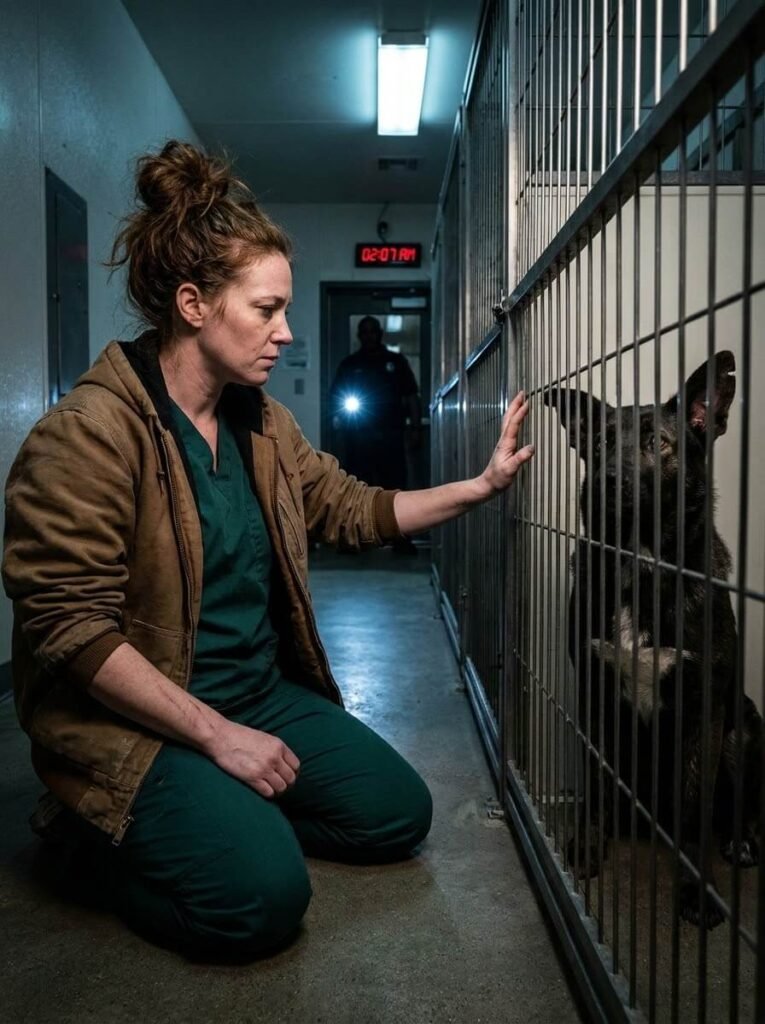
They walked past a row of kennels, dogs rising and falling against the bars as they passed, until they reached the last one on the left.
Diesel was pressed into the corner, exactly where Priya had described him the night before.
He lifted his head at the sound of Dana’s voice before he even saw her.
“Hey, buddy,” she said softly, crouching low the way she had learned to do eight years ago under a bridge in the rain. “Hey. It’s me.”
He crossed the kennel in three steps and pushed his head against the bars, into her open hand, his whole body shaking with something that was not fear anymore.
Dr. Brooks watched the reunion for a moment before speaking.
“That’s not the reaction of an aggressive animal,” she said quietly.
Dana felt her throat tighten. “I know. I know he’s not.”
“There’s something else,” Dr. Brooks said. “When we scanned him for a chip during intake, the reader picked up two numbers layered close together, an old signal and a newer one. It’s rare, but it happens when an animal’s been chipped twice over the years, sometimes by different owners who didn’t know about the first one.”
Dana’s stomach dropped.
“The newer chip is registered to Grant Whitfield,” Dr. Brooks continued. “Filed three years ago, when you say you adopted him from a rescue listing.”
“And the older one?”
Dr. Brooks looked down at a printout in her hand, the ink slightly faded.
“The signal’s weak. We haven’t been able to fully pull the registration yet. It’s old enough that it might be with a different provider than the one we use now. I’ve got someone trying to track it down.”
Dana looked at the crescent of white fur on Diesel’s chest, the small notch in his left ear, and felt something she had been holding at arm’s length for eight years finally step into the light.
“I think I know what it’s going to say,” she said.
Dr. Brooks studied her face. “Why don’t you tell me.”
“Because I think I already met this dog once,” Dana said. “A long time before I ever adopted him. I think his name used to be Scout.”
Dr. Brooks did not answer right away. She looked at the dog, then at the printout, then back at Dana.
“If that’s true,” she said slowly, “then whatever’s about to come up in that record is going to matter a lot more than a scheduling hold.”
Behind them, a security guard named Walt Higgins had come around the corner, drawn by the sound of a dog crying with something other than fear, and stood in the hallway watching a woman kneel in front of a kennel like she had found something she thought she had lost for good.
He did not know the whole story yet.
But he had spent thirty one years as a sheriff’s deputy learning to recognize the difference between a person causing trouble and a person trying to undo it.
He recognized which one this was.
Part 4 – What Dr. Brooks Found in the Old File
The provider on the older chip took most of the day to respond.
Dana was not allowed to see Diesel during business hours, shelter policy while ownership was in dispute, so she sat in her car in the parking lot on her day off, drinking gas station coffee and watching the front door like it might open on its own.
Walt Higgins found her there around noon, tapping on her window with two knuckles.
He was sixty one, broad shouldered, with close cropped gray hair and the kind of stillness that came from decades of walking into rooms where anything could happen.
He had been a sheriff’s deputy for thirty one years before retiring into shelter security, a job he took, he liked to say, because animals never lied to him the way people sometimes did.
“You’ve been out here three hours,” he said, not unkindly. “Come inside. Dr. Brooks wants to talk to you.”
Dana followed him in, her legs stiff from sitting.
Priya was already in the small back office when they arrived, along with Dr. Brooks, a laptop open on the desk between them.
“We got the record,” Dr. Brooks said, gesturing for Dana to sit. “It took some digging. The provider changed systems twice in the last eight years, which is part of why it didn’t show up in a normal scan.”
She turned the laptop screen toward Dana.
An old registration form, digitized from what had clearly once been paper. A low cost clinic downtown, a date eight years back, a name typed carefully into the owner field.
Dana Whitfield.
Dog’s name: Scout. Approximate age at chipping: four months. Breed: German Shepherd mix.
Dana pressed a hand over her mouth.
“I did file it,” she whispered. “I forgot I actually filed it.”
“You never transferred or deactivated the chip when the dog was rehomed,” Dr. Brooks said gently. “Which means legally, and honestly, emotionally, you never fully let him go. The system just never let go either.”
Priya spoke up from the corner, her voice careful. “There’s more. I called Renee, the woman listed on an old vet record from four years ago as a secondary contact.”
Dana’s head snapped up. “You found Renee?”
“She still had your old coworker’s number saved,” Priya said. “She told me Scout got out of her fence about four years ago, during a storm. She looked for him for weeks. She never found him. She always assumed the worst.”
The room went quiet.
Dana thought of the rescue listing she’d found three years ago, a stray picked up wandering near a farm road outside town, no chip detected on the first pass because the reader back then had been an older, weaker model.
A year of running loose. A year of surviving on his own before someone finally brought him in and called him a stray, gave him a new name, and listed him for adoption.
And Dana, six years into a marriage that was already quietly cracking, had scrolled past his photo and felt something pull at her she never let herself examine.
“I thought it was a coincidence,” she said out loud, more to herself than to the room. “The way he looked. I told myself it was a coincidence.”
“It wasn’t,” Dr. Brooks said simply. “It was Scout. You rescued him twice without knowing it was the same rescue.”
Walt, standing by the door, cleared his throat.
“There’s one more thing you should know,” he said. “Mr. Whitfield came by an hour ago. Tried to expedite the surrender processing before you could file a claim.”
Dana’s whole body went cold. “What did you tell him?”
“I told him the file was under review pending a chip discrepancy,” Walt said. “Which was true. He didn’t love that answer.”
Dr. Brooks folded her hands on the desk.
“Legally, this changes things significantly,” she said. “The original chip predates his surrender by eight years, and it’s registered to you. Combined with the fact that the aggression report doesn’t match anything we’ve observed in three days of intake, I have real grounds to hold this euthanasia order entirely, regardless of Thursday’s deadline.”
Dana let out a breath she felt like she’d been holding since the text message two nights ago.
“Can I see him?”
Dr. Brooks nodded. “I think, actually, you should be the one to walk him out of that kennel.”
Priya was already standing, keys in hand.
Walt held the door.
Dana walked down the same hallway she had walked two days before, past the same rows of kennels, until she reached the last one on the left, where a dog who had once been a soaked, shivering puppy under a bridge on Haywood Street rose to meet her, eight years and one storm and one stranger’s cruelty later, exactly the way he had the very first time.
“Hey, Scout,” she said quietly, testing the old name out loud for the first time in almost a decade.
His tail moved, slow and uncertain, then faster, like the name had reached some part of him that had never fully forgotten it either.
Part 5 – The Room With the Empty Leash Hook
Dr. Brooks signed the release paperwork herself.
She listed the reason in careful, official language, discrepancy in ownership documentation, active prior microchip registration, behavioral assessment inconsistent with surrender report, but what she said out loud to Dana, once the forms were done, was simpler.
“You don’t surrender a dog you’re afraid of by accident,” she said. “You surrender him on purpose, and you write down whatever gets him processed the fastest.”
Dana clipped the old leash to Scout’s collar with hands that would not fully stop shaking.
The leather had cracked further with age, the brass clip a little duller than she remembered, but it still fit into her palm the exact same way.
Walt walked them both to the car, carrying nothing, just present, the way he had learned over thirty one years that some moments needed a witness more than they needed help.
“You did the right thing,” he said, at the driver’s side door. “Breaking a rule to fix a wrong one usually is.”
Dana had not told him yet about the fence she had climbed two nights earlier, the one that had gotten her caught on camera trying to reach Scout’s kennel from the outside run before shelter hours, the reason Walt had found her there in the first place.
He had let it go without a report. Some things, he’d told her quietly that first night, were not really break ins. They were just people trying to undo something that should never have happened.
Scout rode home with his head out the cracked window, ears back, entirely unbothered by the cold November air, exactly the way he had at four months old and exactly the way he had for three years as Diesel.
Grant called that evening.
Dana let it go to voicemail twice before she finally answered, standing in her kitchen with Scout pressed against her legs, already back in his old habit before she’d even had time to think about whether he remembered it.
“You had no right to go behind my back,” Grant said, before she’d said a word.
“You surrendered my dog for euthanasia without telling me,” Dana said. “I think we’re well past who had a right to what.”
“He’s dangerous, Dana. You don’t know what he’s like when you’re not around.”
“I know exactly what he’s like,” she said. “I’ve known for eight years. You’re the one who never bothered to find out.”
There was a long silence on the line.
“I found the paperwork,” Dana said quietly. “The old chip. His real name. I know you knew, or should have known, when you filed the surrender, that he was already mine before he was ever ours.”
Grant hung up without answering.
She did not call him back.
That night, for the first time in six months, Dana went into the spare room she had converted after the divorce, a room she used mostly for laundry now, and found an old hook still screwed into the wall by the door from years before, empty since the week she’d given Scout to Renee.
She hung the cracked leash there.
Scout followed her in and sat beneath it, looking up at the leash and then at her, as if some old part of him remembered exactly what that hook used to mean.
She thought about the thing Dr. Brooks had said to her that morning, standing in the shelter hallway while Scout leaned his full weight into her legs, the words that had settled into her chest and had not left since.
“Sometimes the thing we think we’re finally saving,” Dr. Brooks had told her, “is the same thing that already saved us once. We just forgot what we used to call it.”
Dana had not fully understood it in the moment.
She understood it now, sitting on the floor of a laundry room with a dog’s head heavy in her lap, in a house that finally, for the first time in nine years, felt like it belonged only to her.
Scout had not saved her from a burning building or a car crash.
He had saved her from a version of herself that had learned to give away the things she loved most, quietly, without a fight, because it was easier than the alternative.
Giving him up at twenty six had been the first time she folded herself small to keep a peace that was never really peace at all.
Getting him back at thirty four was the first time in nine years she had refused to fold at all.
“I’m not doing that again,” she said out loud, to no one, to the empty laundry room, to the dog who could not understand the words but understood, somehow, exactly what they meant.
Scout thumped his tail once against the floor and did not move from her lap for the rest of the night.
Part 6 – The Ice Storm Test
Three weeks later, the first real ice storm of the season rolled into Asheville on a Tuesday night, the kind that knocked out power lines across half the county and sent tree limbs crashing down onto quiet streets.
Dana had learned, in three years with Diesel and now in three weeks with Scout again, that storms had always been the hardest part.
He would press his whole body against her legs, shaking, panting, unable to settle no matter how calm she tried to sound.
She had assumed, quietly, that some fears simply did not heal. That some things a dog carried from being lost and alone for a year would just have to be managed forever, not undone.
The power went out at 9:40 PM, the house dropping into sudden darkness broken only by the blue white flash of ice hitting the windows.
Scout began to shake immediately, the way he always did, pacing tight circles by the back door.
Dana got down on the floor with him the way she had under the bridge eight years earlier, the way she had at the shelter kennel three weeks before, low and steady, her voice doing the only work it knew how to do.
“I’ve got you,” she said. “I’m not going anywhere. Nobody’s giving you up this time.”
He pressed into her, shaking, but he did not bolt for a door or hide under furniture the way he used to when Grant raised his voice.
He stayed exactly where she was.
Around midnight, with the power still out and the ice tapping steadily against the glass, her phone buzzed with a text from an unknown number.
This is Priya. Just checking on Scout, the storm’s bad tonight. How’s he doing?
Dana looked down at the dog curled against her side, no longer shaking quite as hard, his breathing slower than it had been an hour earlier.
He’s scared but he’s staying with me. That’s new. That’s really new.
Priya’s reply came fast, warm even through a screen.
That’s not new. That’s just him finally believing it’s safe to.
Dana sat with that in the dark for a long time, one hand resting on Scout’s chest, feeling the crescent of white fur beneath her fingers, the steady rhythm of his heartbeat slowing to match the quiet in the room.
By morning, the ice had coated every branch in the neighborhood in glass, and the power was still out, but Scout was asleep, fully stretched across the kitchen floor in a patch of pale winter light, something she had never once seen him do during a storm before.
Walt stopped by two days later, once the roads had cleared, dropping off a space heater he insisted she didn’t need to return.
He crouched down to greet Scout in the front hallway, and the dog, who had once flinched from every raised voice in his life, walked straight up to him and leaned his whole weight against the old deputy’s knees.
“He remembers you,” Dana said, surprised.
“Dogs remember who was gentle with them,” Walt said simply. “Doesn’t take long for them to sort that out.”
She had started bringing Scout by the shelter on her days off, not out of obligation but because Priya had asked, gently, if he might be willing to sit calmly near the intake kennels sometimes, for the newer arrivals who came in shaking the way he once had.
He was good at it in a way that surprised everyone but Dana.
He would lie down a few feet from a frightened new dog, not pushing, not demanding anything, just present, the way Walt had once been present for her in a shelter hallway, the way she had once been present for a soaked puppy under a bridge.
Grant had stopped calling by the second week. His lawyer sent one final letter regarding the dog’s legal status, which Dr. Brooks’s paperwork resolved without much argument once the old microchip record was entered into the file.
Dana kept the letter in a drawer she rarely opened.
She kept the leash on its hook by the laundry room door, no longer empty, no longer a reminder of what she had given away, but a reminder of what had somehow, against every reasonable odds, found its way back.
Part 7 – Eight Years, One Dog
Four years passed the way years do once a life finally settles into something steady.
Scout turned ten the following spring, his muzzle beginning to gray at the edges, his runs shorter but no less determined, still first at the back door every morning, still first to press against Dana’s legs during a storm, though the storms bothered him less now than they used to.
Dana left the ER for a slower pace two years in, taking a position training new nurses instead, work that let her be home most nights instead of most middays.
She still kept the cracked leash on its hook by the laundry room door.
She had bought Scout a new leash within the first month of getting him back, sturdier, brighter, easier on her hands during long walks along the greenway. She used the old one anyway, most days, because some things were not really about function.
Priya finished vet school two years after that first text message, and came back to Asheville to work alongside Dr. Brooks at the same shelter where a dog once sat shaking in the back corner of a kennel with four days left on a countdown that never should have started.
Walt retired from shelter security the year Scout turned eleven, though he still stopped by most Sundays, mostly, everyone suspected, to see the dog.
There was a framed photo on Dana’s kitchen wall now, a puppy under a bridge on Haywood Street, muddy and soaked and four months old, next to a photo taken the week he came home the second time, ten years old and gray at the muzzle, sitting calm beside a woman who no longer checked her rearview mirror out of old habit.
She thought sometimes about the year he’d spent lost, wandering after a storm broke through a fence, surviving on instincts nobody had taught him, finding his way eventually to a farm road and a stranger who called him a stray and never knew any better.
She thought about the version of herself who had let him go the first time, twenty six years old and already learning how to make herself small.
She did not blame that version of herself anymore. She had simply stopped being her.
Sometimes the thing we think we’re finally saving is the same thing that already saved us once, Dr. Brooks had told her, years earlier, in a small back office that smelled like antiseptic and wet fur.
We just forget what we used to call it, until something, or someone, or some old cracked leash in the trunk of a car, reminds us.
Scout passed peacefully in his sleep the winter he turned thirteen, curled in his usual spot by the back door, the leash still hanging where it had hung for years, the empty hook, this time, not a wound but simply a shape she had learned to live gently beside.
Dana still tells people, when they ask about the framed photo of a muddy puppy under a bridge, that she rescued that dog twice without knowing it was the same one both times.
What she usually leaves out, unless someone asks the right question, is that somewhere in between those two rescues, he had quietly been rescuing her the whole time too, one storm, one hallway, one hand through kennel bars at a time.
If this story touched your heart, follow this page for more unforgettable dog stories about second chances, quiet rescues, and the family we find our way back to.