
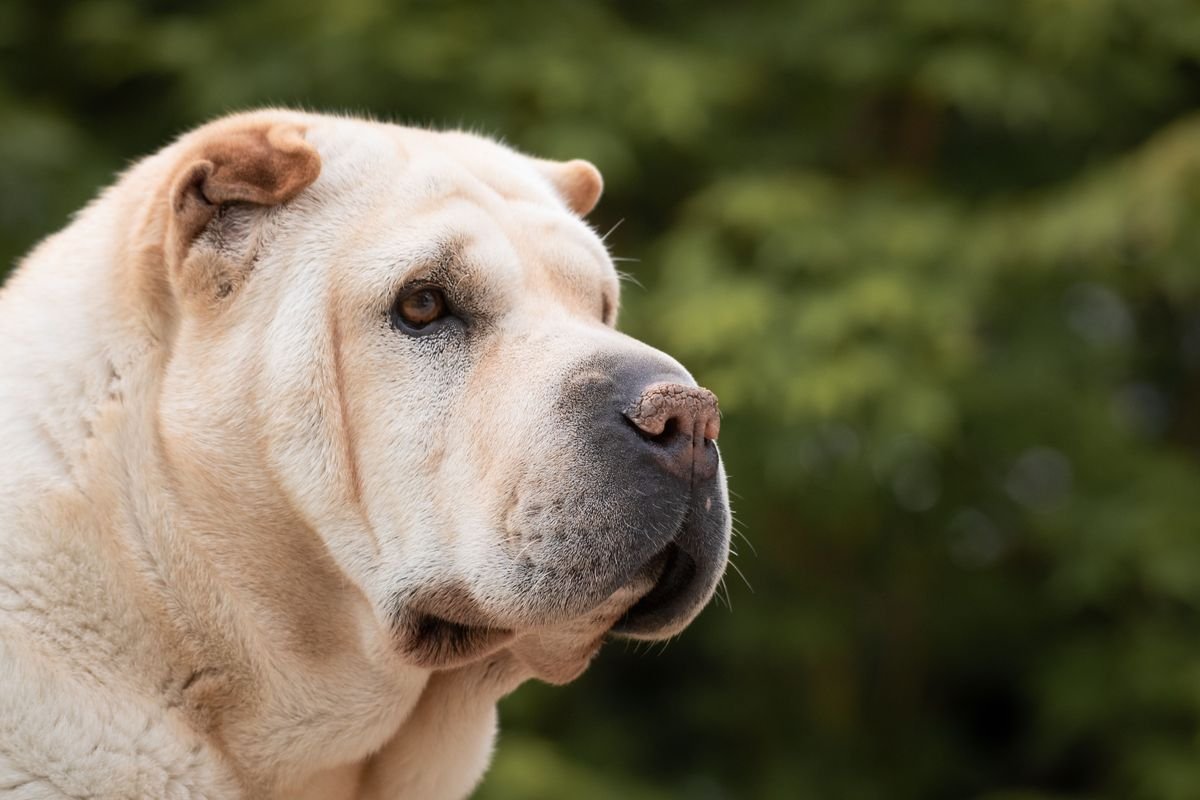
If you have ever looked at your dog and wondered whether that distinct bump under the lower lip qualifies as a chin, you are not alone. The question ‘do dogs have chins’ is surprisingly common among pet owners. The answer depends on how you define a chin. In human anatomy, the chin is the forward-projecting part of the lower jaw. But dogs have a different skull shape. Let’s examine the canine face to see if it includes a true chin.
Understanding Canine Facial Anatomy
To answer whether dogs have chins, we first need to understand the basic structure of a dog’s face. The lower jaw of a dog is called the mandible. It is a single bone that holds the lower teeth. The front part of the mandible, where the lower incisors sit, is the mandibular symphysis. In humans, this area is reinforced and projects forward to form the chin. In dogs, the mandible is more streamlined.
Dogs have a much longer snout than humans. Their premaxilla and nasal bones extend forward, creating a muzzle. The lower jaw is also elongated but does not have a prominent bony protrusion at the front. Instead, the lower lip and the surrounding soft tissue can create the appearance of a small bump, especially in certain breeds.
Do Dogs Have a Chin? The Scientific Answer
Strictly speaking, no, dogs do not have a chin in the human sense. A chin is defined as the forward-most part of the mandible that extends beyond the teeth. In humans, the chin is a unique evolutionary feature. It is believed to have developed to help withstand the stresses of chewing tough foods or to facilitate speech. Dogs, on the other hand, lack this bony projection. Their mandible does not extend beyond the lower incisors.
However, many people refer to the furry area under a dog’s lower jaw as its chin. This is a common colloquial usage. For example, when we say a dog has a ‘wet chin’ after drinking, we are talking about the area below the mouth. In that sense, dogs have a ‘chin’ as a descriptive region of their face, but not as a precise anatomical structure.
Differences Between Dog and Human Chins
The most obvious difference is that the human chin is a bony protuberance, while the dog’s ‘chin’ is primarily soft tissue. Human chin bones are unique among primates. Dogs do not have this feature. Another difference is the role of the chin in facial expression. Muscles around a human chin can move to express emotions like doubt or determination. Dogs use their entire muzzle and mouth for expressions but not the chin area specifically.
In terms of evolution, the human chin is considered a byproduct of other changes in skull shape, such as the shortening of the jaw. Dogs have undergone domestication, which altered their skulls, especially in brachycephalic breeds like Bulldogs and Pugs. These breeds have shorter snouts and may appear to have a more defined chin due to the relative position of their lower jaw, but anatomically it is still not a true chin.
Why It Matters for Dog Owners
Understanding whether dogs have chins can affect how you care for your pet. For instance, the area under a dog’s mouth is prone to drool, food debris, and moisture. This can lead to skin irritation or infections known as chin acne. Many dog owners refer to this area as the chin when discussing cleaning routines. Knowing that it is not bone but soft tissue emphasizes the need for gentle cleaning.
Additionally, certain health issues are associated with this region. For example, a lump under a dog’s lower jaw might be a swollen lymph node, an abscess, or even a tumor. If you feel a bump in your dog’s ‘chin’ area, it is important to have it checked by a veterinarian. The lack of a bony chin means any swelling is more likely to involve soft tissues or glands.
Common Myths About Dog Chins
One myth is that dogs have a chin similar to humans because they can rest their head on surfaces. In reality, dogs rest their heads by placing the side of the jaw or the muzzle on the surface, not a protruding chin. Another myth is that a dog’s chin can be used to determine age or health. While some breeds may develop more prominent wrinkles or folds under the jaw with age, this is not due to chin development.
A third myth suggests that dogs with larger chins are more dominant. There is no scientific basis for this. The appearance of a ‘chin’ in dogs is largely due to the amount of loose skin and fat in that area, which varies by breed. For instance, Bloodhounds have abundant skin folds that give the illusion of a large chin, while Greyhounds have very little skin there.
Final Thoughts
So, do dogs have chins? From a strict anatomical standpoint, no. But if you mean the region below the mouth, then yes, dogs have a ‘chin’ that serves as a convenient descriptor for a part of their face. The next time your dog rests its head on your lap, you can appreciate that the bump you feel is not a bone but a charming bundle of fur and skin. Understanding this difference helps you better care for your canine companion and recognize when something might be wrong in that area.