
Part 1
The scraping sound came first, before anything else made sense.
Metal dragging against frozen chain link, slow and uneven, somewhere past the tree line.
It was 7:14 in the morning, and the plow trucks had not even finished the county road yet.
A dog was chained to a fence post at the edge of an abandoned property outside Butte, Montana, and the chain had frozen solid into the ground overnight.
That was the first thing the mail carrier noticed when he pulled his truck onto the shoulder to check on the sound.
The second thing was that the dog was not barking.
It should have been barking.
Most people who spend three decades delivering mail across a rural route develop a strange kind of radar for wrongness, a sense for driveways that look emptier than they should, mailboxes that stop filling up, curtains that stay shut too long.
He had that radar sharpened further by six years in the Marine Corps, four of them spent as a dog handler attached to a unit that cleared roads before anyone else walked them.
People who saw him now, a big man in a faded postal parka with a slight limp in his left knee, rarely guessed any of that.
They saw a quiet man who waved from his truck and left dog treats in certain mailboxes for certain dogs.
They did not know his name was Walter Higgins, and that for a long time he had answered to a different word entirely, one barked out over radio static in a language of hand signals and silence.
He put the truck in park and got out into snow that came up past his boots.
The property beyond the fence had been empty for months, an old lot with a collapsed shed and a For Sale sign buried under drifts.
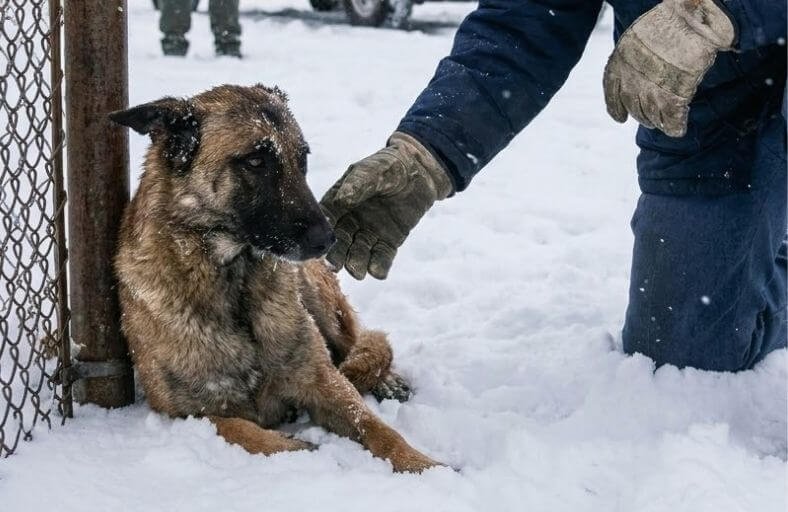
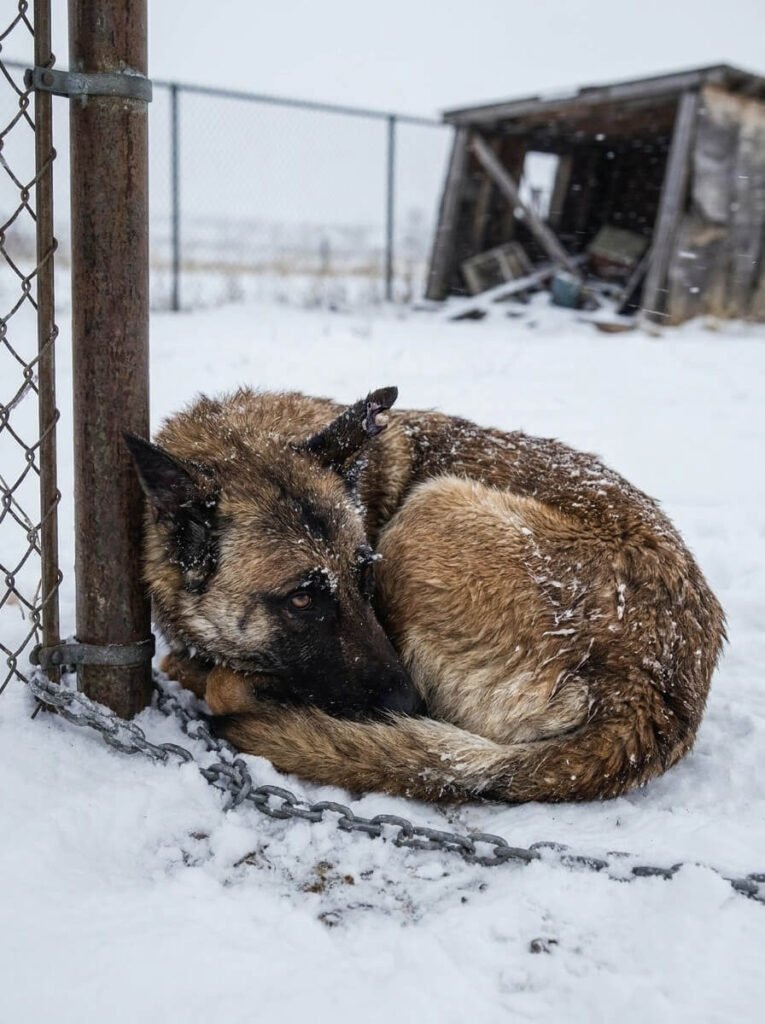
Through the chain link, he could see a shape pressed against the base of a metal post, dark and still, half buried in snow that had blown sideways all night.
A Belgian Malinois mix, maybe three years old, lay curled so tightly that its nose touched its own frozen tail.
Its coat was matted into hard clumps, crusted white along the back where wind driven snow had frozen directly onto the fur.
One ear was torn at the tip, old damage, long healed over.
The chain ran from a heavy collar to the fence post, and somewhere along its length it had frozen into a solid ridge of ice fused to the ground.
The dog’s ribs showed clearly even through the matted coat, a body that had been losing weight for weeks, not days.
Walt stood at the fence for a long moment before he moved.
He knew that stillness was not calm.
He had seen that particular stillness before, in dogs that had stopped expecting anything good to happen, dogs conserving the last of their strength instead of wasting it on fear.
He called it in before he did anything else, standing in the wind with his radio pressed against his ear, giving the dispatcher the cross streets and the state of the chain.
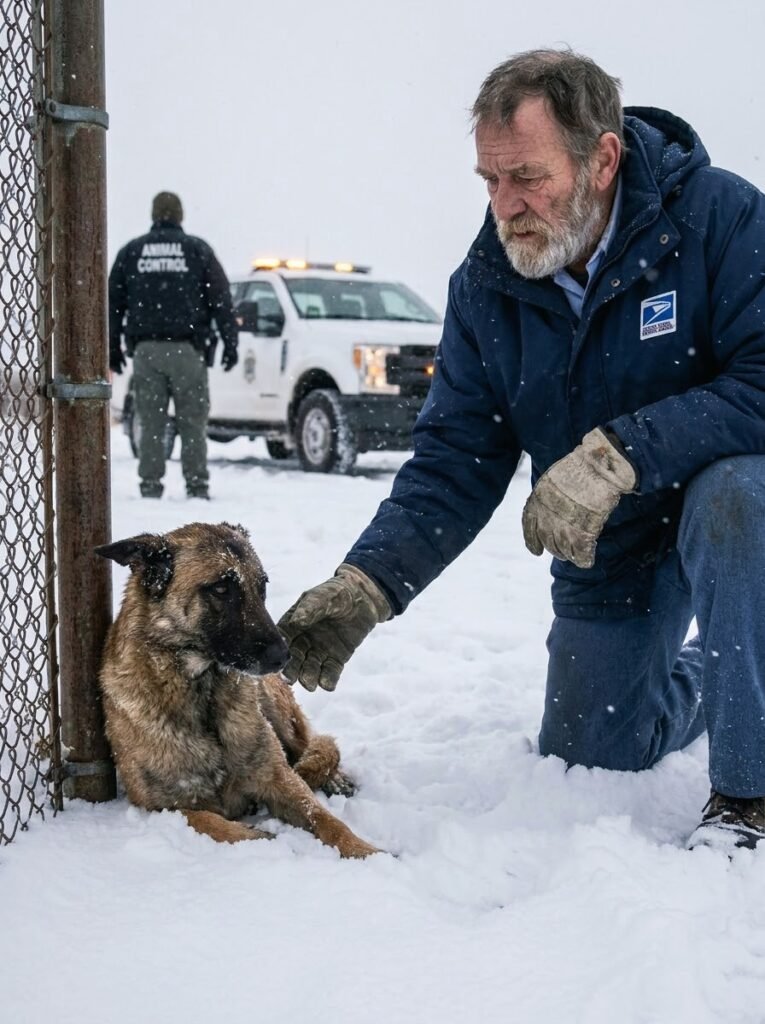
Twenty minutes later, a white pickup with the Butte Animal Control logo pulled up behind his mail truck, and a woman in a heavy orange jacket climbed out carrying a coil of rope and a set of bolt cutters.
She introduced herself simply, no wasted words, the way people do when they have already worked a hundred calls like this one.
Rosa Delgado had been an animal control officer for eleven years, most of them in counties where winter rescues were not rare, and she moved toward the fence with the unhurried pace of someone who had learned that speed only frightened frightened animals further.
Together they studied the dog from a distance before deciding anything.
Its ears had gone flat the moment they approached the fence line, and a low sound came from its throat, not quite a growl, more a warning that its patience had limits.
“He’s not aggressive,” Rosa said quietly. “He’s terrified and out of options. Big difference.”
Walt nodded, because he already knew that difference better than most people ever would.
He had spent years learning to read exactly that line in another animal’s body, back when getting it wrong could cost more than a bite.
The chain, when they got close enough to examine it, was worse than either of them expected.
It had not simply frozen to the ground.
Snowmelt and refreeze over several days had welded it directly into a support wire running along the base of the fence, creating a tangled knot of metal and ice that no simple bolt cutter could reach cleanly.
Any sudden pull on that chain would yank hard against the dog’s neck before it gave way.
Rosa crouched a few feet back and studied the angle for a long moment.
“We’re going to need warm water, a wind break, and about an hour we don’t really have,” she said. “But we’re not rushing this.”
Walt looked at the dog’s eyes, half closed against the wind, still watching them with the flat, guarded focus of an animal that had learned not to trust movement.
Something in that gaze snagged at a memory he could not immediately place, a feeling more than a picture, gone before he could hold onto it.
He would not understand why for two more days.
For now, all he knew was that a dog was dying slowly at the end of a frozen chain, and that somewhere behind his ribs, an old and very specific kind of alarm had just quietly switched back on.
“His name is Scout,” Rosa said, glancing at the intake tag someone would eventually fill out. “Or it will be, until we know different.”
Walt pulled his gloves tighter and stepped toward the truck to grab the moving blankets he kept for exactly this kind of call.
Whatever came next, he already knew it would take longer than an hour, and cost more than either of them had planned for that morning.
Part 2 – The Night Diesel Didn’t Come Home
Rosa went back to her truck for the warm water jugs she kept for exactly this kind of morning, and Walt stayed at the fence, watching the dog watch him.
He had not planned on telling anyone what he was thinking.
He rarely did.
Sixteen years earlier, in a different kind of cold, on a different continent, Walt Higgins had knelt in dust instead of snow, one hand resting on the flank of a Belgian Malinois named Diesel.
They had been a team for three years by then, the kind of partnership that stopped feeling like handler and dog and started feeling like two halves of the same nervous system.
Diesel could read a change in Walt’s breathing before Walt understood why his own chest had tightened.
Walt could read the set of Diesel’s ears from thirty yards and know, with total certainty, whether the road ahead was clear.
On the night that mattered, it was not clear.
Diesel alerted on a stretch of road that everyone else had already walked twice.
Walt trusted the alert, called the halt, and watched the device team confirm what his dog already knew before any human instrument caught up.
Three men went home to their families because of that alert.
Diesel did not walk away from the mission that followed it two weeks later, a different device, a different stretch of road, one final morning that Walt had relived more times than he could count.
He had carried his dog’s body himself, refusing every offer of help, because it felt like the last order he could still give and the last one Diesel could still follow.
He came home from that deployment with a Purple Heart he rarely mentioned and a silence he carried everywhere.
The Marine Corps offered him another dog eventually.
He said no.
Some things, he told the counselor assigned to his case, you do not simply replace.
He left the service two years later, moved to Montana because his sister lived outside Butte and because the mountains reminded him of nothing at all, which felt like exactly what he needed.
The postal job came almost by accident, a temporary route that turned permanent when the previous carrier retired.
Thirty one years old at the time, Walt discovered he liked the solitude of it, the long gravel roads, the dogs that ran to greet his truck at certain houses, the quiet predictability of a job where nothing ever exploded.
He kept Diesel’s tag clipped inside his jacket pocket, a small scratched disc stamped with a single letter, and he touched it sometimes without noticing he had done it.
He was touching it now, standing at a fence in the snow, though he could not have said when his hand had moved there.
The Malinois mix on the other side of the chain link had gone rigid the moment Walt raised his hand to adjust his hood, freezing mid motion, eyes locked on the movement with an intensity that felt oddly familiar.
It was not simple fear.
Fear made most dogs flinch or retreat.
This dog held perfectly still, tracking the hand the way a soldier tracks an incoming sound, waiting to see whether it meant harm before deciding how to respond.
Walt had seen exactly that reaction only once before in his life, watching Diesel freeze the same way during a night training exercise when a flare went up too close and too fast.
He told himself it was coincidence.
Working dogs from certain lines were bred and trained toward similar temperaments, he reasoned, and startle responses were not exactly rare in this breed.
Still, the sight lodged itself somewhere behind his sternum and refused to move.
Rosa came back with two jugs of warm water and a folded moving blanket tucked under one arm.
“We’re going to build him a corridor first,” she said, nodding toward a stack of wooden pallets near the collapsed shed. “Something narrow enough that he only sees one way to go, and it happens to be toward us.”
Walt helped her drag the pallets into a rough funnel shape, working quietly, grateful for something to do with his hands.
“You’ve done cold weather rescues before,” Rosa said, not quite a question.
“Some,” Walt answered, which was true and also nowhere near the whole truth.
She did not push further, and he was grateful for that too.
They worked for the next twenty minutes building the makeshift corridor, laying down an old moving blanket as a path, setting a bowl of warmed broth just inside the funnel’s mouth where the dog could smell it without needing to move far.
The dog’s nose twitched at the scent, the first sign of interest either of them had seen.
“He’s hungry enough to consider it,” Rosa said. “Question is whether he trusts it enough yet.”
Walt watched the animal’s eyes shift from the bowl to the humans and back again, weighing something in a calculation neither of them could fully see.
He thought of Diesel again, of every slow, patient hour it had taken to earn that dog’s first real trust, long before either of them had understood what they would eventually mean to each other.
He did not say any of that out loud.
He simply crouched lower, made himself smaller, and waited.
Part 3 – The Last Cut Before the Chain Gave Way
The corridor held for almost forty minutes before the dog moved at all.
Rosa had warned Walt that this part could not be rushed, that a starving, frostbitten animal sometimes needed longer to decide on trust than either of them had patience for, and she had been right.
They took turns stepping back from the fence, giving the dog room to consider the narrow path of pallets and blankets without two pairs of eyes locked onto him at once.
At 8:52, the dog finally shifted his weight and dragged himself two feet closer to the bowl of warmed broth.
The chain groaned against the frozen wire but did not give.
“That’s real progress,” Rosa said quietly. “Don’t react big. Just let him keep choosing it.”
Walt kept his hands loose at his sides and said nothing, watching the dog lower his head toward the bowl with visible effort, drinking in short, careful pulls.
For the first time since they had arrived, the dog’s ears came up slightly, no longer flattened in pure defense.
It was Rosa’s turn to work on the chain itself, and she approached the problem the way she approached every difficult angle, slowly and from the side rather than head on.
She poured warm water in careful stages along the section where chain met ice, letting each pour soak in and loosen the bond before adding more, never enough at once to shock the metal or startle the dog with sudden movement.
Walt held a folded tarp as a wind break, shielding both the dog and the working area from gusts that kept trying to undo an hour of careful progress.
Underneath the outer layer of ice, they discovered a second problem neither of them had expected.
The chain had not just frozen to the ground.
It had tangled through a length of old fence wire buried just beneath the surface, twisting into a small knot of steel that the bolt cutters could not reach without first clearing more ice away by hand.
“This is going to take precision, not muscle,” Rosa said, kneeling closer, angling a folded board between the chain and the dog’s neck as a barrier. “One wrong pull and that collar yanks tight before we mean it to.”
She worked the bolt cutters link by link once enough ice had melted away, testing each cut with a light touch before committing to it, watching the dog’s body language after every single motion.
Walt stayed at the dog’s eye level the entire time, speaking low and steady, the same even tone he had once used on a different animal in a much hotter country, a tone that had nothing to do with the words themselves and everything to do with the rhythm underneath them.
The dog’s gaze kept flicking to Walt’s face between each snip of the cutters, as if checking a barometer only he could read.
At 9:31, the final link gave way with a sharp metallic snap, and the chain fell free from the fence post entirely.
The dog did not bolt.
He did not even lift his head.
He simply lay there, free for the first time in what had likely been days, too exhausted and too wary to understand yet what freedom meant.
“That’s normal,” Rosa said softly, seeing the flicker of concern cross Walt’s face. “Mechanical freedom doesn’t fix fear. He needs to choose to get up on his own.”
They backed away again, giving him space, letting the open end of the corridor lead toward the open door of the transport crate Rosa had positioned near her truck.
Ten minutes passed in near silence, broken only by wind and the occasional creak of the empty shed nearby.
Then, slowly, the dog gathered his legs beneath him and rose, swaying once before finding his balance.
He took one step toward the crate, then another, moving with the stiff, careful gait of an animal whose paws had gone numb long ago.
At the crate’s entrance, he paused and looked back once, directly at Walt, before stepping inside on his own.
Rosa exhaled a breath she had clearly been holding. “That’s the whole ballgame right there. He walked in himself.”
At the clinic twenty minutes later, Dr. Patricia Osei examined the dog under bright lights, running gloved hands carefully along frostbitten ears and cracked, blistered paw pads.
“Severe frostbite, moderate malnutrition, dehydration,” she said, reading off a growing list. “But he’s young, and he’s a fighter. I’ve seen worse pull through.”
She parted the fur near his left ear to check for swelling, and stopped.
“Huh,” she said, half to herself. “That’s not something you see every day out here.”
Walt, still standing by the exam table more out of habit than invitation, felt something tighten in his chest before she had even said another word.
“What is it?” he asked.
Dr. Osei angled the dog’s ear gently toward the light, revealing a small, faded tattoo just inside the flap, the ink long since gone soft with age but the shape still unmistakable.
“Looks like a working line ID mark,” she said. “The kind breeding programs use to track litters. Military contract kennels use something almost identical.”
Walt’s hand moved, without his permission, to the scratched metal tag inside his jacket pocket.
He said nothing for a long moment, staring at the small dark mark inside the dog’s ear as though it might rearrange itself into something less impossible.
“You alright?” Rosa asked, watching his face.
“Fine,” Walt said, in a voice that did not sound entirely convinced of that itself. “Just thought I recognized something. Probably nothing.”
He did not believe that even as he said it.
Part 4 – The Tattoo Inside Scout’s Ear
Walt could not stop thinking about the tattoo for the rest of that day.
He finished his mail route on autopilot, driving familiar gravel roads while his mind kept circling back to a small dark mark inside a dog’s ear, and to a matching tag he had carried in his own pocket for sixteen years.
That evening, he did something he had not done in a long time.
He called an old friend from his unit, a former logistics sergeant named Doug who had stayed close to the K9 contracting world even after leaving the service.
“Working line tattoos usually trace back to specific breeding kennels,” Doug told him over the phone. “If you’ve got a partial ID, I can probably find out which one. Might take a day or two.”
Two days later, Doug called back with a name that made Walt sit down hard on the edge of his kitchen chair.
Bellamy Kennels, a small contract breeding operation that had supplied working dogs to several military and law enforcement programs roughly two decades earlier, including, according to Doug’s contact, the very program that had once matched Walt with a young Belgian Malinois named Diesel.
The kennel had lost its primary contract years ago and scaled down significantly, though records suggested the owner, a man named Frank Bellamy, still lived on the original property outside a small town less than ninety minutes from Butte.
Walt drove out there the following Saturday, telling himself he only wanted to confirm the dog’s medical history for the shelter’s paperwork.
He knew, somewhere underneath that explanation, it was not the real reason.
Frank Bellamy turned out to be a stooped man in his mid seventies, moving slowly with the help of a cane, living alone in a farmhouse surrounded by empty, overgrown kennel runs.
He listened to Walt’s description of the rescue with a expression that shifted from polite interest to something heavier, something closer to guilt, as the details piled up.
“Chained to a fence, you said,” Bellamy repeated quietly. “Frostbite. Skinny as a fence rail.”
“That’s him,” Walt confirmed.
Bellamy was silent for a long moment, staring out the window toward the empty runs.
“That’ll be Ranger,” he finally said. “Last one I had left. I got sick a while back, lost track of things I shouldn’t have. My nephew was supposed to be checking on him while I was in the hospital. I should have made sure of that myself.”
He led Walt inside to a cluttered back room and pulled a worn logbook down from a shelf, its cover soft with age, pages filled with dense handwritten litter records going back decades.
He flipped through with practiced fingers until he found the page he wanted, then turned the book around so Walt could see it.
Two names sat side by side on the same litter entry, born eleven months apart from the same sire, a proven working line stud the kennel had used for years.
One name was Diesel, sold to a military contractor and later matched with a young handler named Higgins.
The other, born from a later breeding of the same line, was Ranger, held back from the working program after failing an aggression evaluation as a young dog, deemed too gentle, too easily startled by loud noise, unsuitable for deployment work.
Bellamy had kept him as a personal pet ever since, out of what he now admitted was a mix of fondness and simple inability to place him elsewhere.
Walt stared at the two names on the page for a long time, feeling something shift and resettle inside his chest, not quite grief and not quite relief, something in between that he did not yet have a word for.
“He’s not the same dog,” Walt said quietly, more to himself than to Bellamy. “I know that. I’m not confused about that.”
“No,” Bellamy agreed. “But he came from the same place your Diesel did. Same blood, near enough. Guess the world finds strange ways to circle back sometimes.”
Walt asked if he could keep the page, or a copy of it, and Bellamy tore it out without hesitation, along with a faded photograph tucked into the same section of the logbook, a picture of a much younger Bellamy holding two nearly identical Malinois puppies, one marked with a small notch clipped in its right ear for identification.
Driving back to Butte that evening, the torn page resting on the passenger seat beside him, Walt found himself gripping the steering wheel tighter than the empty highway required.
He was not sure yet what any of this meant for him, or for the dog now recovering in a clinic kennel, still too thin, still learning that hands reaching toward him did not always mean harm.
He only knew that something had shifted the moment Dr. Osei parted the fur near that torn ear and found a mark neither of them had expected.
Whatever came next, he suspected it would ask more of him than simply filling out an adoption form.
Part 5 – The Notebook From Bellamy’s Kennel
Walt did not sleep much that night.
He sat at his kitchen table with the torn logbook page and the old photograph spread out in front of him, Diesel’s tag resting beside them like a small anchor.
Somewhere around two in the morning, he admitted to himself what he had been avoiding all evening.
He was scared.
Not of the dog.
Scared of what it would mean to let himself care again, and scared of what it would mean if he didn’t.
He drove to the clinic first thing the next morning, earlier than visiting hours technically allowed, and Dr. Osei let him in anyway when she saw his face through the glass door.
Scout was standing in his kennel run for the first time, weight still shifted carefully off his healing paw pads, watching the door the way he watched everything now, alert but no longer frantic.
“He ate his whole bowl this morning,” Dr. Osei said, checking her chart. “First time since he came in. That’s a good sign.”
Walt crouched near the kennel, not reaching in, just letting Scout see him at eye level the way he had learned to, all those years ago, with a different dog in a different country.
“I found out where he came from,” Walt said quietly.
He explained it in pieces, the kennel, the logbook, the two names on the same page, watching Dr. Osei’s expression shift from professional interest to something more careful.
When he finished, she was quiet for a moment, studying the dog through the wire mesh.
“I want to be honest with you about something,” she finally said. “This dog is not going to fix what happened to your last one. Nothing will. That’s not how grief works, and it’s not how dogs work either.”
Walt nodded slowly, because some part of him had known that already, even if he hadn’t let himself say it out loud.
“But he’s also not asking you to replace anything,” she continued. “He doesn’t know he shares blood with a dog he never met. He just knows a man kept coming back to sit outside his kennel every day this week, even when he had no medical reason to.”
She closed the chart and looked at Walt directly.
“Some dogs don’t need you to remember their whole story,” she said. “They just need you to stay long enough to help them write the next chapter.”
Walt sat with that for a long moment, the words settling somewhere he hadn’t expected them to reach.
He thought about the empty corner of his living room where a dog bed had sat, folded and unused, for sixteen years.
He thought about the tag in his pocket, and about a torn logbook page that connected two lives without erasing either of them.
“I’d like to adopt him,” Walt said, surprising himself slightly with how steady his own voice sounded.
Dr. Osei smiled for the first time that morning. “I had a feeling you might say that.”
The paperwork took another week to finalize, partly for medical clearance and partly, Walt suspected, because Rosa wanted to make certain he understood what he was signing up for.
“He’s going to have setbacks,” she warned him during the final home visit, walking through Walt’s small house with a clipboard under one arm. “Frostbite recovery, malnutrition, trust issues, all of it takes longer than people expect. This isn’t a movie ending.”
“I know a little something about long recoveries,” Walt said, and something in his tone made Rosa glance up from her clipboard.
She didn’t ask.
She simply nodded and kept walking.
The day Walt brought Scout home, he did not carry him inside.
He opened the truck door, stepped back, and waited.
Scout sat on the seat for a long moment, ears shifting as he took in the unfamiliar sounds of a quiet street, before finally climbing down on his own and following Walt’s slow footsteps toward the front porch.
Inside, Walt had set a new dog bed in the same corner where the old one used to sit, a deliberate choice he had debated for days before deciding it felt less like replacing something and more like finally being ready to use that space again.
Scout sniffed the bed carefully, circled it twice, and lay down with a long, heavy sigh that seemed to release something Walt recognized from his own chest.
He did not rename him Ranger.
That name belonged to a chapter that had already closed, back at a kennel outside a small Montana town.
Scout felt like the right name for whatever came next, a word about searching forward instead of looking back.
Walt sat down on the floor beside the bed, not too close, and reached into his jacket pocket for the old scratched tag he still carried everywhere.
He held it for a long moment, turning it over in his fingers.
Then, for the first time in sixteen years, he set it down on the small shelf above the dog bed instead of returning it to his pocket, not put away, just finally allowed to rest somewhere out in the open.
Scout lifted his head, watched the movement, and settled again, close enough now that his tail brushed against Walt’s boot.
Neither of them moved for a long time.
Part 6 – The Night of the Fourth of July
The first few months brought small victories that meant more than they should have.
Scout learned the sound of the mail truck’s engine and started waiting by the window before Walt even pulled into the driveway.
He learned that Walt’s raised hand usually meant a treat, not a threat, though it took nearly two months of slow, deliberate practice before the flinch disappeared entirely.
By early spring, he was riding along on short sections of Walt’s route, tail thumping against the passenger seat every time they slowed near a house with a familiar dog waiting at the fence.
The neighbors noticed the change too.
An older woman named Ruth, who lived at the end of Walt’s street and had watched him live alone for over a decade, stopped him one afternoon while he walked Scout past her mailbox.
“You look like a different man,” she said simply. “Good different.”
Walt didn’t have a smooth answer for that, so he just nodded and kept walking, though something in his chest sat a little lighter for the rest of the day.
Not everything came easily.
Scout still startled hard at sudden loud noises, a slammed door, a dropped pan, thunder rolling in over the mountains.
Walt recognized the pattern immediately, because he had lived inside a version of it himself for years.
He never forced Scout through those moments.
He simply sat with him, low and still, waiting out the storm the same patient way Rosa had taught him at that frozen fence line months earlier.
The real test came on the Fourth of July.
Walt had almost forgotten how loud small town fireworks could get until the first string of firecrackers cracked somewhere down the block just after dusk.
Scout bolted from his spot by the window and pressed himself into the narrow gap behind the living room recliner, body rigid, breath coming fast and shallow.
Walt lowered himself onto the floor nearby, not reaching for him, not calling him out, just staying close enough to be felt without being forced.
The fireworks kept building outside, closer and louder, a rolling barrage that rattled the windows every few seconds.
Walt kept his voice low and even, the same rhythm he had used at that frozen fence in January, the same rhythm he had once used half a world away in a very different kind of noise.
“I’ve got you,” he said quietly, over and over, not expecting the words themselves to matter so much as the steadiness behind them. “Right here. Not going anywhere.”
It took almost forty minutes before Scout’s breathing slowed enough for him to creep out from behind the recliner and press himself against Walt’s side instead, trembling but no longer frantic.
Walt wrapped one arm around him and stayed there on the floor long after the fireworks outside finally quieted down.
It was not a perfect night.
It was not, by any measure, an easy one.
But it was proof of something real, a fear faced together instead of alone, a small victory built slowly out of hundreds of quieter ones that had come before it.
The next morning, Walt sat on the porch with his coffee, Scout stretched out beside him in a patch of early sun, and found himself thinking about that frozen fence post one more time, and about how far a single dog had traveled since then, one cautious step at a time.
He thought healing rarely looked like the stories people told about it.
It looked more like this.
Quiet mornings.
Small trembling nights that ended in someone staying anyway.
Part 7 – Six Years on the Same Route
Six years passed the way most good years do, quietly, and mostly without anyone noticing until they added it up.
Scout rode along on Walt’s mail route more mornings than not, greeting familiar dogs at familiar fences, no longer flinching at raised hands or sudden sounds the way he once had.
His frostbitten ears had healed into permanently notched tips, small reminders of that January morning that neither man nor dog needed reminding of anymore.
Walt kept working his route past the age most carriers retire, joking to Rosa once that he wasn’t ready to give Scout an excuse to sleep in.
Rosa still called sometimes, mostly just to check in, though she liked to remind Walt that he had gone from a man who barely spoke at rescue scenes to a man who brought coffee for the volunteers at the annual shelter fundraiser.
Frank Bellamy passed away quietly two winters after their first meeting, and Walt drove out for the small service, bringing Scout along, letting him sniff at the empty kennel runs one last time before they left.
He kept the torn logbook page framed on his living room wall, right beside a photograph of himself in uniform standing next to a young Belgian Malinois with dark, alert eyes.
Diesel’s tag stayed on the shelf above Scout’s bed, exactly where Walt had first set it down, no longer something he needed to keep hidden inside a jacket pocket.
Some visitors asked about it, and Walt had learned, slowly, how to answer without his voice catching quite as often as it used to.
“That was my partner,” he would say. “This one’s my partner now. Different chapters. Same book, maybe.”
Scout, older now, moved a little slower on cold mornings, a touch of stiffness settling into hips that had survived worse than most dogs his age ever faced.
He still waited by the window every afternoon for the sound of Walt’s truck, ears lifting at the exact pitch of that engine before it ever turned onto their street.
Dr. Osei’s words had stayed with Walt longer than almost anything else from that whole frozen winter, and he found himself repeating a version of them sometimes, to new foster families at the shelter, to nervous first time adopters standing exactly where he once had.
Some dogs did not need you to remember their whole story, he told them.
They just needed you to stay long enough to help them write the next chapter, one quiet, ordinary day at a time.
He had not gone looking for that lesson.
It had found him instead, frozen to a fence post on a gray January morning, waiting patiently for someone willing to kneel down in the snow and start again.
If this story touched your heart, follow this page for more unforgettable dog rescue stories about second chances, healing, and the quiet bonds between veterans and the animals who understand them best.
Disclaimer: The events and characters depicted in this story are works of fiction. They are intended to illustrate and elevate the powerful emotional connection between humans and dogs, encouraging compassion, responsibility, and love toward animals.