
PART 1
The ice cracked once, then went silent, and that silence was worse than the sound.
Maren Kowalski had heard that particular silence only one other time in her life. She had spent five years trying not to remember what came after it.
The call had come in at 6:40 that morning. A dog walker on the eastern trail had seen paw prints stop dead at the edge of open water near the old fishing pier.
No prints leading back out. Just a raw black hole in the white, and something dark moving inside it.
Maren had been the warden assigned to Lake Vandermere for eleven years. She knew every inch of this shoreline the way some people know their own kitchen.
She knew where the ice thinned first, where the current ran warm beneath the surface, where the old willow roots reached out under the water like fingers.
She also knew exactly which stretch of ice this was.
It was the same stretch where her son had gone under.
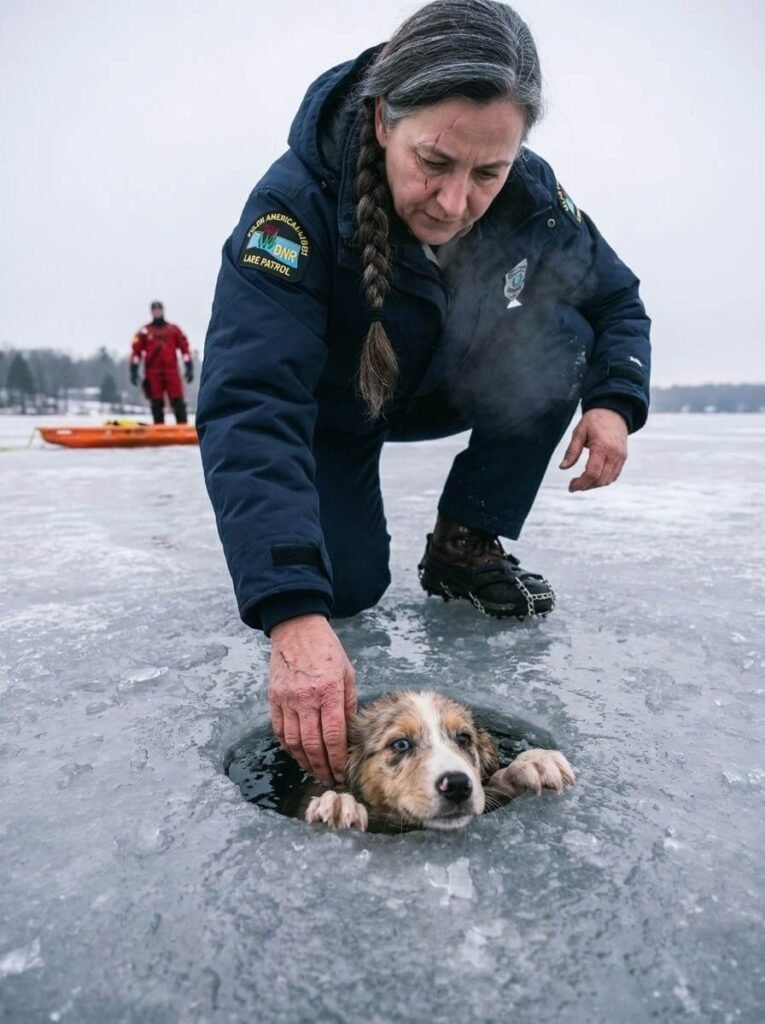
Maren was fifty pounds of gear and a lifetime of practiced calm as she army crawled across the ice toward the hole, distributing her weight the way training had drilled into her for two decades.
Behind her, Owen Prescott fed out rope from the shore, his breath fogging in short, controlled bursts. He did not ask if she wanted someone else to take point.
He already knew the answer.
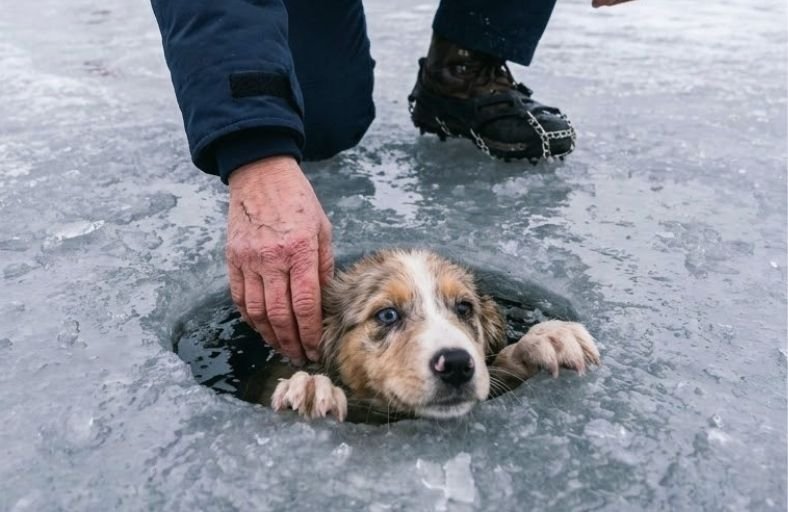
Inside the hole, barely visible above the black water, was a small black nose. It rose, trembled, disappeared, then rose again.
“Easy,” Maren said, though she wasn’t sure if she was talking to the animal or to herself. “I’ve got you. Just breathe.”
As she got closer, the shape beneath the surface came into focus. It was a puppy, no more than seven months old by the size of his paws, with fur so patchy in places that raw pink skin showed through.
His ribs pressed against thin, wet skin like the slats of a fence. One leg twitched weakly against something unseen below the ice, caught, unable to pull free.
He turned his face up toward her, and Maren’s breath caught for a different reason than the cold.
One of his eyes was pale blue. The other was dark brown.
Maren Kowalski did not believe in signs. She had stopped believing in signs the winter Eli died, when every sunset and every cardinal on the porch rail had felt like a cruel joke instead of a comfort.
But something about that mismatched stare froze her in place for a full second longer than it should have.
“Mare.” Owen’s voice cut through the wind, steady, familiar. “Talk to me.”
“He’s caught on something,” she called back. “Can’t tell what yet.”
She had grown up in Cedar Hollow, on the same gravel roads her father had walked before her, in a house that still smelled like his pipe tobacco if you opened the right closet.
She had become a warden not because it paid well, but because the water had always felt like family to her, patient and honest in a way people rarely were.
That honesty had cost her almost everything five years ago.
She kept her son’s memory in one place only, a small brass fishing lure clipped to the inside pocket of her parka, never worn where anyone could ask about it.
Eli had made it himself at a summer camp craft table, clumsy solder and crooked hook, and he had been so proud of it that he’d begged to use it on their very next trip.
She reached the edge of the hole and lay flat, spreading her weight across the cracking surface, reaching one gloved hand down into water so cold it burned.
The puppy’s leg was tangled in something below, a length of nylon rope or an old fishing line, wrapped tight around a submerged branch from the dead willow that leaned out over this exact spot.
“Rope’s caught on the old tree root,” she called. “Same as always.”
Owen went quiet for a moment on the shore. He knew what “same as always” meant on this lake. He had been the one who pulled Eli’s body from beneath these very roots, five years and eleven days ago.
“Cutters coming to you,” he said, and his voice had gone rougher.
Dr. Carla Jennings, the dog walker who had made the call, stood back near the trailhead with her phone raised, not to film, but to hold the GPS pin steady so the rescue truck could find the exact break in the tree line.
Her hands were shaking, though the temperature that morning was only in the low twenties.
“He was chasing something,” Carla called out, her voice tight. “I saw him run straight for the memorial bench, and then he was just gone.”
Maren’s stomach turned over.
The memorial bench.
A small plaque with Eli’s name on it, bolted to a bench that faced the water, placed there by the fire department the spring after he died.
She had not been able to sit on it in five years.
She worked the rescue cutters down through the freezing water with fingers that had gone half numb, found the taut nylon by feel alone, and sawed until it gave way in a sudden slack that nearly sent her sliding forward into the hole herself.
Owen’s rope caught her weight before it happened.
The puppy came free all at once, a soaked, shivering, impossibly light bundle of bone and matted fur.
Maren pulled him against her chest inside her open parka, felt his heartbeat hammering fast and thin against her ribs, and started the slow crawl back toward shore.
He did not fight her. He pressed his cold nose into her collarbone and shook.
“You’re okay,” she whispered, over and over, the same words she had once whispered into a different set of ears on this same ice, words that had not been true then. “You’re okay. I’ve got you.”
At the truck, Dr. Priya Patel was already waiting with warmed blankets and an oxygen line, her face calm in the particular way of someone who had done this exact drill more times than she could count.
“Hypothermic,” Priya said, running gentle hands over the puppy’s ribs. “Malnourished. And this fur loss isn’t from the water. This has been going on for weeks.”
“Mange,” Maren said quietly. It wasn’t a question.
“Looks like it. We’ll know more once he’s stable.”
The puppy’s mismatched eyes stayed fixed on Maren the entire ride to the clinic, even as the shivering slowed and the blankets began to warm him.
Maren did not know yet that his collar carried initials that would undo five years of careful silence.
She did not know that somewhere two hours away, a nineteen year old boy in a red parka was about to see a local news photo and drop his phone on the kitchen floor.
She only knew that for the first time since the ice took her son, something small and broken had looked up at her and chosen to stop fighting.
Part 2 – Six Days Before the Anniversary
The clinic was quiet by nine that night, and Maren was still there.
She had told herself she would only stay long enough to file the incident report. Three hours later, she was sitting on an overturned bucket in the recovery room, watching a heat lamp glow over a crate where the puppy slept in fitful twitches.
Priya came in with two cups of coffee and handed one over without asking if Maren wanted it.
“You don’t have to stay,” Priya said.
“I know.”
“He’s stable. Vitals are climbing. He’ll make it through the night.”
Maren wrapped both hands around the paper cup. “I know that too.”
Priya sat down on the exam table, letting the silence stretch the way she always did when she sensed there was more underneath a sentence than the words themselves carried.
“Six days,” Maren said finally.
“Six days until what?”
“The anniversary.” Maren didn’t look up from the crate. “Five years, this Sunday.”
Priya’s expression softened, but she didn’t reach for platitudes, and Maren was grateful for that. In the years since Eli died, she had collected a long list of things people said that were meant to help and never did. Priya had never once said any of them.
Five years and eleven days before that morning, on a Sunday very much like this coming one, Eli Kowalski had been nine years old, red cheeked from the cold, tugging his mother’s sleeve to beg for one more hour on the ice before dinner.
Maren had been thirty feet away, checking a thin patch near the north shore with another warden, when she heard the boys shouting.
Not laughing. Shouting.
By the time she reached the hole, Owen was already flat on his stomach on the ice, arm buried to the shoulder in black water, and a boy in a red parka was screaming Eli’s name over and over into the wind, his voice cracking, his small gloved hands scrabbling uselessly at the broken edge.
That boy had been maybe fourteen at the time. Maren had never learned his name.
In the chaos of the rescue attempt, in the ambulance ride, in the funeral and the year of fog that followed, the boy in the red parka had simply become part of the wallpaper of the worst day of her life, present but unformed, a detail she had buried along with everything else.
She had never once wondered what happened to him.
“You should go home and sleep,” Priya said gently. “I’ll call you the second there’s any change.”
“I know.”
Neither of them moved.
Outside, Owen Prescott was in the parking lot loading gear back into the rescue truck, his thermos steaming on the tailgate beside him.
He had been the department’s ice rescue technician for eighteen years, gruff enough that new hires sometimes mistook him for cold, though anyone who worked alongside him long enough learned otherwise.
He had cried at Eli’s funeral harder than most of the family had, standing in the back row in his dress uniform, refusing to let anyone see his face.
He knocked twice on the clinic door before letting himself in.
“You staying the night?” he asked Maren.
“Somebody should.”
Owen looked at the crate, at the small ribs rising and falling under the heat lamp, and something in his jaw tightened.
“Same spot,” he said quietly. “Almost exactly the same spot.”
“I know.”
“You don’t have to read anything into it, Mare.”
“I’m not,” Maren said, though her voice wavered just enough that Owen didn’t believe her, and she didn’t fully believe herself either.
She thought about the brass lure clipped inside her coat. She thought about the bench with her son’s name on it, facing water that had never given him back in any way that mattered. She thought about a boy in a red parka whose face she could no longer picture clearly, whose voice she still sometimes heard in her dreams.
Around midnight, the puppy stirred, lifted his head, and looked directly at her through the crate bars with that strange, split colored gaze.
“Hey,” she whispered. “You’re still here.”
His tail thumped once against the blanket, weak but real.
Maren reached a finger through the bars, and he pressed his nose against it, warm now instead of ice cold, and something in her chest that had been frozen for five years cracked, just slightly, along an old fault line.
She did not know his real name yet. The department had started calling him Scout for the incident paperwork, a placeholder that would not survive the week.
She did not know that his collar, still bagged in the evidence kit from the rescue, waterlogged and buried under a strip of nylon, had two letters scratched crudely into the metal buckle.
J and S.
She would not read them until the following afternoon, when Priya finally cut the ruined collar free to treat the raw skin beneath it, and held it up to the light with a small frown.
“Somebody carved this by hand,” Priya said. “Looks recent, actually. Maybe within the year.”
Maren took the collar and turned it over in her palm.
J.S.
The letters meant nothing to her yet.
They would not stay that way for long.
Part 3 – The Name on the Collar
By the third day, the puppy had a name that had stuck without anyone officially deciding on it.
The staff called him Scout, and Scout had started to answer, ears perking at the sound before his tail even caught up.
He was eating on his own now, small careful bites of prescription food, his ribs still visible but no longer sharp enough to count from across the room.
The mange treatment had begun, medicated baths every other day, and Maren had started coming by after her patrol shifts to help hold him steady in the tub, since he trusted almost no one else’s hands yet.
“He’s a fighter,” Priya said, toweling him dry while Scout leaned his full weight against Maren’s knee. “Whoever had him before clearly loved him enough to name him something.
This mange didn’t happen because nobody cared. It happened fast, probably from exposure, maybe after he’d already been through something.”
“Like what?”
“Hard to say. Stress can trigger it. So can sudden changes in environment. If he was healthy a few months ago and this bad now, something disrupted his life pretty badly.”
Maren thought about that for a long moment, running a hand along Scout’s damp back.
“We should scan for a chip,” she said. “If somebody’s missing him, they deserve to know he’s alive.”
It felt, in that moment, like the responsible thing to say. It did not feel, yet, like something that would reach backward into her own life and take hold of it.
The scanner beeped on the second pass, and a string of numbers appeared on Priya’s screen.
She typed them into the registry database, and both women waited while the little wheel spun.
REGISTERED OWNER: SULLIVAN, J.
ADDRESS: FAIRPORT, WI
Fairport was two hours east, a town Maren knew only vaguely, the kind of place you passed through on the way to somewhere else.
“Sullivan,” Priya said. “Well, that lines up with the collar.”
Maren stared at the screen longer than the information required. There was no reason the name should have meant anything to her.
Sullivan was common enough, and Fairport was far enough away that it barely registered as connected to anything in Cedar Hollow.
And yet something small and unnamed shifted in her chest, the way it does right before a memory surfaces, before you can name what you’re about to remember.
“You okay?” Priya asked.
“Fine,” Maren said. “Just tired.”
She told herself that was the truth. She almost believed it.
That evening, sitting alone in her kitchen with a mug of tea gone cold beside her, Maren opened the department’s old case file on Eli’s death for the first time in over a year. She had kept it, the way she kept the lure, in a place she rarely opened.
The witness statements were there, typed and filed, most of them brief. She scanned past her own words, past Owen’s, until she reached one near the bottom, taken from the boy who had been on the ice that day.
Witness: Sullivan, Jonathan T. Age 14.
Statement: We were fishing near the north hole. Eli went to check his line. The ice made a sound and then he was gone. I tried to grab him. I couldn’t reach him. I’m sorry. I tried.
Maren set the file down on the table with hands that were no longer steady.
Jonathan Sullivan.
J.S.
She thought of the boy in the red parka, screaming into the wind, small gloved hands scrabbling at broken ice while a grown man dove in beside him.
She thought of a nineteen year old, two hours away in Fairport, who had once been fourteen years old on this exact lake, on this exact day of the year, watching her son disappear.
And now his dog had gone through the same ice, near the same tree, close enough to the same hole that it could not reasonably be called coincidence.
Maren sat very still in her kitchen for a long time, the untouched tea growing colder, the brass lure heavy in her pocket like it had gained weight overnight.
She did not know yet whether this was a wound reopening or something else entirely.
She only knew that somewhere out there, a boy she had never truly seen was about to find out his puppy was alive, and that the woman who pulled him from the ice was the last person on earth he probably expected to hear from.
Part 4 – What the Microchip Remembered
The call came on the fourth morning, before Maren had even finished her coffee.
Priya’s number lit up her phone, and her voice was quick, careful. “The registered owner just called the clinic. Somebody shared the rescue photo on the county Facebook page last night. He saw it.”
Maren’s hand tightened around the mug. “Sullivan.”
“His mother, actually. She said her son recognized the dog immediately. She said he hasn’t stopped shaking since.” Priya paused. “Mare, she also asked if the person who pulled him out was you. By name.”
Maren didn’t answer right away.
“They’re driving over this afternoon,” Priya said. “I told her I’d need to check with you first, given the timing. If you’d rather not be here, I understand completely.”
Maren looked out her kitchen window at the gray sky pressing low over the frozen lake in the distance, at the shape of the memorial bench she still couldn’t bring herself to sit on.
“I’ll be there,” she said.
She arrived at the clinic an hour before the appointment and spent most of it sitting with Scout, who had begun greeting her at the crate door with his whole back half wagging, unaware that his old life and his rescuer’s oldest grief were about to collide in the same small room.
At two fifteen, a battered gray sedan pulled into the lot.
A woman got out first, hurried and anxious, followed by a tall, thin young man who moved like he wasn’t sure his legs would carry him the whole distance to the door.
Maren recognized nothing about his face. Five years and a boy’s growth spurt had erased whatever memory she might have carried of him.
But when he stepped inside and saw her standing beside the crate, something in his expression collapsed all at once, and she understood, in that instant, exactly who he was.
“You’re her,” he said, voice barely above a whisper. “The warden. From the lake. From that day.”
“Yes.”
His mother put a hand on his shoulder, steadying him. “JT, breathe.”
Maren studied him properly now. Jonathan Sullivan, nineteen, tall and rail thin with the kind of nervous energy that suggested he hadn’t slept well in longer than a few nights.
His eyes were red rimmed, and his hands trembled slightly at his sides, the same trembling hands, she realized, that had once scrabbled uselessly at broken ice.
“I got him from a grief counselor,” JT said, the words tumbling out before anyone asked. “About a year ago. I was, I wasn’t doing well. She said an emotional support dog might help. I named him Chief.”
Chief.
Not Scout. Never Scout. That name had only ever belonged to a rescue report.
“He’s the only thing that’s ever actually helped,” JT continued, his voice cracking. “And three weeks ago I finally worked up the nerve to come back here, to see the lake, to see the bench. My mom thought it might help me let go of some of it.
Chief got off leash for one second, and he just, he ran straight for the water. I couldn’t catch him.”
Maren’s throat tightened.
“I’ve been driving back every weekend since, looking along the shore,” JT said. “I thought he was gone. I thought I’d lost the one thing that made this whole town survivable to visit, in the same spot I lost, in the same spot where.”
He couldn’t finish the sentence. He didn’t need to.
Maren crouched down by the crate and opened the latch. Chief bounded out immediately, tail a blur, and went straight to JT’s legs, whining high in his throat, pressing his whole body against him the way frightened, relieved animals do.
JT dropped to his knees on the clinic floor and wrapped both arms around the dog, sobbing in a way that suggested years of held breath finally letting go.
“I’m sorry,” he said, not to the dog, not to his mother, but to Maren, over and over. “I tried to reach him. I tried so hard. I’ve thought about it every single day for five years. I’m so sorry.”
Maren stood frozen for a long moment, an old, familiar coldness rising in her chest, the same coldness that had kept her from sitting on a bench with her own son’s name on it.
Then she looked at the dog pressed against the crying young man’s chest, one blue eye and one brown eye watching her over his shoulder, and something in her finally, quietly, gave way.
She knelt down beside them both.
“You didn’t do this,” she said softly. “The ice did this. Not you. Not a fourteen year old boy.”
JT looked up at her, disbelieving, like he had been waiting five years for permission he never thought he’d receive.
Neither of them noticed Priya quietly stepping back into the hallway to give them the room.
Neither of them noticed that Chief, still trembling faintly from his own ordeal, had settled his small body between the two of them, one paw resting on Maren’s boot, the other against JT’s knee, as if he had decided, without being asked, that this was exactly where he belonged.
Part 5 – The Boy in the Red Parka
Dr. Priya Patel gave them fifteen minutes alone before she came back with the discharge paperwork, and by then the room had gone quiet in a different way than before.
JT was sitting cross legged on the floor now, Chief curled half in his lap, half in Maren’s.
His mother had stepped outside to take a phone call, giving the three of them space that none of them had asked for but all of them seemed to need.
“I looked for you,” JT said finally. “After. I mean, not right after. My parents moved us to Fairport that summer. My dad got a job transfer, but I think mostly they just wanted me away from the lake.” He rubbed a hand over Chief’s ears. “I looked you up online a few times over the years. I never knew what I’d even say.”
“What would you have said?”
“I don’t know. Sorry, probably. Just sorry, on repeat, the way I’ve been saying it for five years to nobody.”
Maren watched Chief’s chest rise and fall against JT’s knee, steady now, warm now, nothing like the shivering bundle she had carried off the ice four days earlier.
“I read your statement,” she said quietly. “From the file. You said you tried to grab him.”
“I did. I got maybe two feet of ice and then it started cracking under me too. Owen pulled me back before I went in.” His jaw tightened. “I’ve hated myself for those two feet every day since.”
Priya, standing in the doorway with the paperwork forgotten in her hand, spoke up then, her voice gentle but sure.
“Can I say something?” she asked. “As someone who has spent fifteen years treating trauma in animals that can’t explain what happened to them, only show it in their bodies?”
Both of them looked up at her.
“Grief does not need forgiving to heal,” Priya said. “It needs company. That’s it. That’s the whole secret nobody tells you. You don’t heal by convincing yourself it wasn’t your fault, or by convincing yourself it was. You heal by not carrying it alone anymore.”
The words settled into the room the way certain sentences do, quietly, without fanfare, and yet impossible to unhear once spoken.
Maren felt the old brass lure in her coat pocket like it had grown warm.
“I haven’t sat on that bench in five years,” she said, almost to herself. “Not once.”
JT looked at her. “The one by the north shore? With his name on it?”
She nodded.
“I walk past it every time I come back,” JT said. “I’ve never been able to sit on it either.”
Chief lifted his head at the sound of their voices, looked between them with his mismatched eyes, and let out a small sigh before settling back down, as though he had been waiting patiently for two grieving people to finally say the true thing out loud.
“He ran toward it,” Maren said. “Carla said he ran straight for the bench before he went through. Why would he do that?”
JT’s throat worked for a moment before he answered. “I sit near there sometimes, when I visit. Maybe he remembered. Dogs remember more than we think.”
Maren looked down at the small dog now sleeping peacefully between them, oblivious to the weight of everything he had just carried across a frozen lake and back.
“Would it be all right,” she asked slowly, “if I came with you? Next time you visit the bench?”
JT’s eyes filled again, but this time it wasn’t only grief in them.
“Yeah,” he said. “Yeah, I’d like that.”
Chief’s tail thumped once against the floor, as if he understood exactly what had just been decided, and had simply been waiting for the humans to catch up.
Outside, the gray afternoon had begun to soften, the first hint of a thaw pressing faintly against the cold, though the lake itself would stay frozen for weeks yet.
Some things, Maren thought, took longer to melt than others. That didn’t mean they never would.
Part 6 – The First Sunday Walk
The following Sunday, five years and eighteen days after the ice took her son, Maren Kowalski sat down on the memorial bench for the first time.
Chief sat between her boots and JT’s sneakers, patient in a way that still surprised the vet techs who had known him only as a shivering, mange scarred rescue a week earlier. His fur had begun filling back in along his ribs, patchy still, but no longer raw.
JT had started driving over most Sundays after that first visit, sometimes with his mother, sometimes alone, always with Chief riding shotgun with his head out the window despite the cold.
It became, without either of them planning it, a routine. Maren would finish her morning patrol, meet them at the trailhead, and the three of them would walk the shoreline together, ending, always, at the bench.
They didn’t talk about Eli every time. Sometimes they talked about nothing at all, about the weather, about JT’s classes at the community college two towns over, about Owen’s terrible coffee.
Grief, Maren was learning, did not require constant conversation to be present. It could simply sit quietly beside you on a bench, the way it did now, while a dog with one blue eye and one brown eye watched ducks on the far shore.
The real test came four weeks later, on the night of the town’s annual Winter Lights festival, when the fire department set off fireworks over the lake to mark the thaw season’s opening.
Chief had never heard fireworks before. When the first burst cracked across the sky, he bolted from JT’s side in a blind panic, leash slipping from cold fingers, and ran straight toward the dark tree line near the old willow.
Maren’s heart lurched into her throat before she had time to think about why.
“Chief!” JT’s voice cracked with fear, real fear, the kind that lived in a body that had already lost too much on this exact patch of ground.
Maren was already moving, flashlight cutting through the dark, calling his name in the same steady voice she used on every rescue, the voice that had pulled him out of the ice in the first place.
They found him twenty yards from the shoreline, not on the ice at all, but pressed flat against the base of the memorial bench, trembling, but safe, as if some instinct had steered him toward the one place he associated with people who loved him rather than toward the water itself.
JT dropped to his knees and gathered him up, sobbing with relief instead of grief this time, and Maren crouched beside them both, one hand on the dog’s shaking back, the other resting, without quite deciding to, on JT’s shoulder.
“He’s okay,” she said. “You’re both okay.”
Healing, she was learning, did not mean the fear disappeared. It meant that when the fear came, as it always eventually would, there was someone steady standing close enough to reach.
Later that night, after Chief had calmed and the fireworks had finished and JT’s mother had driven them both home to Fairport, Maren sat alone on the bench a while longer, brass lure warm in her closed fist.
“He’s a good one, Eli,” she said quietly to the empty water. “You would have liked him.”
The lake did not answer, the way it never had.
But for the first time in five years, the silence didn’t feel like something taken from her.
It felt like something she was finally learning to sit inside.
Part 7 – Two Winters Later
Two winters after the ice, Chief no longer flinched at loud noises near the water.
He had grown into his paws, into a broad chest and a thick winter coat that had fully replaced the patchy, mange scarred fur of that first freezing week.
He was seven years old in dog years now by the vet’s estimate, though he still greeted every arrival at the trailhead like he’d been waiting all day for exactly that person.
Sunday walks had become Sunday dinners, and Sunday dinners had become something closer to family, though nobody had ever formally called it that out loud.
JT had graduated from the community college and taken a job at the county parks department, close enough to Cedar Hollow that he no longer needed his mother to drive him in for the anniversary each year.
He still came every February. He always would.
Maren still worked lake patrol, still knew every inch of Vandermere’s shoreline the way some people know their own kitchen.
She still carried the brass lure clipped inside her coat, though these days she took it out more often, showed it to people who asked, let herself talk about the boy who had made it with clumsy solder and a crooked hook.
The memorial bench had a second plaque now, added quietly last spring, small enough that most visitors walked past without noticing. It read simply: For everyone still learning to sit here.
Chief liked to sleep beneath it in warmer months, one paw always stretched toward whichever direction the water lay.
On the fifth anniversary of the day he had run through the ice, JT knelt beside the bench, one hand resting on Chief’s graying muzzle, and said the thing out loud that had taken him seven years and a rescued dog to finally believe.
“I forgive myself,” he said. “Not because it wasn’t real. Because carrying it alone was never going to bring him back.”
Maren, sitting beside him, felt the old, familiar ache rise in her chest, but it arrived differently now, softer at the edges, less like a wound and more like a scar that had finally finished closing.
Grief does not need forgiving to heal, she thought, remembering Priya’s words from a cold clinic afternoon two years earlier. It needs company.
She had found hers in the last place she ever expected to look, at the bottom of a hole in the ice, in the shape of a shivering puppy with one blue eye and one brown eye, sent to her, somehow, by way of a boy she had once forgotten and a son she would never forget.
Chief lifted his head, looked between the two people who had become, in every way that mattered, his family, and let out a long, contented sigh before settling back into the grass beside the bench that bore both a boy’s name and an invitation.
If this story touched your heart, follow this page for more unforgettable rescue dog stories about healing, second chances, and the families that find each other when they need it most.
Note: This is a fictional story designed to highlight the heartwarming connection between dogs and their owners, and to raise awareness about love, compassion, and companionship for our four-legged friends.