
Part 1
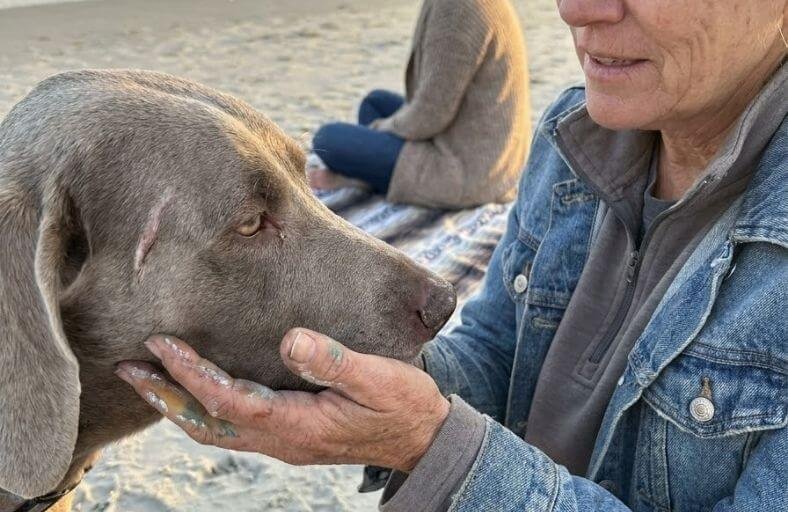
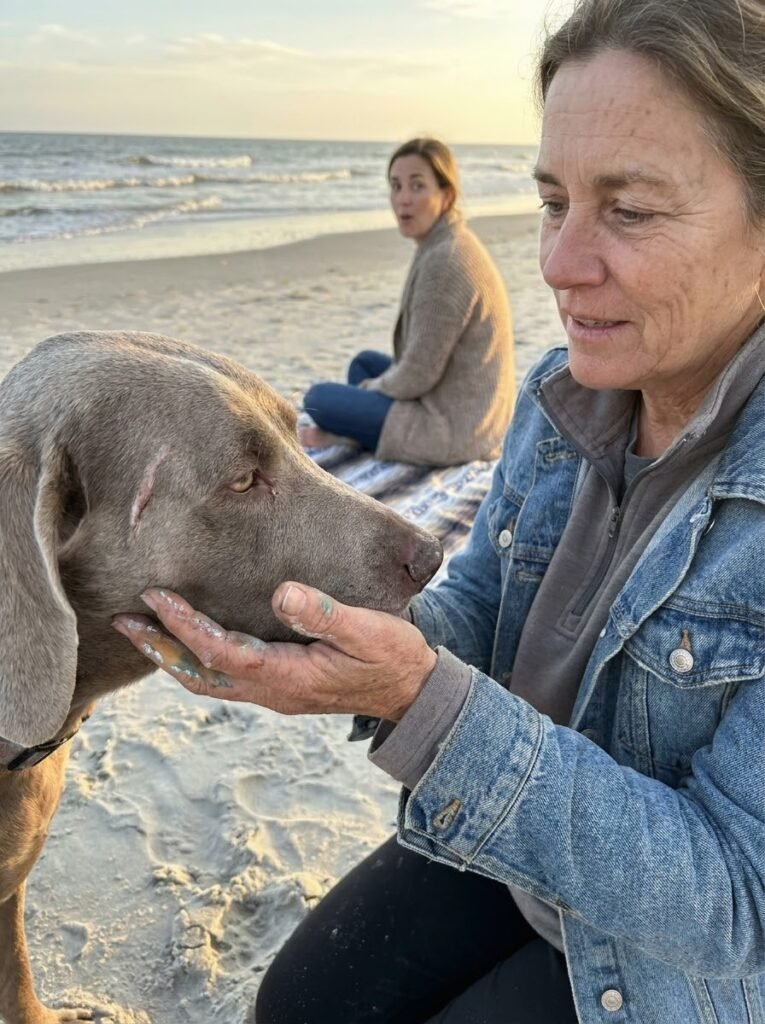
The dog would not stop circling the stranger’s blanket, even after Dana called his name four times.
Scout planted his front paws in the sand and looked back at her once, as if to say he had somewhere more important to be.
Then he turned and pressed his nose into the stranger’s shoulder, gentle but insistent, the way he did when a storm was coming and he wanted someone to know it before the sky did.
Dana Whitfield was not the kind of person who let her dog bother strangers on a public beach.
She spent most of her life trying not to be a bother to anyone, a habit left over from three years of watching people’s faces change when they found out she was a young widow, then watching those same faces change again when they found out about the lupus.
She had grown quiet in ways she used to find embarrassing. Lately she had stopped being embarrassed by much of anything.
That afternoon on Hunting Island, she had a folded compass keychain in her jacket pocket that had belonged to her husband, Cole, and a swimsuit under her clothes that she had not worked up the nerve to wear.
Her daughter, Josie, was fifteen and had spent the whole drive out from Beaufort with earbuds in, which Dana had learned to read as a good sign rather than a bad one. It meant Josie felt safe enough to tune her out for an hour.
They had come to the beach because Dana’s nephrologist had used the word “renal decline” again at her last appointment, and because sitting in a folding chair watching the tide come in seemed like a better use of an uncertain number of remaining Saturdays than staying home and thinking about it.
Two years earlier, a hurricane named Odette had torn through the South Carolina coast and left behind flooded ditches, downed power lines, and one half drowned gray dog with a scar already forming above his left eye by the time animal control found him.
Nobody had ever come looking for him. The shelter named him Scout because he seemed to always be scouting the horizon for something, ears up, body tense, waiting.
He had never fully stopped doing that, even two years into a quiet life with Dana and Josie in a small blue house with a tin roof.
He had also never done what he was doing now, not with a stranger.
The woman on the blanket was maybe forty, dark haired, working a needle through a small embroidery hoop with the unhurried patience of someone who had nowhere else to be.
She startled when Scout first pushed his head under her arm, then laughed, then tried gently to redirect him toward the water, toward a stick, toward anything that was not her own lap.
Scout was not interested in redirection.
He sat down directly in front of her, his whole gray body trembling with the effort of not climbing into her lap entirely, and he stared up at her face with an intensity that made the woman finally lower her needlework and stare back.
“I am so sorry,” Dana called, hurrying across the sand with the leash bouncing uselessly against her leg since Scout had slipped it off his collar somehow, again, the way he always managed to when he had decided something mattered more than obedience. “He never does this. I promise he is friendly, he is just being incredibly rude right now.”
“He’s fine,” the woman said, though she kept glancing at the dog with an expression Dana could not quite place.
Not fear.
Something closer to recognition, the way you look at a face on the street that reminds you of someone you have not thought about in years.
“I’m Dana,” she said, crouching to finally loop the leash back through Scout’s collar, her fingers not quite steady from the short jog across the sand, a reminder of exactly how much her body had changed in the last year. “This absolute menace is Scout.”
“Priya,” the woman said, and something in the way she said the dog’s name back, quiet and testing, like she was trying it against a memory, made Dana look up.
Scout would not stop looking at Priya either.
He leaned his whole weight against her knee and let out a low sound that was not quite a whine, more like relief.
Dana did not know it yet, sitting there on the warm sand with sea grass rattling behind them and her daughter still lost in her music down the beach, but the dog at her feet was not confused, and he was not being rude.
He had found something he had been looking for since before Dana ever met him.
And within a year, that something would save her life in a way none of them could have predicted, in a hospital room three counties away, with a surgeon holding a chart that read one in twenty-two million and calling it the strangest match of his career.
Part 2 – The Blank Line on the Adoption Form
Two years before that afternoon on Hunting Island, Dana had sat across a metal desk at the Beaufort County Animal Shelter filling out adoption paperwork with a pen that kept running dry.
Cole had been gone for eleven months by then.
Josie had asked for a dog three separate times that year, and Dana had said no three separate times, mostly because the idea of keeping one more living thing alive felt like more weight than she could carry.
But grief made people do strange arithmetic sometimes, and somewhere around month eleven, Dana had decided that maybe what she needed was not less weight but a different kind of it. A weight with a heartbeat. A weight that would need her.
The shelter worker, a woman named Carla with a sunburned nose and a clipboard she guarded like scripture, had walked her back to the kennels and stopped in front of a gray dog with a scar over his left eye who was sitting very still, watching the door like he expected someone specific to walk through it.
“That’s Scout,” Carla said. “Came in after Odette flooded half the county two years back. Sweet as anything once he trusts you, but it took him a while to trust anybody here.”
“Do you know anything about where he came from?” Dana had asked, more out of habit than real curiosity, the kind of question you ask a stranger’s dog to fill silence.
Carla had flipped through the folder and frowned.
“Not much. He came to us already named Scout, if you can believe that, some volunteer must have called him that during the flood response, because he answered to it right away.
And he wouldn’t eat out of a bowl for the longest time, only if you cupped your hand. Somebody taught him that. We just never found out who.”
There was a line on the intake sheet marked Foster History, and it was blank.
Dana had not thought much of it that day. She had been more focused on the way Scout finally stood, walked to the front of his kennel, and pressed his scarred head against her hand through the bars, the first time he had approached anyone in the building without being coaxed.
It had felt, in the exhausted, grief soaked logic of that year, like being chosen. She signed the paperwork before she let herself think too hard about whether she was ready.
She brought him home that same week to the little blue house on Bay Street, where Josie cried with happiness in a way she had not cried about anything since her father’s funeral, and where Scout spent the first three nights sleeping pressed against Dana’s bedroom door like he was standing guard against something none of them could see.
It was Josie, not Dana, who first noticed how strange it was that a dog pulled half drowned from a ditch during a hurricane came with a name already attached, and manners already taught, and no paperwork explaining who had taught him.
“Maybe somebody loved him before us,” Josie had said one night, scratching behind Scout’s ears while he sighed and melted into the floor between them. “And maybe they’re still out there somewhere.”
Dana had laughed it off at the time.
Josie had a habit of turning ordinary things into stories, a habit she got from her father, who used to tell her that every object in their house had a secret history if you asked it the right questions.
But that blank line on the intake form would come back to matter more than either of them could have guessed, once a doctor across three counties confirmed that the impossible sometimes leaves paper trails, and once Josie went digging through an old shelter binder looking for answers about a woman named Priya who her mother could not stop talking about.
For now, though, in that first autumn after Odette, all Dana knew was that her house felt less empty with a gray dog snoring in the hallway, and that some nights, when the wind picked up outside, Scout would go stand by the front door and stare out through the glass, waiting for someone who never came.
Part 3 – The Last Ordinary Saturday
The Saturday before the beach, Dana had woken up feeling almost like herself.
It did not happen often anymore. Her lupus had been managed reasonably well for years, something she had learned to live around the way other people live around bad knees or seasonal allergies, but eighteen months ago her kidney function had started sliding in a way her doctors described with increasing seriousness at every visit.
Creatinine levels.
Filtration rates.
Words that used to mean nothing and now lived permanently in the back of her mind like static.
That morning, though, her joints did not ache the way they usually did, and the low grade nausea that had become her constant companion had eased enough that she made pancakes for Josie without having to sit down halfway through.
“You’re humming,” Josie said, suspicious, pouring syrup with the careless abundance of a fifteen year old who has never once thought about calories or sodium.
“I’m allowed to hum.”
“You never hum.”
Teresa Buckner, Dana’s neighbor of nine years, showed up around ten with two coffees and her usual disregard for knocking before letting herself in the back door.
“You look like a person today,” Teresa said, handing Dana a cup. “Not that you don’t always look like a person. You know what I mean.”
“I know what you mean.”
They sat on the back porch while Scout patrolled the yard with the seriousness of a dog on official business, and Teresa, who had been Dana’s loudest advocate through every terrible appointment since the diagnosis, brought up the transplant list the way she always did, gently but relentlessly, like water working on stone.
“Any movement?”
“Same as last time. Long wait, no living donor match on the horizon. Whitcombe says my antibody profile is complicated.
Some blood type and tissue thing that makes it harder than average to find a match.”
“Complicated like impossible?”
“Complicated like I try not to think about the number too hard.”
Teresa did not push further, which was its own kind of kindness, and instead redirected the conversation toward whether Dana had actually agreed to come to the beach that afternoon or was just letting Josie assume she had.
It was Josie’s idea, the trip to Hunting Island. She had been begging for weeks, ever since a girl in her class posted photos of the lighthouse there, and Dana, sensing an ordinary Saturday she did not want to waste, had said yes before she could talk herself out of it.
There is a particular kind of grief that comes from loving someone who is sick without letting them see how afraid you are, and Josie had gotten very good at hiding hers, folding it small enough to fit inside earbuds and sarcasm and requests for beach trips that were really requests for one more good memory before things got worse.
Dana understood this without either of them ever saying it out loud.
They loaded the car around one, towels and an umbrella and a cooler Teresa insisted on packing herself because Dana still was not supposed to carry anything heavy.
Scout rode in the back seat with his head out the window the whole drive, nose working overtime, tail thumping the seat in a rhythm that had nothing to do with anything Dana could see or smell.
She would think about that later. How he had been agitated the entire drive out, restless in a way that was unusual even for him, as if some part of him already knew where they were going, and who was waiting there, even though there was no possible way he could have.
It felt, later, like the last ordinary Saturday. Not because anything went wrong that day.
Because everything after it went so strangely, impossibly right, in a way that made the ordinary version of her life feel like a door that had been quietly closing for a year, right up until a gray dog refused to let it shut.
Part 4 – The Foster Photo Josie Found
The days after the beach were full of a specific, buzzing kind of curiosity that Dana could not shake.
She had exchanged numbers with Priya before they packed up that afternoon, the way you do with someone your dog has decided is important, half expecting to never actually text her.
But Priya texted first, two days later, a short message that read: This is going to sound strange, but I keep thinking about your dog. Would you want to get coffee sometime? I promise I’m not usually this forward with strangers.
They met that Wednesday at a coffee shop on Bay Street, and what was supposed to be a quick half hour turned into two, conversation moving easily between them in a way Dana had not experienced with someone new in years.
Priya worked as a labor and delivery nurse at the hospital in Charleston, an hour’s drive north, and mentioned almost in passing that she had once done volunteer animal rescue work, years back, mostly during hurricane season.
“I actually fostered a dog after one of the storms,” Priya said, stirring her coffee absently. “A gray one.
Never found out what happened to him after animal control finally took him. I think about him sometimes, actually. He had the strangest eyes.”
Dana felt something shift in her chest, quiet and small, like a key turning in a lock she had not known was there.
“What did he look like? Besides gray?”
“He had a scar, right over one eye. From something in the flood, I never knew what. He wouldn’t eat from a bowl for the longest time.
I had to feed him out of my hand for almost two weeks before he trusted anything else.”
Dana set her cup down very carefully.
“I need to show you something,” she said, already reaching for her phone.
She pulled up a photo of Scout, the scar clearly visible above his left eye, his gray coat catching afternoon light on their back porch, and turned the screen toward Priya.
Priya went still in a way that made the whole coffee shop seem quieter around them.
“That’s him,” she said, her voice thin with disbelief. “That’s my dog. That’s the dog I fostered after Odette.”
Neither of them said anything for a long moment. Outside, a delivery truck idled at the curb, its engine the only sound Dana could focus on while her mind tried to catch up to what her body already understood, that Scout had not been confused on that beach at all.
He had recognized a scent, a voice, a hand that once fed him when he had nothing and no one.
That night, Dana told Josie everything over dinner, and Josie, predictably, disappeared into her room afterward and came back twenty minutes later holding an old manila folder she had apparently taken from the shelter binder Carla had let her borrow for a school project the year before, back when Josie had gone through a brief phase of wanting to volunteer there herself.
Inside was a single photocopied intake sheet from two years earlier, and stapled to the back, a photo nobody at the shelter had ever bothered to scan into the digital file.
A young woman crouched in muddy rescue gear, holding a shivering gray dog against her chest, both of them soaked through from the storm.
“I found this months ago,” Josie admitted, a little sheepish. “I didn’t know who she was. I just thought it was cool that Scout had this whole other life before us. I never thought it would actually matter.”
Dana stared at the photo for a long time before she finally understood what her daughter had been trying to tell her back on that first night home from the shelter, when she said maybe somebody loved him before us, and maybe they’re still out there somewhere.
They had been. She had been sitting on a beach blanket a mile from where Dana used to take Cole in the summers, close enough the whole time that a dog with a good enough memory and a stubborn enough heart had simply refused to let the distance stay between them any longer.
What none of them knew yet, not Dana, not Priya, not even Scout circling anxiously between them as if he could sense the shape of what was coming, was that this reunion was about to become something far bigger than a sentimental coincidence.
Two weeks later, during a routine conversation about Dana’s declining health, Priya would casually mention that she was already on the national kidney donor registry, something she had signed up for years ago and mostly forgotten about.
And when the hospital ran the numbers, Dr. Alan Whitcombe would sit across from both women with a chart in his hands and use a phrase that would follow them for the rest of their lives.
One in twenty-two million.
Part 5 – What Doctor Whitcombe Said About Remembering
The transplant workup took longer than either of them expected, six weeks of blood draws and tissue typing and cross matching, each step feeling to Dana like waiting for a verdict she was not sure she was allowed to hope for.
Priya drove down from Charleston for every appointment she could make, sitting beside Dana in waiting rooms that smelled like antiseptic and old coffee, holding a paperback she never actually read. She had explained her decision to Dana plainly, the way she explained most things.
“I signed up for the registry years ago because a patient of mine needed a kidney and didn’t get one in time,” she said one afternoon, while they waited for lab results neither of them could rush. “I told myself if I was ever a match for someone, I wouldn’t hesitate. I just never thought that someone would be a woman my dog picked out of a crowd.”
Dr. Alan Whitcombe called them into his office on a gray Tuesday in November, a manila folder open on his desk, his reading glasses pushed up into gray hair that had gone thin at the crown.
“In twenty six years of doing this work,” he said, sliding the folder toward them, “I have never seen a match this clean between two people with no blood relation.
Blood type, tissue markers, the antibody profile we were told was going to make this nearly impossible.
All of it lines up like it was designed.”
He looked at Priya, then at Dana, then, almost as an afterthought, down at Scout, who had come along for this appointment because Josie insisted a good luck charm never hurt anybody, and who was currently lying across both of their feet under the desk like he had personally arranged the meeting.
“One in twenty two million,” Whitcombe said. “That’s the statistical odds of finding a match this precise between two unrelated donors.
I don’t put much stock in fate, generally. I’ve seen too much bad luck in this job to believe in it. But I will say this.
Sometimes the body remembers a kindness long after the mind has let it go, and sometimes it takes an animal’s heart to drag two strangers back to the moment they were always meant to meet.”
Dana thought about that sentence for a long time afterward, turning it over the way she used to turn over things Cole said, looking for where it would settle inside her.
She thought about Scout circling Priya’s blanket on a beach he had no reason to remember.
She thought about a scarred, half drowned dog who refused to eat except from a stranger’s cupped hand, and how two years later, that same stubborn loyalty had somehow reached backward through time and pulled his rescuer directly into the path of the woman who adopted him.
It did not feel like coincidence anymore. It felt like something closer to a debt finally being repaid, paid forward through a species that had no language for gratitude except showing up, again and again, until someone noticed.
The surgery was scheduled for the second week of December, at the Medical University of South Carolina in Charleston.
The night before, Dana sat on her back porch with Cole’s compass keychain in one hand and Scout’s head heavy in her lap, and she let herself cry the way she had not let herself cry in a long time, not from fear, but from something closer to disbelief that her life had bent this far back toward possibility.
Josie found her out there past midnight and sat down without a word, wrapping a blanket around both their shoulders.
“Dad would have loved this,” Josie said finally. “The whole ridiculous story of it. A dog leading you to the person who saves your life. He always said everything has a secret history if you ask it the right questions.”
“I remember,” Dana said.
“Guess Scout finally answered.”
The surgery, when it came, lasted just under four hours. Dana woke in a recovery room with tubes she did not fully register and a nurse checking numbers on a monitor, and the first coherent thought she had, once the anesthesia cleared enough to think anything at all, was whether Priya was okay in the room down the hall.
She was. Recovery for both women went as well as Dr. Whitcombe could have hoped, and within days, color had returned to Dana’s face in a way Teresa said she had not seen in over a year.
“You look like a person again,” Teresa told her, echoing the words from that last ordinary Saturday, before any of this had happened, before a dog on a beach had rewritten the whole shape of what was possible for a woman who had quietly stopped expecting good news.
Part 6 – The First Storm After
Recovery took months, slow and uneven the way real healing usually is, nothing like the tidy movie version where a person simply wakes up better.
There were setbacks. A minor infection in January that sent Dana back to the hospital for three frightening days. A round of medication adjustments that left her exhausted for weeks longer than anyone had promised her.
Through all of it, Scout adjusted his own routines without being asked, sleeping pressed against her side on the nights her body ached worst, refusing to leave her line of sight for the first six weeks home, as though some part of him understood exactly how close they had come to losing something, and had decided he was not taking any more chances.
By early spring, a new rhythm had settled into the house on Bay Street.
Priya, whose recovery from the donor surgery had been comparatively quick, started driving down from Charleston most Sundays, first to check on Dana, then simply because she wanted to.
What began as a checkup habit slowly became something else entirely, dinners that ran long, a standing invitation, a toothbrush that eventually just stayed in the guest bathroom without anyone formally deciding it should.
Josie, who had spent two years being the quiet, watchful caretaker of a mother she was terrified of losing, seemed to unclench for the first time since her father’s funeral.
She started calling Priya by name without the careful distance she usually kept from adults, and one Sunday in April, Dana caught the two of them in the kitchen laughing so hard over a burned batch of cornbread that neither one noticed her standing in the doorway.
The real test came in late August, when a tropical storm named Helene tracked up the coast and forced a mandatory evacuation notice for parts of Beaufort County.
It was the first significant storm since Dana’s surgery, and the first one Scout had lived through in the house since the hurricane that had nearly killed him two years before it all began.
He grew agitated the moment the wind picked up outside, pacing, panting, pressing himself against the front door the way he used to before Dana understood why.
Priya, who had driven down early that week specifically to be there in case the storm turned serious, sat on the floor with him for over an hour that night, one hand resting flat against his chest, murmuring the same low, steady words she must have used two years earlier in a flooded ditch to calm a half drowned, terrified dog who had no reason yet to trust anyone.
“You’re okay,” she told him, again and again, while rain hammered the tin roof and Josie sat wrapped in a blanket nearby, and Dana watched from the doorway with her hand pressed against her own side, feeling the strange, still miraculous rhythm of a kidney that was not originally hers, doing exactly what it was supposed to do.
Scout eventually settled, his breathing slowing to match Priya’s, his scarred eye drifting shut under the weight of a hand he had apparently been waiting two years to feel again.
The storm passed without serious damage to their part of the county.
But something in that night stayed with all three of them, proof that healing, animal or human, is rarely a straight line.
It circles back sometimes, tests itself against old fears, and needs the same steady hand more than once before it holds.
“He still remembers,” Josie said quietly, once the wind had died down and the power flickered back on. “After everything. He still remembers what scared him, and he still remembers who made it stop.”
Nobody in the room needed to say that the same was true for all of them.
Part 7 – The Beach Where It Started
A year to the day after that first afternoon on Hunting Island, the four of them went back.
Dana walked the same stretch of sand without needing to stop and catch her breath the way she once had, her color good, her energy steadier than it had been in years.
Priya walked beside her carrying a blanket and a battered embroidery hoop she had never quite finished the pattern on, the same one she had been working the day a strange gray dog decided her lap was more important than any other spot on that entire beach.
Josie, sixteen now and taller than she had been the year before, ran ahead with Scout off leash, throwing a stick into the shallow surf while he chased it with the same restless energy that had once made Dana apologize to a stranger for his terrible manners.
They spread the blanket in almost the exact same spot, close enough to guess by memory, close enough that Scout circled it twice before finally lying down with a contented groan, his gray muzzle resting on his paws, his scarred eye watching the two women he loved most settle in beside him.
In the past twelve months, Dana’s kidney function had stabilized completely, her lab numbers so unremarkable now that her last appointment with Dr. Whitcombe had lasted less than fifteen minutes, most of it spent talking about his own dog rather than her chart.
Priya had moved down from Charleston in the spring, taking a position at the Beaufort hospital, close enough that Sundays had quietly become every day.
Somewhere along the way, without either of them planning it as a single dramatic moment, Priya had simply stopped leaving.
“One in twenty two million,” Priya said, watching Scout doze in the sand beside them, the tide pulling in slow and easy under a September sky. “That’s what Whitcombe called the match. But I keep thinking the real odds were something else entirely.
The odds that a half drowned dog I fed out of my hand for eleven days during a hurricane would end up on a beach a year and a half later, refusing to leave the one woman on earth who needed exactly what I had to give.”
“Sometimes the body remembers a kindness long after the mind has let it go,” Dana said, repeating the words Whitcombe had said in his office that gray Tuesday in November, words that had followed her through surgery and recovery and every ordinary Sunday since. “And sometimes it takes an animal’s heart to drag two strangers back to the moment they were always meant to meet.”
Josie flopped down on the blanket between them, sandy and out of breath, Scout following a moment later to press his scarred head firmly against Dana’s knee, the same gesture he had made in a shelter kennel two years earlier when he chose her out of every visitor who had walked past his cage.
Dana reached into her jacket pocket and closed her fingers around Cole’s compass keychain, worn smooth now from three years of carrying it everywhere, and for the first time in a long time, the weight of it did not feel like grief alone.
It felt like proof that love finds its way back around, sometimes through the people you lose, and sometimes through a stubborn gray dog who simply refused to let a debt of kindness go unpaid.
The sun dropped low and gold over the water, exactly the way it had a year before, and none of them moved to leave until the last of the light was gone.
If this story touched your heart, follow this page for more unforgettable dog stories about rescue, second chances, and the animals who somehow always know the way home.