
PART 1
The bus pulled away at 3:15 every afternoon, and every afternoon the same old dog was left sitting on the bench like he had somewhere important to be.
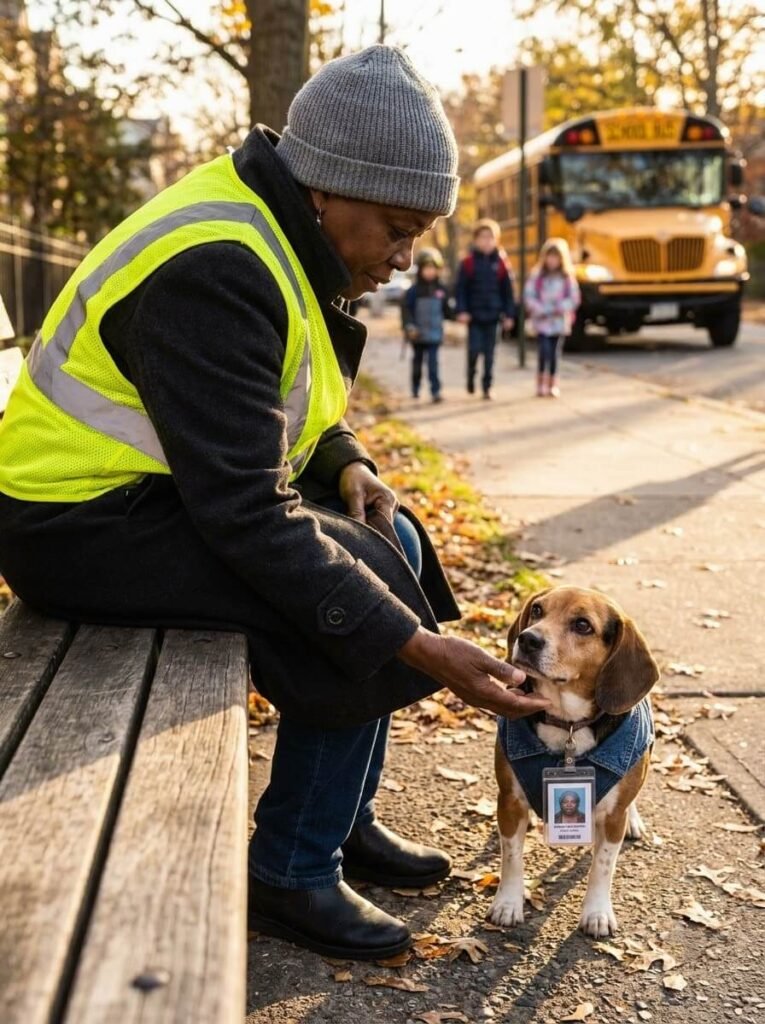
Grace Okafor had worked the corner of Willow and Fifth for two years now, blowing her whistle for the fourth graders and waving her orange flag at cars that rolled through the stop sign a little too fast.
She had seen plenty of strays pass through Cedar Hollow. Most of them ran. Most of them flinched at loud noises and kept their tails low.
This one did neither.
He walked to the bench at exactly 3:10, sat down like he had an appointment, and waited.
People who met Grace assumed she had always done this kind of work. Quiet. Patient. Good with children and slow afternoons.
They were wrong.
For thirty-one years she had worked the trauma bay at Mission Hospital, the kind of job where the phone rings at 2 a.m. and somebody’s whole life changes before sunrise.
She had held more hands in their last minutes than she could count. She had learned to read a room in three seconds flat, to know who was going to make it and who wasn’t before the doctors even said a word.
She still carried a stethoscope in her coat pocket. She had not used it professionally in three years. She just could not make herself leave it at home.
Samuel had been gone that long. A heart attack in the garage on a Tuesday morning, the kind of death that gives no warning and no goodbye.
Grace had spent her whole career catching other people’s worst moments. She never got to catch her own husband’s.
So she quit the ER. She took the vest and the flag and the slow, small rhythms of a school crossing corner, because grief, she had learned, does not need adrenaline. It needs quiet.
Which was why the dog caught her attention in the first place. He was quiet too.
He was a small, sturdy thing, some mix of beagle and corgi by the look of his short legs and long ears, with a notch out of his left ear like an old wound long healed and a soft white patch spreading over one eye.
He walked with a slight limp, arthritis probably, the stiff-legged shuffle Grace recognized from her own knees these days.
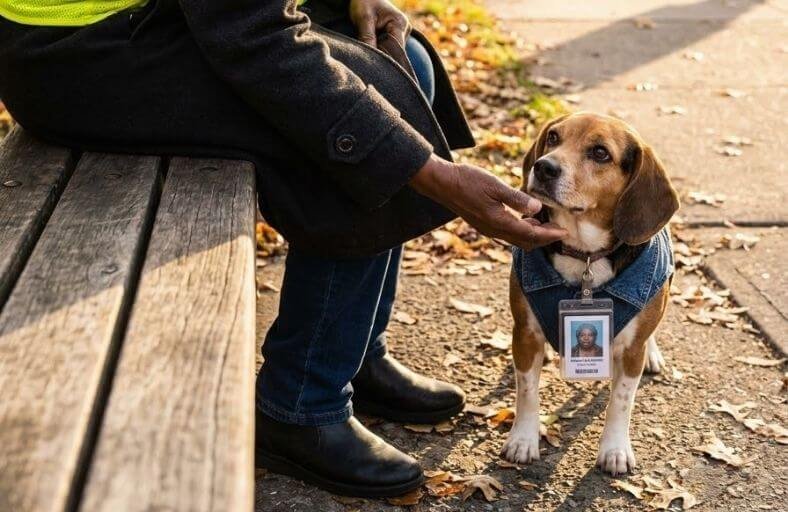
He wore a faded denim vest, the kind made for small dogs, with something clipped to the side she could not quite make out from a distance.
Every day, he sat on the bench. Every day, when the yellow bus rounded the corner and the doors hissed open, he stood up, tail wagging low and steady, and watched every single child come down the steps.
Then, once the last kid was off and the doors closed and the bus pulled away, his tail would stop.
He would sit back down. Wait a few seconds, as if giving something one last chance to happen. Then he would turn and walk himself, slow and limping, back down Willow Street alone.
Nobody claimed him. Nobody called him. He simply repeated the whole thing again the next afternoon.
“That’s Biscuit,” said eight-year-old Tommy Reyes on the second week, tugging Grace’s sleeve while they waited for a break in traffic.
Tommy was new to Cedar Hollow, still finding his footing in a school where everyone else had known each other since kindergarten.
“He smells my lunch bag every day. Right here.” He pointed to the front pocket of his backpack. “Then he lets me go. He does it to everybody.”
Grace frowned. Not the frown of confusion, but the frown of a woman who had spent three decades noticing patterns other people missed.
“He smells everyone’s bag?”
“Yep. Every single day. Then he sits back down.”
Grace looked at the dog more closely then. Not begging. Not sniffing at random the way a stray hunting scraps might.
His nose moved with purpose, low along each backpack’s front pocket, methodical, almost clinical. Like he was checking for something specific.
Like he had a job.
She crouched down slowly that afternoon, the way she used to approach frightened patients, low and unhurried, palm open.
Biscuit did not flinch or growl. He simply looked up at her with the one clear eye, the other clouded faintly beneath that patch of white fur, and let her see, for the first time up close, what was clipped to the side of his little denim vest.
A small laminated square, edges worn soft from handling. A charm bracelet looped through a buttonhole beside it, tiny silver beads catching the afternoon light.
She could not read the writing from that angle. But she could see initials, carefully printed in what looked like a child’s handwriting.
N. W.
Her chest tightened in a way she had not felt in years, not since the last time she had knelt beside a stretcher and known, before anyone told her, that something terrible had happened to someone far too young.
She did not get a closer look that day. A car honked, kids needed crossing, and Biscuit slipped away down Willow Street the moment her attention turned.
But she thought about him all evening. A dog who checked every child’s lunch bag like a nurse checking vitals.
A dog who waited for a bus every single day and never once got on it.
A dog wearing a dead child’s initials on his collar tag, if that was even what it was.
Grace had spent thirty-one years learning to recognize when a small detail was actually the whole story trying to surface.
This felt exactly like that.
PART 2 – The Afternoon Nora Started the List
Grace did not sleep well that night. She kept thinking about the tag, the initials, the way the dog’s nose moved with such deliberate purpose along each child’s backpack.
In her years in the ER, she had learned that instinct rarely lied. Something in her gut told her this dog was not lost. He was working.
The next afternoon, she arrived at the corner fifteen minutes early.
She wanted to watch him before the bus came, before the chaos of kids and cars and whistles. What she found surprised her.
Biscuit was already there, lying beneath the bench with his chin resting on his paws, ears perked at every car that passed. He was listening for something specific. She was almost sure of it now.
At 3:10, he rose and took his post beside the bench, exactly as he had the day before.
“He does this every single day,” said a woman walking her toddler past the stop. She slowed just long enough to add, “Started maybe two months ago. My husband thought somebody dumped him. I feed him sometimes, but he won’t come home with anybody.”
Two months.
Grace filed that detail away carefully. Two months was not long enough for a dog to develop a stray’s wariness on his own. Two months was, however, exactly long enough for something sudden and terrible to happen to a family.
She thought of her own two months after Samuel died. The way she had kept setting out two coffee cups every morning without meaning to. The body remembers rituals long after the mind understands they no longer serve anyone.
Maybe dogs did too.
When the bus arrived, Grace watched more closely than she ever had. Biscuit’s nose worked down the line of children stepping off, quick precise passes along each backpack’s front pocket, the place most kids kept snacks. He paused a half second longer at a boy holding a granola bar, sniffed once, then moved on without alarm. He paused again at a girl with a juice box, same quick check, same release.
It was not begging. It was screening.
Grace had worked enough allergy codes in her career to know the signs of someone trained to detect a specific threat.
Drug-sniffing dogs worked this way.
Diabetic alert dogs worked this way.
And so, she now remembered, did peanut allergy service dogs, trained to detect the scent of peanut protein on wrappers, hands, and breath before a child with a severe allergy accidentally came into contact with it.
Her pulse quickened.
“Tommy,” she called gently, once the corner had cleared enough to catch her breath. “Has Biscuit ever gotten upset? Like, really upset, not just sniffing?”
Tommy thought about it, swinging his backpack strap. “One time Marcus had peanut butter crackers. Biscuit barked at him a whole bunch. Like, really loud. Marcus got kind of scared.”
“And then what happened?”
“Marcus put the crackers away. Biscuit stopped barking.”
Grace felt something settle into place, cold and clear, the way a diagnosis sometimes clicks after a dozen scattered symptoms suddenly line up.
This was not a lost dog wandering a bus stop out of confusion.
This was a dog doing a job somebody had taught him, checking every child for the exact threat that had once endangered a child he loved.
That night, unable to shake the feeling, Grace called her old friend Dr. Ruth Chen, the veterinarian who had treated Grace’s own aging cat for years before he passed.
“A beagle corgi mix, male, arthritic gait, notch in the left ear, cloudy left eye,” Grace described. “Wears a denim vest, has a laminated tag and a charm bracelet clipped to it. Sound familiar to you?”
There was a long pause on the line.
“Grace,” Ruth said slowly, “I think I might know exactly who that is.”
She did not say more that night. She asked Grace to bring the dog by the clinic if she ever got the chance, said it would be easier to explain in person, with the chart in front of her. Grace hung up with more questions than answers, and one certainty sitting heavy in her chest.
Whoever N.W. had been, this dog had loved them enough to keep watching for danger long after they were gone.
She thought of the empty side of her own bed. The stethoscope in her coat pocket she still could not make herself put away.
Maybe grief did not look so different, whether you walked on two legs or four.
PART 3 – Biscuit Would Not Leave the Bench
The following Tuesday brought the first hard frost of the season, and Grace arrived at the corner bundled in her heaviest coat, breath fogging in the cold morning air. She had not planned to bring Biscuit to Dr. Chen that day. She had planned, simply, to keep watching.
But something was different.
Biscuit was already at the bench when she arrived, hours before the afternoon bus was due. He was shivering, curled tight against the cold, his notched ear pressed flat.
Grace’s ER instincts kicked in before she could think twice. She crouched down, laid a bare hand against his side, checked his gums, his breathing, the warmth of his paws.
Nothing acutely wrong, just an old dog too stubborn to seek shelter from the cold because leaving the bench was, in his mind, not an option.
“You can’t sit out here all day, sweetheart,” she murmured, the same voice she used to use on frightened patients at 3 a.m. “Come on. Just for a little while.”
She tried to coax him toward her car, parked half a block away with the heater running. Biscuit stood, took two stiff steps toward her, then stopped and turned back to the bench, planting himself firmly beside it. He would not budge another inch.
It was, Grace realized with a small ache in her chest, exactly the kind of refusal she had seen family members give in hospital hallways. The ones who would not leave a loved one’s bedside even for water, even for sleep, because leaving felt like abandoning a promise.
She sat down on the frozen bench beside him instead, wrapping her scarf a little tighter, and waited with him until the bus came.
When it finally arrived and the doors opened, Biscuit’s whole body transformed. Tail up. Ears forward.
That same careful nose check down the line of children, methodical as ever despite the cold. He seemed, for those two or three minutes, entirely himself again. Alive with purpose.
Then the bus pulled away, and the stillness returned.
It was during that quiet moment, kneeling to gently examine his paws for frostbite, that Grace finally got a close, careful look at the laminated tag clipped to his vest.
It was a small school photograph, edges gone soft and rounded from years of handling, protected under a thin layer of clear laminate that had clearly been redone more than once.
A girl, maybe nine years old, gap toothed and grinning, dark curly hair in two puffs, wearing a purple shirt with a cartoon fox on it.
Beneath the photo, in careful, looping child’s handwriting, someone had written a single line and laminated it alongside the picture.
Biscuit’s Bus Stop Job.
Grace’s hands went still.
She turned the tag gently, and on the back, in the same handwriting, a short numbered list had been copied out, clearly transcribed by an adult from something more fragile that must have existed first.
- Sit by the bench.
- Wait for the yellow bus.
- Sniff my snack bag for peanuts.
- Walk me home if Daddy’s late.
The charm bracelet looped through the buttonhole beside it held five small silver beads. A star. A dog. A heart. The letter N. The number 9.
Grace sat back on her heels, the cold forgotten entirely.
This was not a general service dog’s training tag. This was a child’s own instructions, written for her own dog, treated by whoever loved them both enough to preserve it in plastic and never let it fall apart.
A girl named something starting with N. Nine years old, or possibly nine years since something, Grace could not yet be sure which. A peanut allergy serious enough to require a trained detection dog. A father, mentioned right there on the list, sometimes late.
And a dog who was still, months later, following every single line of that list to the letter, as if the girl who wrote it might step off the bus any day now and need him to.
Grace thought of her own kitchen table, the way she still sometimes set out two mugs before catching herself.
The way grief did not always announce itself as sadness.
Sometimes it looked exactly like discipline. Like ritual.
Like refusing to leave a bench in the freezing cold because somewhere, underneath all logic, part of you still believes the job isn’t finished yet.
She carefully clipped the tag back onto Biscuit’s vest, the way she imagined its owner once had, a thousand mornings and afternoons ago.
“Okay,” she whispered, more to herself than to him. “Let’s find out who you’re really waiting for.”
That evening, she called Dr. Chen back, read her the name stitched faintly into the vest’s collar tag that she had somehow missed on her first inspection.
Nora W.
There was a long silence on the line before Ruth Chen finally spoke, her voice thick with something Grace recognized instantly, the particular gravity of a person about to deliver news they wished they didn’t have to.
“Grace,” she said quietly, “I need you to sit down.”
PART 4 – The Photo Clipped to His Collar
Dr. Ruth Chen’s small animal clinic sat two miles from the bus stop, tucked between a hardware store and a bakery that always smelled like cinnamon.
Grace arrived the next morning with Biscuit wrapped in an old towel on the passenger seat, having finally managed to coax him into the car with a strip of turkey bacon and the promise of warmth.
Ruth was waiting at the door before Grace had even parked.
“His name is Biscuit Whitfield,” Ruth said, once they were seated in the small back office, the dog curled cautiously at Grace’s feet. “He’s been a patient here for six years.
I treated him for an ear infection when he was three, that’s the notch you’re seeing, an old injury from before his family adopted him from the county shelter.”
She pulled up a chart on her computer, then hesitated with her hand still on the mouse.
“His owner was a little girl named Nora Whitfield. She had a severe peanut allergy, diagnosed at four. Anaphylactic. The kind where seconds matter.” Ruth’s voice caught slightly. “Her father trained Biscuit himself, with a private trainer’s help, starting when
Nora was six.
Scent detection for peanut protein. It’s not uncommon for families managing serious allergies in young kids. The dog checks food, checks hands, alerts before exposure happens.”
“And the list,” Grace said quietly. “The bus stop job.”
“Nora wrote that herself, in first grade, and updated it every year in her own handwriting. Her father laminated a new copy each time she added something.” Ruth’s eyes were wet now. “It was a real job to her. She took it seriously. She trained Biscuit to walk her home from the bus stop every single afternoon, checking her snack bag first, because she was terrified of accidentally eating something dangerous when her father couldn’t be there to check for her.”
Grace’s throat tightened. “Where is she now, Ruth?”
Ruth was quiet for a long moment.
“Nora died in August,” she finally said. “At a friend’s birthday party. Someone brought a homemade cake that used almond flour and peanut oil, not knowing about her allergy, and it wasn’t labeled.
She had a reaction faster than anyone expected. Her EpiPen was in her bag at home, in the rush to leave for the party they’d forgotten to pack it.
Daniel, her father, tried everything he could. He got burns on both hands trying to get her breathing again before the ambulance arrived. It wasn’t enough.”
The office went silent except for the faint hum of the refrigerator in the corner and Biscuit’s soft breathing at Grace’s feet.
Grace thought of every code she had ever run in her thirty-one years, every parent she had held back from a gurney, every time seconds had decided everything. She understood, with sudden and total clarity, exactly what kind of wound Daniel Whitfield was carrying in those scarred hands.
“He kept Biscuit at first,” Ruth continued, “but the dog stopped eating. Wouldn’t touch food for four days straight.
He scratched at the front door until his paws bled, trying to get out to the bus stop at exactly 3:10 every single afternoon, the way Nora had trained him to for three years.
Daniel finally realized the only thing keeping Biscuit alive was letting him finish the job Nora had given him.”
“So he lets him go,” Grace said softly. “Every day.”
“Every day. He put a GPS tracker on his collar and calls the school to let them know Biscuit isn’t a threat, just a neighborhood fixture now.
He watches from his truck sometimes, parked down the block, just to make sure Biscuit gets home safe afterward.” Ruth wiped her eyes quickly. “He can’t bring himself to stop it. He says it’s the only time all day Biscuit looks like his old self again.”
Grace looked down at the small, tired dog curled against her boot, his cloudy eye half closed, his good ear twitching in his sleep.
Nine years old. Arthritic. Half blind in one eye. Still walking two miles round trip every single afternoon, rain or frost, to sniff the lunch bags of children who were not the one child he was actually looking for, because somewhere in his loyal, unglamorous heart, quitting was simply not part of the instructions Nora had given him.
Sit by the bench. Wait for the yellow bus. Sniff every bag. Walk her home if Daddy’s late.
He had never once gotten to Step 4. Not since August. And yet every single afternoon, he still tried.
Grace reached down and rested her hand gently on his head, the way she used to rest a hand on a frightened patient’s shoulder in the last moments before something changed forever.
“I think,” she said quietly, “it might be time I met Nora’s father.”
Ruth nodded, already reaching for her phone. “I think he might need that more than you know.”
PART 5 – Biscuit and the Empty Seat by the Window
Daniel Whitfield showed up at the corner of Willow and Fifth two days later, a full twenty minutes before the bus was due, sitting in his truck the way Ruth Chen had described.
Grace recognized him immediately from the careful, guarded way he held himself, shoulders tight, hands wrapped around a coffee cup he was not drinking.
She walked over slowly, the way she used to approach a family in a waiting room, unhurried, palms visible.
“Mr. Whitfield,” she said. “I’m Grace. I work the crossing here.”
He looked at her for a long moment before nodding. Up close, the burn scars on his hands were unmistakable, pale ropes of tissue across his knuckles and palms, the kind of scars that come from holding onto something too long instead of letting go.
“Ruth told me you found the tag,” he said, voice rough. “The list.”
“I did.”
He was quiet for a moment, staring past her toward the bench where Biscuit already lay curled beneath it, waiting.
“She wrote that list the summer she turned six,” Daniel said finally. “Made me laminate it at the library because she said dogs can’t read regular paper if it gets rained on. She updated it every year on her birthday.
Added things. Crossed things out.” He gave a short, broken laugh. “Last year she added walk her home if I was late. Because I used to run behind sometimes, job sites, traffic. She worried about it more than she let on.”
Grace said nothing. She had learned, over three decades in trauma medicine, that grief rarely needed a response. It needed a witness.
“I kept him inside for two weeks after,” Daniel continued. “Thought it would be easier for both of us. He wouldn’t eat. Wouldn’t sleep.
Scratched the door until his paws bled trying to get out at exactly 3:10 every day. My sister said I was being cruel keeping him locked up like that, but I was terrified something would happen to him too.”
“But you let him go anyway,” Grace said gently.
Daniel nodded, eyes fixed on the bench. “Dr. Chen told me something I haven’t been able to shake. She said sometimes the kindest thing you can do for a grieving creature, human or otherwise, is let them keep the job that’s keeping them alive. Even if the job doesn’t make sense to anyone else anymore.”
At 3:15, the bus rounded the corner, and Biscuit rose from beneath the bench exactly as he had every day for two months, tail lifting, ears forward, nose already working before the doors had fully opened.
Daniel’s breath caught audibly beside Grace. She glanced at him and saw something complicated crossing his face, not quite pain, not quite peace, but something suspended carefully between the two.
“That’s the first time I’ve watched him do it up close since it happened,” he admitted quietly. “I usually just watch from the truck. Can’t get much closer than that.”
They stood together in silence as Biscuit finished his rounds, sniffed the last backpack, watched the bus pull away, and sat back down, tail stilling.
“He still checks every single one,” Daniel murmured. “Like she’s going to be on it one day.”
Grace thought of her own kitchen table, the two coffee mugs she still sometimes set out before catching herself.
She thought of the stethoscope in her coat pocket that no longer had any medical purpose except the simple, stubborn comfort of not letting go completely.
“My husband’s been gone three years,” she said quietly. “I still keep his slippers by the door. Not because I think he’s coming back. Because some part of grief isn’t logical, it’s just love that hasn’t figured out yet where to put itself.”
Daniel looked at her then, really looked, and something in his shoulders eased slightly, as if being understood by a stranger carried a different kind of weight than being comforted by people who loved him.
“Nora’s room is exactly the way she left it,” he admitted. “Her booster seat is still in my truck. I can’t move it. Every time I think about taking it out, it feels like admitting she’s not coming back for good.”
“You don’t have to move it,” Grace said. “Not until you’re ready. Grief isn’t a deadline, Mr. Whitfield. It’s a relationship you keep having, even after the person’s gone.”
He nodded slowly, watching Biscuit rise stiffly and begin his familiar limping walk down Willow Street, exactly two miles back toward the house where an empty booster seat still waited in the back of a truck and an empty seat by the kitchen window still faced the street where a yellow bus used to stop.
“Would it be alright,” Daniel asked quietly, “if I walked with him? Just today?”
Grace smiled, the first real smile she had allowed herself in longer than she wanted to admit. “I think that’s exactly what he’s been waiting for.”
They walked together, three of them now, the old dog setting the pace, the father matching his daughter’s dog’s stride step for step, and the retired nurse who understood loss well enough to know that healing rarely looks like moving on. Sometimes it simply looks like finally being allowed to walk the same road together instead of alone.
Love doesn’t end when someone leaves the room, Grace thought, watching Biscuit glance back once to make sure Daniel was still there. It just learns a new job to do.
PART 6 – The Halloween Night Biscuit Didn’t Run
Word travels fast in a neighborhood built around a single elementary school, and within two weeks, most of Cedar Hollow knew some version of Biscuit’s story. Grace never told it in full, mindful of Daniel’s privacy, but she made sure the children at the bus stop understood one simple thing.
“He’s not lost,” she told them one crisp morning, kneeling so she was eye level with the whole cluster of backpacks and mittens. “He’s working. Every single one of you is part of his job. So when he checks your bag, you let him. It matters to him more than you know.”
The kids took to it with the easy, uncomplicated devotion only children seem capable of. Within days, Biscuit’s afternoon rounds had become something the whole bus stop looked forward to.
Tommy Reyes started saving him a small dog biscuit each day, tucked carefully in the front pocket where Biscuit could easily find it during his check.
A girl named Priya started calling him “the snack detective,” a name that stuck fast and made even Daniel laugh the first time he heard it.
Daniel began joining most afternoons now, standing a little apart at first, then closer, then eventually right beside Grace at the corner, coffee in hand, watching his daughter’s dog do the job she had given him with a steadiness that seemed, slowly, to be healing something in both of them.
He still could not remove the booster seat from his truck. He still had not touched Nora’s room. But he had started eating dinner at the table again instead of standing over the sink, and he had started, in small ways, talking about her instead of only carrying her silently.
The first real test came on Halloween night.
A storm rolled in from the mountains that evening, sudden and violent, the kind of late October squall that rattles windows and sends trick-or-treaters running for cover.
Thunder cracked hard enough to shake the bus stop bench itself, and within minutes the quiet street was a chaos of screaming wind, flashing porch lights, and children in costumes scattering for shelter.
Grace was walking home when she saw Biscuit standing frozen at the edge of Willow Street, storm raging around him, clearly disoriented by the noise and the sudden dark.
Old dogs did not handle thunderstorms well, and Biscuit’s stiff joints made any fast movement painful and uncertain.
For one terrible moment, Grace was afraid he would bolt, the way frightened animals sometimes do, straight into traffic or lost entirely in unfamiliar dark.
He did not run.
Instead, through the wind and rain, Grace watched him turn in a slow, deliberate circle and limp directly toward the one familiar landmark he trusted most in the entire neighborhood. The bench.
He climbed beneath it, tucked himself into the small dry space underneath, and waited, exactly the way he had waited every single afternoon for two months, trusting that if he simply stayed at his post, someone who loved him would eventually come.
Daniel found him there ten minutes later, soaked to the bone but calm, tail giving a small tired thump against the wet pavement when the truck’s headlights swept across him.
“Hey, buddy,” Daniel said, crouching down in the pouring rain, voice thick. “I’ve got you. Job’s done for tonight.”
He carried Biscuit to the truck himself, wrapping him in his own jacket, and Grace watched from her porch as the old dog nestled against Daniel’s chest with the particular boneless trust of a creature who finally, after two long months, believed he was allowed to rest.
The next morning, Daniel arrived at the bus stop early, and for the first time, he brought something with him. A small waterproof cover for Biscuit’s vest, and beside the laminated photo tag, a second tag he had made himself.
Biscuit’s Bus Stop Job, Continued, it read simply. Watched over by Daniel and Grace.
It was not a replacement for Nora’s list. It never could be. But it was proof, quiet and steady, that the job she had given her dog had grown to include the people who loved her too, and that grief, given enough patience, could become something closer to companionship than pain.
“I think,” Daniel admitted quietly that morning, watching Biscuit take his post beneath the bench right on schedule, “I’m finally ready to move the booster seat. Not out of the truck. Just to Nora’s room. Where it belongs.”
Grace touched his arm gently. “That sounds like exactly the right kind of ready.”
PART 7 – The Bench With the Small Brass Plaque
Three years passed the way years tend to after the worst of grief finally loosens its grip, not quickly, and not without setbacks, but steadily, the way a scar softens without ever fully disappearing.
Biscuit grew old the way loyal dogs often do, slowly and then all at once. His muzzle whitened further.
His limp deepened into a careful, deliberate shuffle that took him longer each season to complete his two mile round trip.
Dr. Chen adjusted his joint medication twice, then a third time, and gently began preparing Daniel for what she called, as kindly as such things can be said, the long goodbye.
He never missed a single afternoon at the bench. Not once, in nearly four years, not through summer heat or winter ice or the handful of storms that rolled through the mountains each year.
Even in his last months, when his back legs trembled from the effort, Daniel would carry him partway and set him down half a block from the stop, so Biscuit could still finish the job on his own four paws, exactly the way Nora had trained him to.
“It matters to him,” Daniel told Grace once, watching the old dog take his final steps toward the bench with painstaking care. “Even now. Maybe especially now.”
Biscuit passed away peacefully on a quiet Sunday morning in March, curled on a blanket in Nora’s old room, Daniel’s scarred hand resting against his side the entire time.
He was thirteen years old. Dr. Chen said, gently, that dogs rarely live that long with the joint condition he had carried for years, and that whatever kept him going that extra time was not medicine.
It was purpose.
Grace cried the way she had not cried since Samuel’s funeral, surprising herself with the depth of it for a dog she had known only three years.
But grief, she had learned by then, does not measure itself by length of time known. It measures itself by depth of what was witnessed.
The Cedar Hollow community, the same neighborhood that had once assumed Biscuit was simply a lost stray, came together that spring to do something small but permanent.
With Daniel’s blessing, the elementary school PTA raised funds for a small brass plaque, fixed to the bus stop bench where it had all started.
It read simply:
In memory of Nora Whitfield and her dog Biscuit, who taught this street what loyalty really means. Job well done.
Tommy Reyes, no longer the new kid but a confident fifth grader now, still stops at the bench each afternoon on his way home, just for a moment, just to touch the plaque the way some kids touch a lucky charm.
Daniel eventually adopted another dog, a young shelter mutt named Scout who has never once had to check a lunch bag for peanuts, who gets to simply be a dog, chasing squirrels and sleeping in sunbeams without carrying anyone else’s grief on his small shoulders.
Daniel says it feels like the right kind of tribute. Not a replacement. Just proof that love, once it learns how to heal, eventually makes room for joy again too.
Grace still works the corner of Willow and Fifth most afternoons, older now herself, her own knees stiffer, her own hair a little whiter beneath the knit cap.
She keeps Samuel’s stethoscope in her coat pocket still, not out of sadness anymore, but out of the same quiet loyalty Biscuit once taught an entire neighborhood to recognize.
Love doesn’t end when someone leaves the room. It just learns a new job to do.
Sometimes that job looks like sitting on a park bench in the freezing cold. Sometimes it looks like keeping a stethoscope you’ll never use again.
Sometimes it looks like a small brass plaque on a bench where a girl and her dog once waited faithfully for each other, long after one of them could no longer come home.
Cedar Hollow never forgot the old beagle who waited at the bus stop. And somewhere, Grace likes to believe, Nora never had to wait alone either.
If this story touched your heart, follow this page for more unforgettable dog stories about loyalty, grief, and the quiet ways love finds its way home.