
Part 1
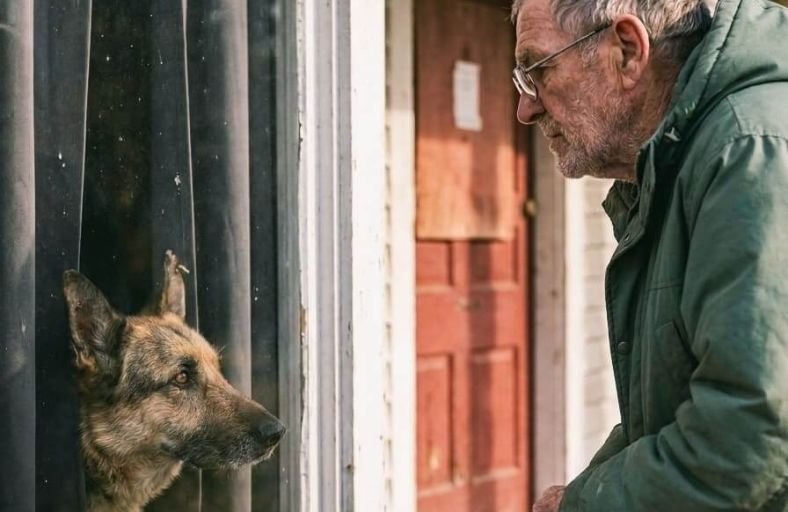
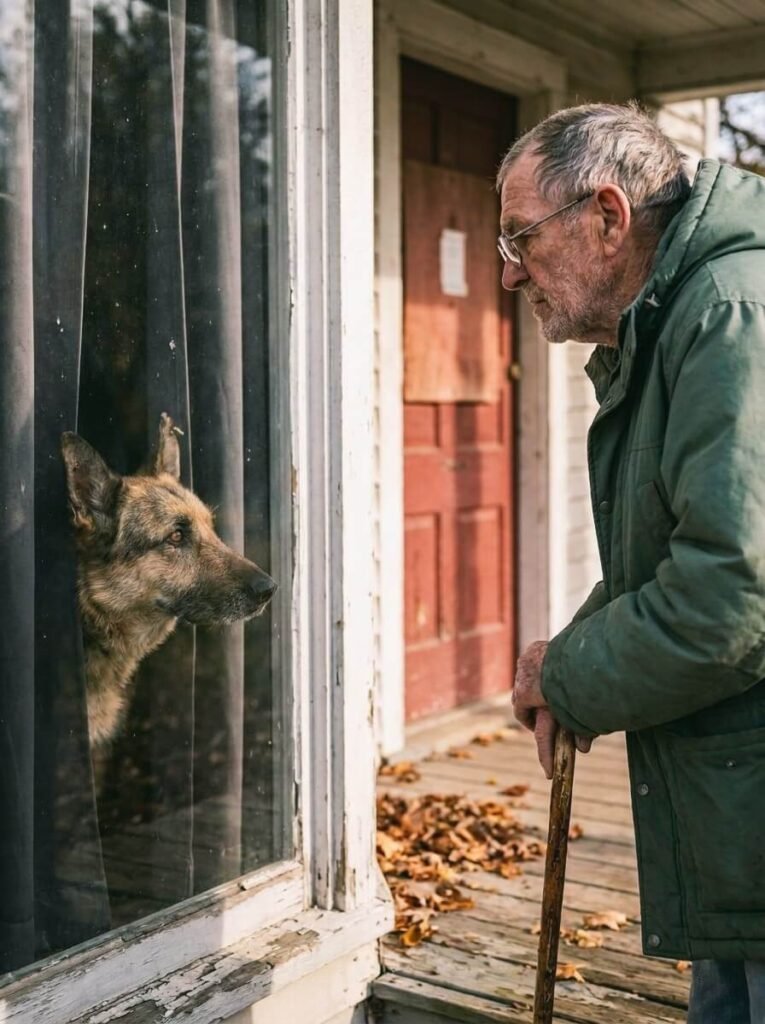
The police officer put her shoulder to the heavy front door, breaking the court seal that had locked the yellow house for sixty-three days, and the first thing that moved in the dark was an amber eye staring through the blinds.
Everyone in the neighborhood thought the house was empty.
My name is Arthur “Artie” Pendelton, and I was seventy-six years old then, a white American retired postal worker with a slight limp in my right knee, faded wire-rimmed glasses, and thirty-four years of walking the same suburban streets of Spokane, Washington.
I knew every porch, every mail slot, every creaky step, and every dog along my old route. I lived three doors down in a small bungalow that felt too big ever since my wife, Joan, passed away three years ago.
I kept an old brass mail-carrier’s whistle on a worn leather lanyard around my neck out of habit, a small piece of metal that reminded me of a life where people expected my arrival.
The house at 412 Elm Street belonged to Martin Pike, a fifty-two-year-old white American man who had been arrested in late September for financial fraud. When the police led him away in handcuffs, Martin told the officers he had already sent his pets to stay with a relative in Oregon.
It was a lie.
A terrible, calculated lie that sat behind a paper court seal taped across the front doorframe.
For nine weeks, the house stayed silent. The grass turned yellow, autumn leaves piled up against the porch, and winter frost began to settle on the windowpanes.
I walked past that house every morning, my old mailman’s eye catching small details out of reflex. On the sixty-third day, I saw a corner of the hallway blind twitch.
I called Officer Lena Brooks, a thirty-four-year-old white American police officer with a sharp eye, a firm posture, and a reputation for actually listening to senior citizens when something felt wrong.
When the heavy wooden door finally cracked open, a smell hit us—stale air, dust, damp wood, and the unmistakable scent of deep starvation.
Officer Brooks pulled her flashlight.
The beam swept across the dark entryway.
Sitting at the top of the carpeted stairs was a large German Shepherd and Collie mix. He was emaciated. His ribs stuck out like cage wire under a dull coat, his footpads were raw, and his left ear had a distinctive notch.
Yet he did not bark. He did not growl. He stood like a guard whose shift had ended two months ago, but who refused to leave his post.
His name was Atlas.
As Officer Brooks stepped forward, Atlas did not run to the door toward freedom.
Instead, he turned slowly and walked back into the dark upper hallway.
He stopped, looked back over his shoulder at us, and let out a low, raspy whine.
We followed him.
At the end of the hall, inside a cold bedroom filled with overturned boxes, Atlas lay down on the floor beside a pile of old blankets. He extended one long, thin front leg and pulled a piece of wool back with his paw.
Curled underneath was a frail, fourteen-year-old orange tabby cat named Pearl. She was completely blind from retinal degeneration, shivering, and so thin her bones felt like parchment.
Atlas lowered his large head beside her nose, nudging her gently until the old cat let out a faint, dry purr.
The dog had not stayed alive alone.
He had stayed alive to keep her from dying.
Part 2 – The Amber Eyes Behind the Blinds
Two months before the front door was forced open, Martin Pike’s house had been shut down under a county asset seizure order.
Martin was the kind of neighbor who rarely spoke to anyone. He kept his curtains drawn, drove an old gray sedan, and ignored the neighborhood block association meetings. When federal marshals and local police arrived on that September morning, they took him out in handcuffs while neighbors watched from their lawns.
Officer Lena Brooks had been one of the arresting officers.
“He told us point-blank,” Officer Brooks told me as we stood on the porch that November morning, watching the animal rescue team load their crates. “I asked him specifically if there were any animals inside the house. He swore his sister in Portland had taken his dog and cat two days prior.”
It was a cold, calculated lie designed to avoid animal cruelty charges on top of his fraud indictment.
Inside the sealed house, time had stopped.
When the electricity was cut three days after the arrest, the heat went off. The autumn air in Spokane dropped rapidly, turning the interior into a dark, freezing vault.
For sixty-three days, Atlas and Pearl were left with whatever had been left on the floor.
When Dr. Melissa Ward, a forty-two-year-old white American veterinarian with wire-rimmed glasses and a calm, methodical demeanor, arrived at the scene, she immediately began examining the physical evidence inside the kitchen.
The kitchen was a disaster of survival.
Atlas had torn open three cardboard boxes of dry pasta, a bag of flour, and several bags of old dog kibble stored under the sink.
He had learned to manipulate the handle of the downstairs toilet, flushing it with his paw to access fresh water when the toilet bowl ran dry. He had hunted mice in the dark, leaving small piles of bones behind the refrigerator.
He was a German Shepherd mix, intelligent, strong, and built for problem-solving.
But the most puzzling detail was found near the rear of the house.
In the back kitchen nook, overlooking the narrow service alley, a window pane had been shattered. A heavy branch from an oak tree outside had snapped during an October windstorm, punching a hole through the lower glass.
The hole was broad, clear, and low to the counter.
It was more than large enough for a seventy-pound German Shepherd mix to leap through and reach the alley below.
When Officer Brooks shined her flashlight on the window frame, she found brown dog hair caught along the jagged edges of the wooden frame.
“He reached the glass,” Brooks whispered, looking at the floor. “He was right here.”
Yet, the dog had never jumped.
I looked down at my old postal whistle resting against my chest. In my thirty-four years of delivering mail, I had seen dogs do incredible things for their owners, for food, or out of fear. But I had never seen a dog stay inside a freezing, starving ruin when an open window was staring him in the face.
As the vet techs carefully wrapped Pearl in a heated blanket, Atlas refused to enter his crate until he saw where the cat was being placed.
He limped alongside her stretcher, his tail tucked low, his amber eyes fixed entirely on the small orange bundle.
Only when Pearl’s crate was secured inside the animal control van did Atlas allow Dr. Ward to slip a soft lead around his neck.
I stood on the sidewalk as the van doors closed. The wind was picking up, blowing dry pine needles across Elm Street.
My knee throbbed from the cold, but I couldn’t tear my eyes away from the paper seal still fluttering on Martin Pike’s front door.
I went back to my empty bungalow, but for the first time in three years, the quiet inside my house felt unbearable.
Part 3 – The Thirty-First Journey Up the Stairs
The day after the rescue, I drove my old pickup truck to the Spokane County Animal Shelter.
The facility was loud, smelling of bleach, wet dog coats, and industrial floor cleaner. It was the kind of noise that usually made my head ache, but I walked straight to the medical isolation wing where Dr. Ward had placed Atlas and Pearl.
They were in a private corner suite with double doors.
Pearl lay on a heated pad inside a low-sided plastic bed. She was severely dehydrated, receiving intravenous fluids through a small catheter taped to her front leg.
Her eyes, milky white from long-standing cataracts, stared toward the sound of my footsteps.
Atlas lay beside her bed.
Not in his own bed two feet away.
He had dragged his orthopedic mattress until it pressed directly against Pearl’s plastic tub. His broad chin rested over the edge, inches from the cat’s face.
“Look at this,” Dr. Ward said, stepping out from her office with a clipboard and a digital tablet. She held out the screen for me to see. “The county forensic team went back into 412 Elm Street yesterday to document the animal cruelty case against Pike. They pulled security camera footage from an interior smart-home hub that stayed powered on battery backup for the first three weeks.”
She tapped the glass screen.
A grainy, black-and-white night-vision video began to play.
The timestamp read October 12, 3:14 A.M., three weeks into their imprisonment.
On the screen, Atlas was seen down in the kitchen, scavenging through an open pantry cabinet. He found a small, unopened box of lard biscuits.
He didn’t eat them on the kitchen tile. Instead, he took the box carefully in his jaws, turned around, and began the slow climb up the dark staircase.
The camera in the upper hallway caught the next movement.
Atlas walked into the bedroom, dropped the box in front of Pearl, and used his teeth to tear open the cardboard. He backed away two full steps and lay down on his stomach, watching silently as the blind cat leaned forward to eat the fallen crumbs.
Only after Pearl stopped eating did Atlas lean in to lick the floor clean.
“We counted thirty-one separate instances on that tape before the battery died,” Dr. Ward said, her voice dropping to a quiet, reverent tone. “Thirty-one times he carried food or rodents up those stairs and set them down in front of her first.”
I looked through the glass window of the suite.
Atlas’s tail gave one slow, deliberate thump against the linoleum floor when he saw me standing there.
Pearl was completely helpless. Her advanced age and blindness meant she couldn’t navigate the steep, slippery wooden stairs to the kitchen. Left alone on the second floor, she would have starved within the first ten days.
Atlas had kept her alive by becoming her provider.
“And the window?” I asked.
Dr. Ward flipped to another video clip dated October 28.
On the screen, Atlas was standing on the kitchen counter, his nose pressed against the shattered glass of the rear window. Crisp autumn air was blowing his fur back. Outside, the alley was clear. Freedom was right there.
He put his front paws on the sill.
He prepared to jump.
Then, from the top of the stairs, a faint, high-pitched feline cry echoed down the hallway.
Atlas froze.
His ears rotated back. He stood on the counter for three agonizing seconds, looking out at the open sky, then pulled his paws back. He turned around, jumped off the counter, andtrotted back up the stairs into the dark.
“He checked that window six times over two months,” Dr. Ward whispered. “And every single time, when he heard Pearl call for him, he turned around.”
My eyes filled with tears, blurring the sight of the old dog lying quietly in the suite. I reached into my coat pocket and felt the cool metal of my old mail whistle.
“They can’t be separated,” I said.
Dr. Ward sighed, her face darkening. “You know county shelter rules, Artie. They’re a bonded pair, yes, but Pearl is fourteen, blind, and requires intensive medical care. Atlas has severe hunger trauma and resource guarding tendencies around other animals. Finding a home that will take a traumatized German Shepherd mix and a terminally frail cat together… it’s nearly impossible.”
I looked at the dog through the glass.
“Then stop looking,” I said.
Part 4 – The Window That Stayed Unused
The adoption paperwork for a bonded pair with high medical needs was complicated.
Because Martin Pike’s criminal case was still moving through the district court, Atlas and Pearl were technically classified as impounded evidence in an active felony animal cruelty investigation. They couldn’t be formally adopted until a judge released them.
I spent the next three weeks driving to the shelter every single day.
I brought two small fleece blankets from my bungalow—blankets that still carried the faint, sweet scent of lavender detergent my wife Joan used to buy. I sat on the concrete floor of their kennel suite for hours at a time.
At first, Atlas was defensive.
Whenever a shelter worker walked past with a food tray, the big dog would throw his emaciated body over Pearl, low-throated growls vibrating through his chest. He lived in constant terror that someone was going to take the cat’s food away, or worse, separate them.
I didn’t force myself on him.
I used the training I had picked up over thirty-four years on the mail route. I sat sideways, avoiding direct eye contact, and spoke in the low, rhythmic tone I used to use when delivering packages to houses with territorial yard dogs.
“Just sitting here, Atlas,” I’d say, pulling a dog biscuit from my pocket and placing it on the floor halfway between us. “Not taking anything. Just keeping you company.”
On the fifth day, Atlas didn’t growl when I sat down.
On the ninth day, he let me reach out and touch the notched tip of his left ear.
On the fourteenth day, while Dr. Ward was changing Pearl’s IV fluids, Atlas walked over, leaned his entire seventy-pound frame against my bad knee, and let out a deep, trembling sigh that shook his ribs.
I wrapped my arms around his neck and buried my face in his thick, dusty fur.
On November 28, Officer Brooks walked into the shelter carrying a signed court order.
“Pike pled guilty to three counts of wire fraud and two counts of aggravated animal abandonment,” she announced, setting the paper on Dr. Ward’s desk. “The judge signed the release. They’re legally cleared for adoption.”
She looked over at me sitting on the floor with Atlas’s head in my lap.
“I assume you brought a leash, Artie?”
My house on Elm Street hadn’t heard the sound of four paws on the hardwood floors in three years.
When I opened the front door, Atlas hesitated on the porch steps. He held his head low, his amber eyes scanning the living room, the rugs, the dark hallways, testing the air for any sign of a trap.
I carried Pearl in a soft fabric carrier, setting her gently onto a thick, brand-new orthopedic bed I had placed right beside my favorite armchair.
Atlas watched me like a hawk.
He walked into the living room, stepped carefully around the coffee table, and sniffed every corner of Pearl’s bed. He checked the front window blinds. He walked down the short hallway to check my bedroom.
Then he came back, lay down directly across the threshold of the living room, and closed his eyes.
He was setting up his guard post.
That night, a severe winter storm hit Spokane. Snow slammed against the glass, and the wind howled through the eaves of my old bungalow.
Around 2:00 A.M., I woke up to the sound of soft, frantic pacing in the hallway.
I threw off my covers, grabbed my cane, and limped into the living room.
Atlas was standing by the front window, his body rigid, his breath fogging the lower pane. He was shaking violently, his ears pinned back in sheer panic as the storm rattled the window frame.
The noise of the wind had triggered the memory of the cold, sealed house.
I sat down right there on the rug in my pajamas.
“Atlas,” I called softly.
He didn’t move.
I reached up, took the old brass mail whistle around my neck, and blew a tiny, soft puff of air through it, not a sharp whistle, but a gentle, familiar metallic click that every neighborhood dog on my old route knew meant one thing: the mailman is here, and everything is on schedule.
Atlas turned his head.
He looked at the brass whistle, then down at me sitting on the floor.
I held out my hand.
He walked over, collapsed his heavy front half into my lap, and let me stroke his ears while the storm raged outside.
From her bed across the room, Pearl let out a long, quiet meow.
Atlas nudged my wrist once, as if telling me to keep watch, then finally let his muscle tension melt away.
Part 5 – Adoption Papers, Old Fears
Living with a dog carrying sixty-three days of starvation trauma is not a linear journey.
The first month in my bungalow was defined by strict, unyielding routines. Atlas lived by a clock only he could see. If breakfast was delayed by even five minutes past 6:00 A.M., he would begin pacing the kitchen, his nails clicking frantically against the linoleum, his breath coming in short, panicked gasps.
He had a deep, visceral terror of closed interior doors.
If I closed the bathroom door, Atlas would lie outside the frame, whining and scratching at the carpet until I opened it back up. He needed to see every corner of his environment, and most importantly, he needed to keep eyes on Pearl at all times.
Pearl’s health slowly stabilized, though her age showed in her slow, stiff movements.
She was entirely dependent on Atlas to navigate the new house.
Without her sight, she used the sound of his collar tags and his heavy breathing to map out the rooms.
When Atlas walked to the kitchen for water, Pearl would stand up, press her shoulder against his hip, and walk alongside him, using his body as a living guide rail.
If he moved too fast and left her behind, she would stop and let out a sharp, lost meow.
Atlas would instantly freeze, turn back, and lower his shoulder until her head touched his fur again.
Dr. Ward visited my house in mid-December for a progress check.
She watched as Atlas carefully escorted Pearl from the sunroom to her food dish in the kitchen, slowing his pace to match the old cat’s cautious steps.
“He’s her eyes, Artie,” Dr. Ward said softly, setting her medical bag on the table. “And she’s his purpose. If he didn’t have her to look after, I don’t think his heart would have survived what happened in that house.”
I made tea and sat across from her.
“I know what that feels like,” I said, looking at the framed photograph of Joan resting on the mantle. “When Joan died, I spent two years just floating around this place. No route to walk. No one waiting for me to bring the mail home. A house gets real dark when you don’t have a reason to open the curtains.”
Dr. Ward smiled gently. “True loyalty isn’t measured by how long you can survive alone, but by what you refuse to abandon when the door is closed.”
That sentence hung in the warm air of my kitchen, settling into the marrow of my bones.
The neighborhood slowly learned about the two new residents at 418 Elm Street.
One afternoon, Officer Brooks stopped by in her patrol car during a shift break. She brought a large bag of specialty senior cat food and a durable rubber chew toy for Atlas.
When she walked through the front door, Atlas didn’t growl.
He recognized her uniform, or maybe he recognized her voice from the morning she broke the seal on 412 Elm.
He walked up to her, pressed his head firmly against her knee, and allowed her to scratch behind his notched ear.
“He looks different, Artie,” Officer Brooks said, her eyes turning shiny behind her glasses. “His coat is coming back.”
“He gained nine pounds,” I said proudly. “And Pearl gained two.”
Officer Brooks knelt on the rug and let Pearl sniff her fingers.
“Martin Pike’s sentencing was finalized yesterday,” she added quietly. “Four years in state prison. No parole for two. Permanent ban on owning animals.”
I looked out the window toward the top of the street where 412 Elm sat behind a tall chain-link fence, waiting for an auction.
“Good,” I said. “The world’s got enough locked doors without people making new ones on purpose.”
Part 6 – The Quiet Rules of the Bowl
By late January, the deep winter snow had locked Spokane in a thick sheet of ice, but inside my bungalow, a new rhythm had taken root.
We had rules now.
The first rule was the feeding ritual.
Because of Atlas’s severe hunger trauma, I couldn’t just drop food into a bowl and walk away. If I did, he would gulp his kibble so fast he would choke, then immediately panic about Pearl’s dish.
So every morning at 6:00 A.M., I sat on the floor between them.
I placed Pearl’s dish down first.
Atlas would sit three feet back, his dark amber eyes watching intently. He wouldn’t touch his own dish until Pearl took her first bite. Once the old cat began chewing, Atlas would let out a long sigh, lower his head, and eat his own meal with measured, careful focus.
He needed to see her eat to believe the world was safe.
The second rule was the mail carrier’s whistle.
Whenever a sudden noise, a snowblower outside, a truck backfiring, a heavy gust of wind, made Atlas tense up, I would touch the brass whistle hanging from my neck.
The soft clink of metal against metal acted as an anchor, a physical reminder that we were in a home where schedules were kept and promises were honored.
The local news station eventually picked up the story.
A short article appeared in the Spokane Chronicle under the headline: The Dog Who Refused the Window.
Within forty-eight hours, the story spread across social media. People from all over the country began mailing letters, care packages, and donations to the shelter in Atlas and Pearl’s name.
A retired postal worker from Ohio sent a handmade wool sweater for Pearl.
A school class from Seattle sent a box of chew toys with a giant banner signed by thirty third-graders: THANK YOU ATLAS FOR BEING A GOOD BOY.
A local animal rescue group used the publicity to launch the “Atlas & Pearl Bonded Pair Fund,” raising over twenty thousand dollars to cover veterinary costs for senior and special-needs animals stuck in county shelters.
Neighbors started stopping by my porch during my afternoon walks with Atlas.
People who had lived on my street for ten years without saying more than a casual hello now came out to pet his head and ask how Pearl was doing.
“He brought the whole block together, Artie,” my neighbor Mrs. Higgins said one afternoon, leaning over her garden fence to offer Atlas a liver treat. “We all walked past that house for two months and didn’t see a thing. It makes you realize you gotta pay closer attention to what’s happening behind locked doors.”
Atlas accepted the treat politely, held it gently in his mouth, walked back up my porch steps, and dropped it right beside Pearl’s sunbed before going back down to finish his walk.
Mrs. Higgins wiped her eyes with her apron.
I just smiled, adjusting my coat against the cold.
Some dogs are taught to serve.
Others are born knowing that strength isn’t meant for taking. It’s meant for carrying those who can’t walk on their own.
Part 7 – Facing the Room Together
Three years have passed since the morning Officer Brooks broke the seal on 412 Elm Street.
My bungalow is no longer quiet.
Pearl is seventeen now, an ancient, slow-moving feline queen who spends eighty percent of her day asleep under a heated blanket near my armchair.
She is entirely deaf now, to go along with her blindness, but she never seems lost. She doesn’t have to be. She has a living, breathing shadow that moves whenever she shifts.
Atlas is ten.
His muzzle has gone gray, matching the silver hair at my temples, and his hips have begun to stiffen up on cold, rainy mornings. He takes joint supplements in a spoonful of peanut butter every night, a ritual he considers the absolute highlight of his evening schedule.
We still walk the old mail route together every afternoon at 2:00 P.M.
Atlas walks on a loose leather leash beside my left knee, his notched ear swiveling toward every passing car, every barking dog behind a fence, every child waving from a porch.
He carries a small blue service pack across his shoulders, not for medical gear, but because he likes having a job to do.
Inside the side pocket, I keep three things:
A bag of soft liver treats.
A spare pair of reading glasses.
And the old brass mail whistle that brought him back from the window.
When we pass 412 Elm Street, we don’t hurry.
The old yellow house was bought two years ago by a young family with three noisy, happy children and a golden retriever puppy that barks at the fence.
The dark windows are open now. White curtains flutter in the spring breeze, and flowers grow along the front porch where paper seals once taped off tragedy.
Atlas always stops at the sidewalk gate.
He doesn’t look at the house with fear. He looks at it with the quiet, dignified composure of a soldier looking back at an old battlefield he survived.
He lifts his broad head, sniffs the air, and then turns toward me, his amber eyes clear, bright, and completely at peace.
I reach down, touch the notched tip of his left ear, and give the brass whistle a gentle tap against my button.
“All clear, Atlas,” I say softly. “Let’s go home.”
He gives one slow, happy thump of his tail against my shin, turns toward our bungalow down the street, and leads the way.
We survived our dark rooms in different ways.
I survived mine by finding two forgotten souls who needed a place to rest.
Atlas survived his by refusing to leave a blind friend behind in the dark.
And together, we learned that no matter how long a house stays sealed, no matter how cold the winter gets, love has a way of turning the key, opening the front door, and inviting the warmth back inside.
If this story touched your heart, follow this page for more unforgettable dog stories about rescue, loyalty, bonded pairs, and the quiet heroes who prove that true devotion never leaves anyone behind.